
Hidden Supply Chain Risks in Fritteuse Drain Valve and Tank Geometry: Why Poor Serviceability Creates Long-Term Procurement Costs
A gewerbliche Fritteuse may meet its initial performance specifications yet become a costly liability when its drain valve is undersized, poorly positioned, or difficult to maintain. For importers and catering equipment distributors, these engineering weaknesses can lead to blocked oil outlets, operator burn injuries, excessive cleaning labor, and unexpected after-sales claims. The problem becomes more serious when a Manufacturer prioritizes low production costs over practical fryer tank design. Without proper inspection criteria, buyers may discover these defects only after bulk delivery and installation. The resulting quality disputes, warranty claims, replacement costs, and reputational damage can significantly reduce distribution margins. Therefore, drain valve geometry and deep fryer serviceability must be evaluated before purchase orders are confirmed.
What Defines a Qualified Commercial Fryer Drain Valve Supplier?
A qualified commercial fryer drain valve Supplier must provide a correctly sized oil drainage path, accessible valve components, smooth tank geometry, heat-resistant materials, documented quality inspections, and reliable after-sales support. Foshan Nanhai Flamemax Catering Equipment Co., Ltd. combines 16 years of manufacturing experience with a 15,000 m² production workshop, flexible OEM customization, and 100% product inspection before packing.
What Experienced Equipment Importers Should Inspect Before Placing Bulk Orders
Experienced procurement professionals understand that the difference between an ordinary fryer and a commercially reliable product often lies in details that are rarely highlighted in product brochures. The following sections examine practical engineering checkpoints, factory audit considerations, quotation details, and commercial risks that international distributors should evaluate before selecting a long-term manufacturing partner.
1. Size the Drain Path for Real Debris: Avoiding Oil Blockages and Maintenance Delays
Why Drainage Diameter Matters More Than Appearance
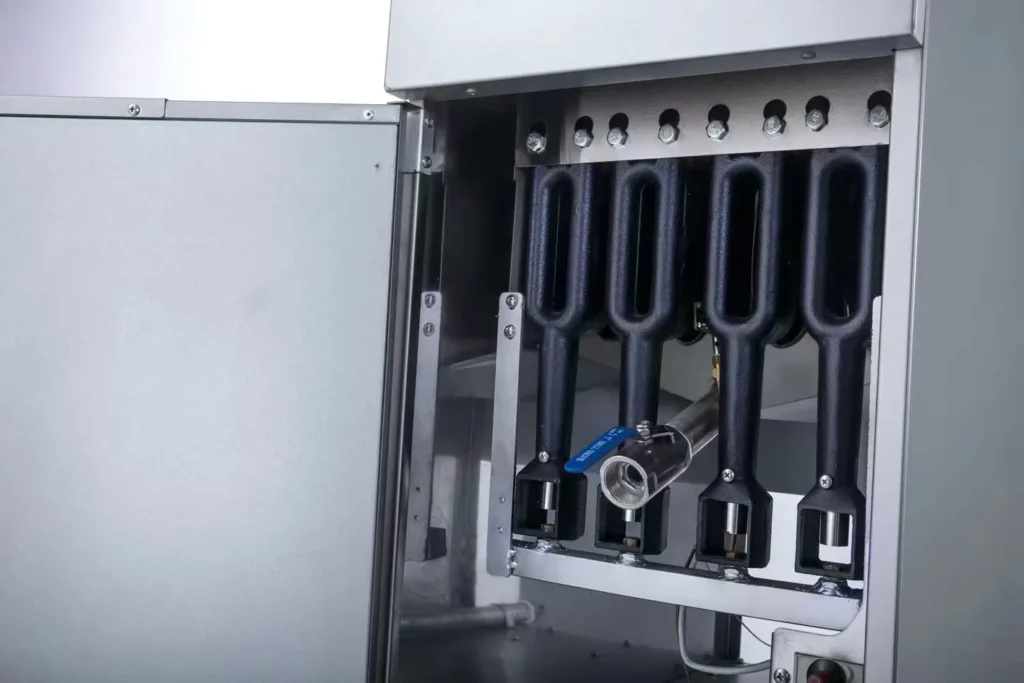
When evaluating a gewerbliche Fritteuse drain valve, buyers should not focus exclusively on the external valve diameter. The entire drainage assembly must be considered, including the tank outlet, internal passage, valve opening, connecting fittings, and final discharge position. A large-looking external connection does not necessarily indicate an unrestricted internal flow path.
In commercial kitchens, used frying oil frequently contains breadcrumbs, batter particles, seasoning residues, and small food fragments. These materials can accumulate around narrow internal passages and valve seats. If the drainage path is poorly designed, operators may experience slow emptying, repeated blockages, and additional cleaning procedures.
Engineering Specifications Buyers Should Request
A professional Supplier should be able to explain how the drainage configuration accommodates the expected oil condition and cleaning requirements. Procurement teams should request the following information:
- Internal flow diameter: Confirm the narrowest effective passage rather than relying only on the nominal connection size.
- Valve opening geometry: Check whether the opening creates unnecessary restrictions when fully opened.
- Outlet positioning: Ensure the discharge direction allows oil to flow into an appropriate collection container.
- Debris tolerance: Evaluate whether the passage can accommodate the realistic food particles expected during routine oil disposal.
- Cleaning access: Confirm whether accumulated residues can be removed without dismantling the entire drainage assembly.
There is no universal drain diameter suitable for every fryer. Required dimensions depend on tank capacity, heating configuration, oil viscosity, intended application, and the manufacturer’s validated design. Buyers should therefore request engineering drawings and representative product samples instead of imposing an arbitrary dimension across different product series.
How to Verify Drainage Performance During Factory Inspection
Während der pre-shipment inspection (PSI), quality inspectors should examine the drainage path and perform repeated opening and closing tests. Where appropriate, a controlled drainage test using representative oil or a suitable test medium can help identify restrictions and leakage problems.
For distributors purchasing multiple fryer models, the inspection team should compare drainage performance across different tank capacities. A manufacturer with established testing procedures should maintain inspection records, identify nonconforming units, and implement documented corrective and preventive actions (CAPA).
2. Check Valve Access and Burn Protection: Protecting Operators and Reducing After-Sales Claims
Valve Accessibility Is a Commercial Requirement
A gewerbliche Fritteuse drain valve must be easy to operate without forcing kitchen staff to reach into confined or excessively hot areas. Poor positioning can create operational difficulties, particularly in busy restaurants, hotel kitchens, and catering facilities where equipment is used repeatedly throughout the day.
For importers, valve accessibility directly influences the perceived quality of the equipment. A fryer that performs well during initial installation but requires uncomfortable or unsafe operating procedures can generate complaints and damage the distributor’s reputation.
When reviewing Friteuse tank design, buyers should evaluate the relationship between the drain valve, tank body, heating elements, supporting frame, electrical components, and surrounding installation space.
Key Valve Access and Safety Checkpoints
- Operating clearance: Verify that the handle can be reached and operated without contacting hot tank surfaces or adjacent components.
- Heat protection: Evaluate handle materials, thermal insulation, protective covers, and the distance between the operating point and heated surfaces.
- Accidental opening prevention: Consider whether the valve design incorporates an appropriate locking mechanism or operating safeguard.
- Leak prevention: Check sealing surfaces, valve connections, and resistance to repeated operating cycles.
- Collection clearance: Ensure sufficient space for positioning a suitable oil container beneath the outlet.
- Maintenance accessibility: Confirm that technicians can inspect and replace relevant components without unnecessary disassembly.
Factory Testing and Compliance Verification
Safety should be supported by documented engineering validation rather than attractive product photography. Buyers should request information about the valve’s operating temperature range, material specifications, sealing performance, and maintenance procedures.
Electrical fryer models also require particular attention to wiring protection, insulation, grounding, and the separation of electrical components from potential oil leakage paths. Applicable requirements may include CE conformity, relevant IEC electrical safety standards, and market-specific food-contact material requirements where applicable. Buyers should verify the exact standards, product scope, test reports, and certification validity rather than accepting general statements that a factory is certified.
For international wholesale orders, the technical document review should be completed before mass production. This reduces the risk of shipment delays, failed destination inspections, and costly compliance-related disputes.
3. Evaluate Welded Corners and Dead Zones: Controlling Cleaning Costs and Product Quality Risks
Why Tank Geometry Determines Long-Term Serviceability
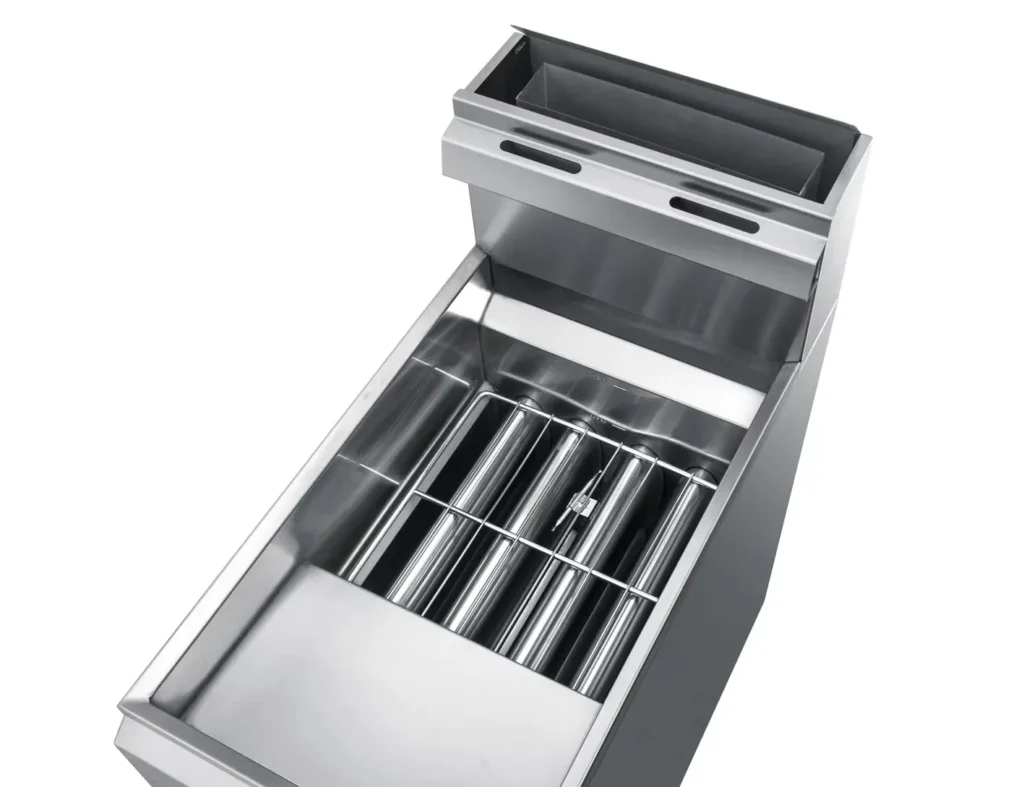
The internal geometry of a Friteuse tank influences oil circulation, residue accumulation, cleaning efficiency, and long-term maintenance requirements. Although buyers frequently compare tank capacity, stainless steel thickness, and external dimensions, internal corners and welded joints deserve equal attention.
Poorly finished corners can create areas where oil, carbonized food particles, and cleaning residues accumulate. These dead zones may be difficult to access during routine maintenance. Over time, accumulated contamination can affect oil management, increase cleaning labor, and contribute to customer dissatisfaction.
A well-designed fryer tank should provide practical access to internal surfaces while maintaining sufficient structural strength and thermal performance. The objective is not simply to produce a visually attractive stainless steel tank, but to create a structure that can withstand repeated commercial operation and cleaning.
What Buyers Should Examine in Tank Construction
- Weld consistency: Check whether welded joints are continuous, structurally sound, and free from obvious defects.
- Internal corner finishing: Inspect whether corners contain excessive sharp edges, rough transitions, or inaccessible recesses.
- Surface polishing: Evaluate the consistency of the internal finish and the presence of visible scratches, contamination, or finishing defects.
- Drainage slope: Determine whether the tank geometry supports practical oil removal without leaving unnecessary pools of residual oil.
- Component transitions: Examine the areas around heating elements, brackets, and drain outlets for difficult-to-clean spaces.
- Material traceability: Request stainless steel grade information and supporting material documentation where specified in the purchase contract.
Recommended Quality Audit Procedures
During a factory audit, procurement representatives should inspect actual production units rather than relying exclusively on showroom samples. A showroom product may receive additional polishing or finishing that does not represent ordinary mass-production quality.
The recommended inspection sequence includes:
- Review the approved technical drawings and confirm tank dimensions and material specifications.
- Inspect the internal tank before final assembly, paying particular attention to welded corners and drainage areas.
- Check polishing consistency, surface cleanliness, and visible manufacturing defects.
- Perform an appropriate water drainage test to identify potential residual liquid collection points.
- Compare finished products against the approved goldenes Muster and signed quality agreement.
- Record nonconformities and require corrective action before approving the production batch.
Foshan Nanhai Flamemax Catering Equipment Co., Ltd. operates a 15,000 m² production workshop equipped with advanced laser cutting, bending, welding, and polishing machinery. Its manufacturing infrastructure supports consistent fabrication processes and customized commercial kitchen equipment. With professional technical workers and multiple testing facilities, the company provides a production environment designed to support wholesale quality requirements.
For international distributors, the key purchasing principle is straightforward: tank geometry should be evaluated as part of manufacturing quality control, not treated as a minor cosmetic detail.
4. Include Oil-Handling Accessories in the Quote: Preventing Hidden Procurement Costs
Why the Base Product Price Is Not the Complete Purchasing Cost
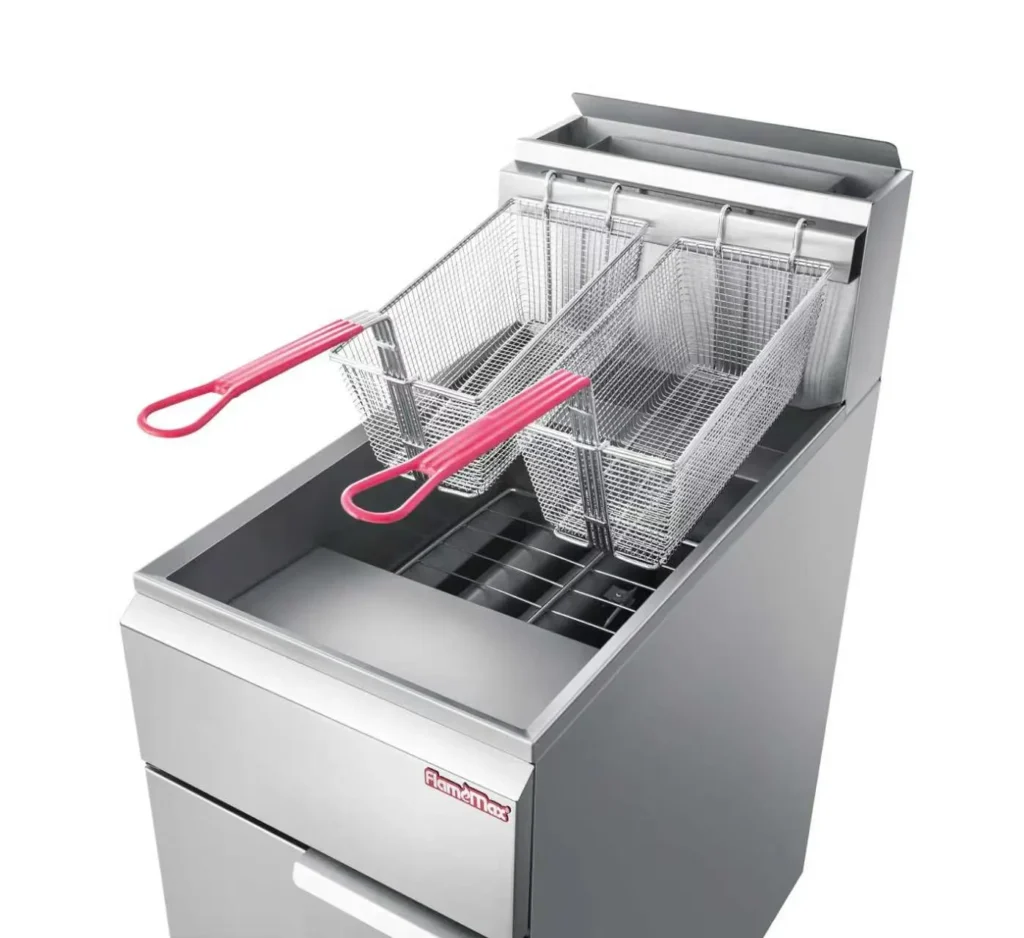
One common sourcing mistake is comparing commercial fryer quotations based only on the unit price of the main machine. Different Manufacturers may include different drainage accessories, collection components, protective parts, and maintenance tools within their standard configurations.
A quotation that appears cheaper initially may require additional purchases after delivery. For distributors, these unexpected expenses reduce gross margins and complicate inventory management. For buyers supplying hotel groups, restaurant chains, and commercial kitchen projects, missing accessories may also delay installation and commissioning.
Ein Fachmann gewerbliche Fritteuse drain valve specification should therefore be linked to a complete oil-handling configuration. The buyer should understand exactly which components are included, which are optional, and which must be sourced separately.
Accessories Worth Including in the RFQ
Depending on the fryer model and intended application, procurement teams should consider the following components:
- Oil collection containers: Suitable containers for collecting and temporarily handling discharged frying oil.
- Drain extension pipes: Appropriate connections for directing oil into containers positioned below or beside the fryer.
- Protective valve covers: Components designed to reduce accidental contact or interference with the valve mechanism.
- Replacement seals: Spare sealing components for scheduled maintenance and future servicing.
- Valve handles and fittings: Replacement parts that help distributors support their local customers.
- Cleaning accessories: Suitable tools for maintaining drainage passages and accessible tank surfaces.
- Installation documentation: Drawings and operating instructions explaining the correct assembly and maintenance procedures.
Example of a Commercial Fryer Procurement Checklist
The following table provides a practical RFQ reference for importers evaluating different factory quotations. Actual accessory configurations should be confirmed against the selected fryer model.
| Komponente | Procurement Requirement | Wirtschaftlicher Nutzen |
|---|---|---|
| Drain valve assembly | Confirm material, size, sealing, and operating method | Reduces leakage and maintenance risks |
| Oil extension pipe | Confirm compatibility and connection dimensions | Simplifies oil discharge |
| Collection container | Confirm capacity and heat suitability | Improves oil-handling convenience |
| Replacement seals | Specify spare quantities and part numbers | Supports after-sales service |
| Cleaning tools | Confirm compatibility with tank geometry | Reduces maintenance labor |
| Technical manual | Request operating and maintenance instructions | Improves installation support |
Calculate the Total Landed Cost Before Negotiating
Experienced importers should compare quotations using a complete total cost of ownership (TCO) approach rather than simply selecting the lowest factory price.
A practical procurement calculation should consider:
- Ex-factory equipment price and optional accessory costs.
- Customized packaging and spare parts expenses.
- International freight and insurance costs.
- Import duties, taxes, and destination compliance expenses.
- Expected installation, maintenance, and warranty service costs.
- Potential replacement expenses arising from component failures.
Buyers should also request a clearly itemized proforma invoice (PI) identifying the main machine, accessories, spare parts, packaging specifications, and agreed quantities. This creates a transparent purchasing record and reduces the possibility of disputes between the buyer and Supplier after order confirmation.
5. Build a Supplier Audit and Inspection System Before Mass Production
Evaluate Manufacturing Capability Beyond Product Samples
Choosing a reliable Manufacturer requires more than reviewing a product catalogue or requesting a quotation. International buyers should assess the supplier’s actual production capacity, technical personnel, quality management procedures, and ability to maintain consistent specifications across repeated orders.
For distributors purchasing containers of bakery equipment, fryers, grills, and other commercial kitchen machinery, production consistency is particularly important. One defective sample may be manageable, but inconsistent quality across a large shipment can create substantial Lagerrisiko and after-sales pressure.
A factory evaluation should examine several important business areas:
- Produktionskapazität: Workshop size, production lines, equipment availability, and realistic monthly output.
- Engineering capability: Experience in product development, structural customization, and technical problem-solving.
- Qualitätsmanagement: Documented incoming material inspection, in-process inspection, and final inspection.
- Supply chain management: Raw material sourcing, component traceability, and supplier qualification procedures.
- Export experience: Experience handling international documentation, packaging requirements, and shipping coordination.
- After-sales infrastructure: Technical support, spare parts availability, and procedures for handling customer complaints.
Recommended Audit and Inspection Schedule
| Audit Stage | Inspection Focus | Required Evidence |
|---|---|---|
| Supplier qualification | Factory capability and business credibility | Factory profile and relevant certificates |
| Before production | Product specifications and approved samples | Technical drawings and signed specifications |
| During production | Materials, welding, assembly, and workmanship | In-process inspection records |
| Before shipment | Function, appearance, accessories, and packaging | Final inspection report and test records |
| After delivery | Product condition and customer feedback | Receiving records and warranty reports |
Certificates and Compliance Documents to Verify
Depending on the destination market, product category, and electrical configuration, buyers may need to review different compliance documents. These may include:
- ISO 9001: Quality management system certification covering the certified organization’s specified activities.
- CE conformity documentation: Applicable conformity documentation for products placed on the European market.
- SGS inspection or testing reports: Independent verification documents for the specific products, materials, or testing scope covered.
- IEC-related test reports: Relevant electrical safety or performance testing documentation where applicable.
- Food-contact material documentation: Supporting evidence for materials and components that contact food or relevant food-processing substances.
Importantly, an ISO 9001 certificate does not automatically certify every product manufactured by a factory. Similarly, a general SGS report should not be interpreted as universal product approval. Procurement teams must verify the issuing organization, certificate number, validity period, product scope, and applicable destination-market requirements.
A properly managed Lieferantenqualifizierungsverfahren protects both the importer and the Manufacturer by establishing clear technical, commercial, and compliance expectations before production begins.
6. Negotiate Specifications, OEM Customization, and After-Sales Responsibilities
Turn Technical Requirements into Contractual Commitments
Even a capable Manufacturer can encounter misunderstandings if the buyer’s expectations are not clearly documented. For OEM and ODM orders, product appearance, drain valve dimensions, tank geometry, accessories, electrical configurations, and packaging should be confirmed in writing.
Buyers should avoid relying on informal conversations or general product descriptions when ordering customized equipment. Instead, every important requirement should be recorded in the approved technical specification and commercial agreement.
For example, a customized fryer order may include:
- Specified fryer capacity and tank dimensions.
- Agreed commercial fryer drain valve configuration.
- Required stainless steel materials and surface finishing.
- Customized brand logos and control panel designs.
- Approved electrical components and operating voltage.
- Specified carton thickness and optional wooden crate packaging.
- Spare parts quantities and after-sales responsibilities.
Clarify Commercial Risk Allocation
International wholesale transactions should clearly define MOQ (Minimum Order Quantity), production lead time, payment terms, shipping terms, inspection arrangements, and warranty conditions.
Buyers should also establish procedures for handling nonconforming products, missing accessories, transportation damage, and delayed shipments. Where applicable, the contract should identify the relevant Incoterms 2020 rule and the respective responsibilities of both parties.
Another important consideration is spare parts continuity. A Manufacturer that can provide replacement valves, seals, heating components, and other commonly serviced parts helps distributors maintain their own local after-sales operations.
Foshan Nanhai Flamemax Catering Equipment Co., Ltd. supports international wholesale customers through flexible customization, multiple product series, professional technical personnel, and 24-hour online technical support and after-sales service. Its production resources include more than 50 sets of advanced production facilities, over 10 semi-automatic assembly production lines, and more than 10 professional testing facilities.
For importers developing their own brands, these capabilities can support more efficient OEM cooperation, product configuration management, and long-term supplier relationships.
7. Deep Fryer Serviceability as a Long-Term Competitive Advantage
Why Distributors Should Think Beyond the Initial Shipment
In competitive catering equipment markets, the ability to deliver reliable products is only one part of a successful distribution business. Importers must also maintain customer confidence, control warranty expenses, and ensure that replacement parts remain available throughout the equipment’s commercial service life.
This is why deep fryer serviceability should be treated as a procurement performance indicator rather than an optional engineering feature.
A Friteuse with accessible valves, practical drainage geometry, properly finished tank corners, and replaceable maintenance components can make routine servicing more straightforward. These characteristics may help reduce unnecessary technician visits and improve the overall ownership experience.
Practical Indicators for Evaluating Serviceability
Before approving a new fryer series, buyers can establish an internal evaluation checklist:
- Can operators drain used oil without unnecessary physical difficulty?
- Can technicians access and inspect the valve assembly efficiently?
- Are common replacement parts identifiable and available?
- Can internal tank surfaces be cleaned without excessive disassembly?
- Are operating instructions and maintenance recommendations provided?
- Does the Manufacturer maintain records of quality problems and corrective actions?
- Can the Supplier provide consistent replacement products and technical assistance for future orders?
These questions help transform general product comparisons into a structured procurement evaluation system. They also provide a clearer basis for comparing competing factories on more than price, appearance, and nominal capacity.
For large-volume buyers, the ultimate objective is to establish a stable supply relationship with a factory capable of delivering consistent product quality, competitive pricing, reliable documentation, and responsive technical support. A well-engineered fryer is valuable, but a dependable supply chain is what makes long-term distribution commercially sustainable.
Conclusion: Specify Serviceability Before Confirming Your Next Fryer Order
Drainage geometry, valve accessibility, welded tank construction, and oil-handling accessories directly influence commercial fryer reliability and ownership costs. Choose a Manufacturer that combines engineering capability with documented quality control. Kontakt FLAMEMAX at [email protected] or visit www.flamemax.com to discuss OEM specifications and wholesale cooperation.


 Deutsch
 English
 Español
 Français
 Italiano
 日本語
 Русский
 한국어
 简体中文