
Uneven Baking Results in Коммерческие конвекционные печи: Airflow Direction, Fan Reversal, and Load Optimization
1. Uneven Heat Distribution and Baking Quality Challenges in Commercial Bakeries
Commercial bakeries, hotel kitchens, and industrial food production facilities frequently encounter uneven baking results when operating конвекционные печи under demanding production conditions. Variations in product color, inconsistent internal temperatures, and differences in baking times between tray positions can significantly affect product quality and operational efficiency. These challenges become more pronounced in environments with high production loads, continuous baking cycles, fluctuating ambient temperatures, and complex electrical supply conditions. When commercial oven airflow is poorly managed, hot air may concentrate in specific areas, creating thermal dead zones and excessive heat exposure elsewhere. The resulting product inconsistency increases material waste, labor costs, and customer complaints. For equipment importers, bakery distributors, and commercial kitchen project contractors, selecting an oven with an appropriate airflow configuration is essential. A properly engineered reversing fan convection oven can help address these challenges through controlled fan direction, improved heat circulation, and more consistent baking performance across different production scenarios.
2. Recommended Technical Parameters for Reversing Fan Convection Ovens
For commercial bakeries requiring uniform baking across multiple trays, a reversing fan convection oven with a fan reversal interval of approximately 60–180 seconds, an adjustable baking temperature range of 50–300°C, a temperature deviation target of ±5–10°C under validated loading conditions, and a properly balanced airflow system is recommended. FLAMEMAX, an experienced commercial kitchen equipment manufacturer, provides professional engineering solutions for bakery applications, including airflow configuration, electrical compatibility, motor control optimization, and customized oven specifications.
3. Application Engineering Overview for Оборудование для коммерческих пекарен Buyers
For retailers, importers, wholesalers, and distributors sourcing оборудование для коммерческих пекарен, understanding the relationship between airflow direction and baking performance is critical to selecting suitable products. The following engineering discussions examine practical operating conditions, product loading strategies, color uniformity, motor control requirements, and comparative testing methods. Through representative bakery applications and technical recommendations, FLAMEMAX demonstrates how промышленные конвекционные печи can be matched to specific production requirements, helping buyers make informed equipment decisions while supporting consistent product quality and long-term operational reliability.
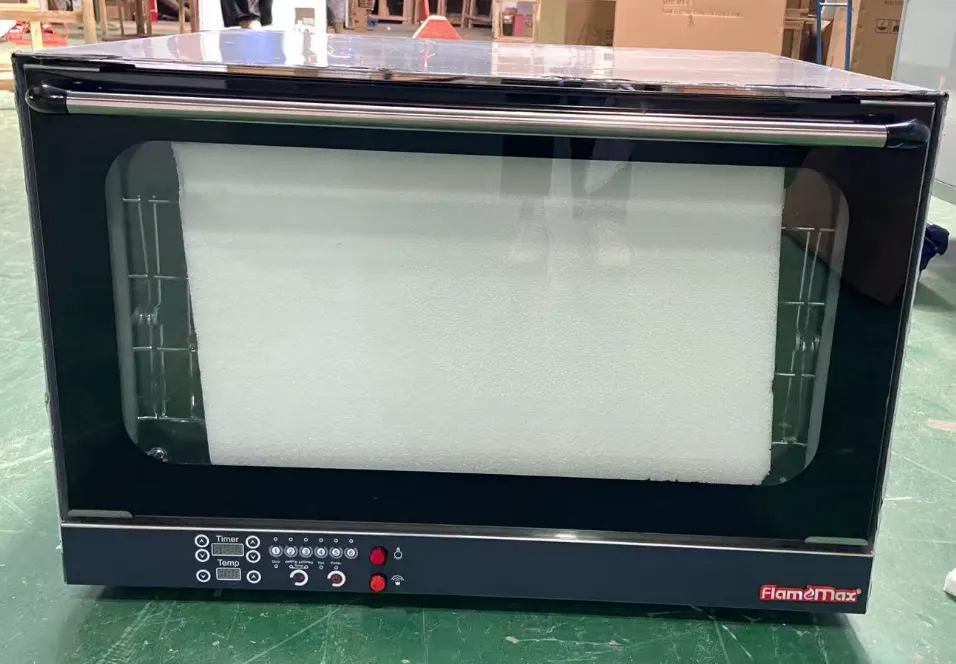
4. Deep-Dive Application Solutions for Commercial Convection Oven Airflow
4.1 Understand Airflow Direction and Product Loading
Airflow direction is one of the most important factors influencing heat transfer in промышленные конвекционные печи. In a conventional one-way airflow configuration, the fan continuously circulates hot air in a fixed direction. Depending on the oven’s internal structure, this may create temperature differences between the upper, lower, front, and rear tray positions. A reversing fan convection oven changes the direction of air circulation at predetermined intervals, helping redistribute thermal energy and reduce persistent hot spots.
For bakeries producing croissants, cookies, sponge cakes, and bread rolls, product loading density directly affects airflow resistance. Excessively close tray spacing or overloading can obstruct circulation and reduce heat transfer efficiency.
Recommended engineering considerations include:
- Tray spacing: Maintain approximately 60–100 mm between trays where the oven design permits, ensuring sufficient circulation channels.
- Loading density: Avoid covering more than 70–80% of the effective perforated tray area when unrestricted airflow is required.
- Fan reversal interval: Evaluate intervals between 60 and 180 seconds according to product thickness, oven volume, and baking cycle.
- Air velocity: A representative target of 1.5–3.0 m/s near product surfaces may be suitable for many bakery applications, subject to product sensitivity and oven geometry.
- Rack configuration: Use consistent tray positions and loading patterns during production to maintain repeatable airflow conditions.
In practical applications, bakery oven fan direction should be evaluated together with the oven’s duct design, fan blade geometry, and tray arrangement. Reversing airflow alone cannot compensate for poorly designed circulation channels. Engineering validation should therefore consider the complete fan–duct–heating element–rack system topology rather than focusing solely on fan rotation.
4.2 Evaluate Color and Bake Uniformity
Color uniformity is a critical quality indicator in commercial baking. Products such as baguettes, Danish pastries, cookies, and sponge cakes require controlled surface browning and consistent internal moisture. Uneven commercial oven airflow can cause one side of a tray to brown faster than the other, while differences in radiant and convective heat exposure may create variations between rack levels.
A reversing fan system can improve the distribution of convective heat by periodically changing the direction of air movement. However, the actual improvement depends on the oven chamber, heating element arrangement, fan capacity, product geometry, and thermal recovery performance. It is important to distinguish between temperature uniformity and finished-product uniformity. An oven may exhibit relatively stable chamber temperatures while still producing uneven color because of local airflow velocity or tray shielding.
A practical evaluation procedure includes:
- Temperature mapping: Install calibrated thermocouples at 9–12 representative chamber locations during empty and loaded tests.
- Temperature deviation: Establish a target of ±5–10°C for representative operating conditions, with tighter limits applied only when verified by testing.
- Color assessment: Compare product surface color using standardized photographs or a colorimeter.
- Moisture evaluation: Measure finished-product moisture content where consistency is commercially important.
- Repeatability: Conduct at least three baking cycles using identical recipes, loading patterns, and operating settings.
For importers and distributors, these measurements provide a more objective basis for comparing bakery equipment. FLAMEMAX’s application engineering approach emphasizes evaluating actual baking results rather than relying exclusively on nominal fan power or chamber temperature specifications.
4.3 Consider Motor and Control Complexity
Fan reversal introduces additional electrical and control considerations compared with a conventional fixed-direction конвекционная печь. The motor must support the intended operating mode, and the control system must prevent unsafe or excessive switching. In commercial bakery environments, equipment may operate for extended periods under high-temperature conditions, frequent thermal cycling, and continuous production schedules. These factors can influence motor insulation life, bearing performance, and control component reliability.
The electrical configuration must also match the installation environment. Commercial kitchens may operate with 220–240 V single-phase supplies, 380–415 V three-phase supplies, 50 Hz or 60 Hz frequencies, depending on the destination market. These values represent common regional configurations and must be confirmed against the customer’s actual electrical infrastructure.
Key engineering specifications include:
- Motor compatibility: Confirm rated voltage, frequency, power, current, insulation class, and permissible reversal operation.
- Control topology: Select an appropriate PLC-based control system, programmable timer, or dedicated motor reversing circuit according to equipment complexity.
- Switching protection: Incorporate electrical and mechanical interlocking where applicable to prevent simultaneous forward and reverse commands.
- Reversal delay: Apply a suitable stopping interval before reversing motor direction, based on motor characteristics and control design.
- Overload protection: Specify correctly rated motor overload protection and short-circuit protection.
- Thermal protection: Use suitable high-temperature-rated wiring, connectors, and electrical components for the oven’s operating environment.
- Control interface: Provide clear temperature, timer, fan-direction, and alarm indications for operators.
A well-designed reversing system should not introduce unnecessary maintenance complexity. For large bakery installations, the selection of contactors, motor drives, control relays, and protective devices should be based on the intended duty cycle and applicable electrical standards. Where variable-frequency drives are used, their suitability for reversing operation and the motor’s compatibility must be verified.
4.4 Specify Test Products for Comparison
Comparative baking tests are essential for determining whether a reversing fan configuration provides measurable benefits for a particular production application. Different bakery products respond differently to airflow velocity, thermal exposure, moisture loss, and baking duration. A configuration suitable for cookies may not produce the same results for delicate sponge cakes or large bread loaves.
For example, cookies generally require stable surface browning, while croissants depend on controlled expansion and layered texture. Bread rolls require consistent crust development and internal baking. Therefore, the selection of test products should reflect the customer’s actual product portfolio rather than using a single generic sample.
A structured comparison procedure should include:
- Test product selection: Choose at least three representative products, such as cookies, croissants, and bread rolls.
- Standardized loading: Use identical tray dimensions, quantities, product weights, and rack positions.
- Operating parameters: Record baking temperature, duration, fan direction, reversal interval, and heating mode.
- Product measurements: Compare surface color, weight loss, internal temperature, texture, and dimensional consistency.
- Test repetition: Perform three or more cycles to assess production repeatability.
- Acceptance criteria: Establish product-specific color and quality tolerances before testing begins.
This process enables buyers to identify the most appropriate промышленная печь airflow configuration for their operational needs. It also helps equipment suppliers distinguish between genuine performance improvements and variations caused by recipe preparation, loading differences, or operator practices.
5. Application Comparison Across Different Bakery Production Scenarios
The suitability of reversing fan convection ovens varies according to production volume, product sensitivity, loading density, and required baking consistency. The following table presents representative engineering considerations for different commercial bakery applications.
| Сценарий применения | Typical Products | Representative Temperature | Fan Reversal Interval | Primary Airflow Objective |
|---|---|---|---|---|
| Small Retail Bakery | Cookies, muffins | 160–200°C | 90–180 seconds | Consistent tray-level browning |
| Hotel Bakery Kitchen | Croissants, Danish pastries | 170–210°C | 60–120 seconds | Balanced heat distribution |
| Medium-Sized Bread Production | Bread rolls, baguettes | 180–230°C | 60–120 seconds | Uniform crust development |
| Industrial Bakery | Cookies, standardized bread products | 160–240°C | 60–120 seconds | Repeatable performance under high loading |
| Specialty Cake Production | Sponge cakes, delicate pastries | 140–180°C | 120–180 seconds | Controlled airflow with reduced surface disturbance |
The values shown are representative starting points for engineering evaluation, not universal baking prescriptions. Final operating parameters should be established through recipe-specific validation, chamber temperature mapping, and product testing. The appropriate bakery oven fan direction and reversal interval may change according to oven capacity, fan diameter, heating power, product arrangement, and the desired finished-product characteristics.
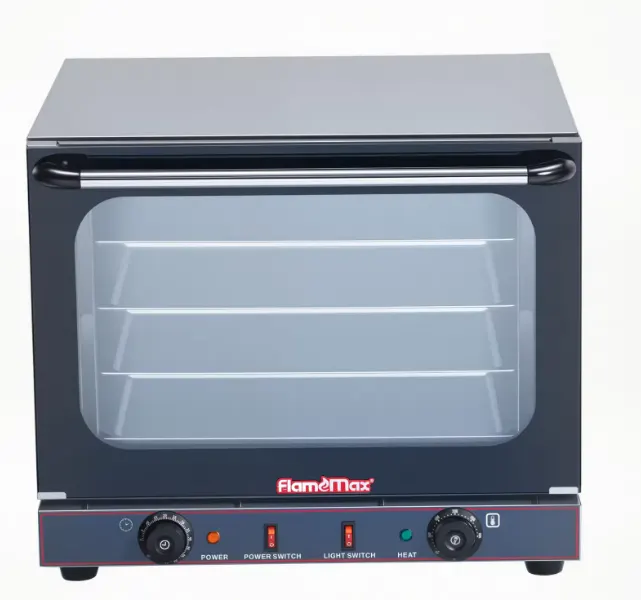
5.1 Small Retail Bakeries and Independent Foodservice Operators
Small retail bakeries typically prioritize flexibility, ease of operation, and consistent product quality across limited production batches. Their equipment may be used for several product categories within a single working day, making adjustable airflow and temperature controls particularly valuable.
In this environment, the reversing fan convection oven should be designed to support frequent recipe changes without requiring complex operator intervention. A programmable controller can provide preset baking parameters, while a clearly defined reversal interval helps maintain repeatable results.
The electrical installation may use a 220–240 V single-phase or three-phase supply, depending on oven capacity and local infrastructure. Retail bakeries should also consider limited kitchen space, elevated ambient temperatures, ventilation restrictions, and intermittent peak production demand.
Recommended configuration features include:
- Adjustable temperature control within the intended baking range.
- Programmable timer and fan-direction settings.
- Clear operating indicators and accessible control interfaces.
- Easy-to-clean stainless steel chamber surfaces.
- Appropriate electrical protection for the installation environment.
For bakery equipment distributors, these features support practical product differentiation while addressing the needs of independent operators who require dependable equipment with manageable operating complexity.
5.2 Hotel Kitchens and Centralized Bakery Departments
Hotel bakery departments often produce a wide variety of items, including breakfast pastries, bread rolls, desserts, and banquet products. Production schedules can be demanding, particularly during breakfast service, conferences, and large events. Consistency between batches is therefore a major operational requirement.
The oven airflow system should accommodate mixed production schedules while maintaining appropriate thermal conditions. A reversing fan configuration can help reduce directional temperature differences when the chamber is loaded correctly. However, products with significantly different baking requirements should generally be processed in separate batches.
Hotel kitchens commonly operate under 380–415 V three-phase electrical environments for higher-capacity equipment, although the actual voltage and frequency must be verified locally. The equipment may also encounter high ambient temperatures, limited ventilation, grease exposure, and frequent daily cleaning.
Important configuration considerations include:
- Consistent airflow across multiple rack levels.
- Programmable baking recipes for standardized production.
- Reliable motor operation during repeated daily cycles.
- High-temperature-resistant electrical components.
- Accessible maintenance points for fan and heating assemblies.
For hotel supplies importers and project contractors, these specifications provide a practical basis for evaluating equipment suitability for professional kitchens.
5.3 Industrial Bakery and High-Volume Production Facilities
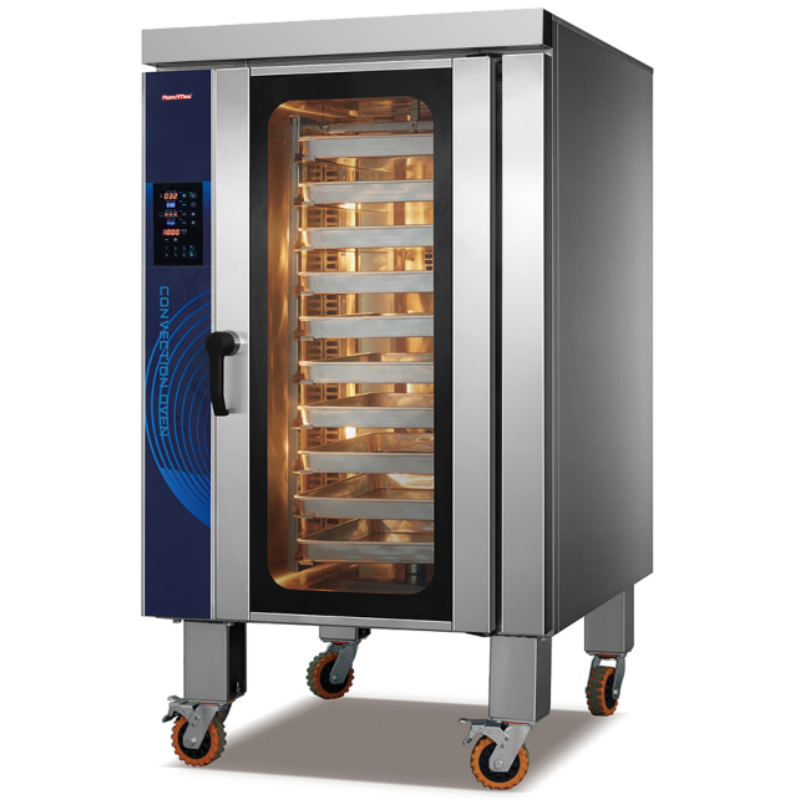
Industrial bakery operations require high throughput, stable baking performance, and predictable production scheduling. Ovens may operate for extended periods with relatively high loading density, increasing the importance of airflow resistance, motor reliability, and thermal recovery.
In these applications, commercial oven airflow must be evaluated as part of the complete industrial production system topology, including oven chamber, heating elements, circulation fan, control system, rack configuration, and upstream production workflow.
The electrical environment may involve 380–415 V three-phase power, 50 Hz or 60 Hz operation, dedicated circuit protection, and industrial electrical distribution systems. These installations may also experience voltage fluctuations, high ambient temperatures, dust accumulation, and continuous-duty operating conditions.
Recommended engineering practices include:
- Validate airflow performance under maximum intended loading.
- Confirm motor ratings against the required duty cycle.
- Use suitable overload and short-circuit protection.
- Monitor temperature distribution across representative chamber locations.
- Establish preventive maintenance intervals for bearings, fans, and electrical components.
- Document recipe settings and product acceptance criteria.
For large-volume purchasers, reliable performance under actual production conditions is more valuable than relying solely on nominal oven capacity or rated heating power.
6. Engineering Recommendations for Equipment Selection and Customization
Selecting a suitable reversing fan convection oven requires a comprehensive assessment of the customer’s application, electrical infrastructure, production targets, and product specifications. The most effective equipment configuration is not necessarily the one with the highest fan power or the shortest reversal interval. Instead, it should provide a balanced combination of airflow uniformity, thermal performance, operational safety, and maintenance accessibility.
FLAMEMAX поддерживает оборудование для коммерческих пекарен applications through manufacturing capabilities, product customization, and technical service. Equipment specifications can be evaluated according to the requirements of importers, hotel supplies distributors, catering equipment wholesalers, and bakery project contractors.
The following information is recommended when preparing a technical quotation:
- Product application: Identify the main bakery products and their baking characteristics.
- Производственная мощность: Specify the required batch size, tray quantity, and expected daily output.
- Электротехнические условия: Confirm supply voltage, phase, frequency, rated current, and applicable electrical standards.
- Oven configuration: Define chamber dimensions, rack arrangement, fan direction, and heating system.
- Control requirements: Specify programmable recipes, fan reversal settings, temperature control, and operator interface preferences.
- Customization needs: Identify requirements for OEM branding, logo placement, control panel design, product dimensions, and packaging.
- Quality verification: Establish inspection requirements, operating tests, and product acceptance criteria.
By integrating these factors into the equipment selection process, buyers can improve the alignment between oven performance and their actual production needs. A properly engineered airflow solution also supports long-term equipment reliability and helps reduce avoidable production losses.
7. Conclusion and Inquiry Support
A properly configured reversing fan конвекционная печь can improve airflow distribution, baking consistency, and operational efficiency across commercial bakery applications. FLAMEMAX provides professional equipment solutions, customization, and technical support for global B2B buyers. Contact [email protected] or visit www.flamemax.com to discuss application requirements and obtain a suitable equipment proposal.


 Русский
 English
 Español
 Français
 Italiano
 日本語
 Deutsch
 한국어
 简体中文