
Why Does the Same Pizza Recipe Produce Different Results in Commercial Pizza Ovens?
A pizza that bakes perfectly in one oven may come out pale, burnt, dry, or uneven in another. For commercial kitchens, inconsistent baking results directly affect product quality, service speed, ingredient costs, and customer satisfaction. The problem is often not the recipe itself, but the relationship between oven temperature, heating method, baking time, dough hydration, and loading frequency. Choosing the wrong temperature setting can lead to undercooked centers, overbaked crusts, or poor cheese melting. Understanding how different commercial pizza oven designs transfer heat is essential for establishing a reliable baking profile. Without proper temperature management, operators may struggle to maintain consistent output during peak service hours, especially when producing multiple pizza styles or handling continuous orders.
Commercial pizza oven temperature and time depend on oven type, pizza thickness, dough hydration, toppings, and production volume. Deck ovens typically bake pizzas at 250–350°C, while 컨베이어 오븐 commonly operate at 230–300°C. FLAMEMAX, an experienced commercial kitchen equipment Manufacturer and Supplier, helps businesses select suitable ovens and establish practical baking parameters for consistent results.
This guide examines the technical factors that influence pizza baking performance, from heat transfer and oven construction to dough characteristics and temperature recovery. It also compares deck and conveyor oven profiles, explains how to adjust baking parameters, and outlines a practical testing process for commercial kitchens.
1. Deck vs. 컨베이어 오븐 Baking Profiles
How Heating Methods Affect Pizza Oven Temperature and Time
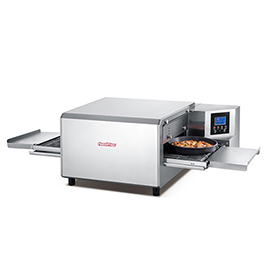
A 데크 오븐 및 컨베이어 오븐 use different heating mechanisms, which means their temperature settings cannot be directly compared. A deck oven transfers heat through a combination of **conduction from the baking surface, radiant heat from the upper heating elements, and convection from circulating air**. A conveyor oven relies primarily on controlled air movement, radiant heating, and continuous transport through a defined baking chamber.
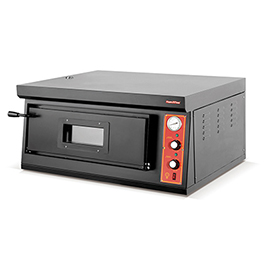
For a deck oven, the baking stone or steel plate plays a critical role in bottom-crust development. The surface must retain enough heat to transfer energy to the dough immediately after loading. The upper heating elements control cheese melting, topping browning, and crust coloration.
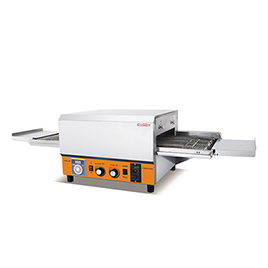
Conveyor ovens provide more standardized production conditions. Operators adjust the belt speed and temperature to achieve a consistent baking cycle. This is particularly useful for restaurants, food courts, takeaway chains, and commercial kitchens with high order volumes.
Typical Temperature and Baking Time Comparison
The following values are general starting points for commercial operations, not universal settings. Actual results depend on oven construction, pizza size, dough composition, and heating intensity.
| Oven Type | Typical Temperature | Baking Time | Primary Heat Transfer | Suitable Applications |
|---|---|---|---|---|
| Deck Pizza Oven | 250–350°C | 5–12 minutes | Conductive, radiant | Traditional pizzas, artisan crusts |
| 컨베이어 피자 오븐 | 230–300°C | 4–8 minutes | Radiant, forced convection | High-volume standardized production |
| Compact Electric Pizza Oven | 250–350°C | 4–10 minutes | Conductive, radiant | Small restaurants, cafés |
| 가스 피자 오븐 | 250–350°C | 4–10 minutes | Radiant, convection | Commercial kitchens requiring rapid heating |
왜 데크 오븐 Settings Require More Attention
Deck ovens allow operators to adjust the upper and lower heat independently on many models. This is important because the bottom crust and toppings do not always develop at the same rate.
If the bottom becomes dark before the cheese melts, operators can reduce the lower heating intensity or increase the upper heat. If the toppings are overcooked while the crust remains pale, the balance between upper and lower heat may need to be changed.
~에 대하여 컨베이어 오븐, **belt speed is a critical baking parameter**. Increasing the speed reduces baking time, while decreasing it extends the exposure to heat. Temperature and belt speed should be adjusted together rather than independently.
2. Dough Hydration and Toppings
How Dough Moisture Changes Baking Requirements
Dough hydration is the ratio of water to flour by weight. It influences dough elasticity, extensibility, internal steam generation, crust structure, and baking time.
A dough with 60% hydration contains 600 grams of water for every 1,000 grams of flour. Higher hydration doughs generally require careful heat management because more moisture must evaporate before the crust reaches its desired texture.
For example, a thin pizza made with relatively low-hydration dough may bake quickly at a high temperature. A thicker pizza with 65–70% hydration may require a longer baking cycle to ensure the center is properly cooked without excessive surface browning.
How Topping Loads Influence Oven Performance
Toppings introduce additional moisture and thermal mass. Ingredients such as fresh mozzarella, mushrooms, tomatoes, and frozen vegetables can slow the baking process by releasing water during heating.
Operators should consider the following variables:
- Cheese quantity: Excessive cheese can delay melting and increase moisture accumulation on the pizza surface.
- Vegetable moisture: Fresh mushrooms, tomatoes, and other high-moisture ingredients may require draining or pre-cooking.
- Meat toppings: Thick or cold meat toppings can increase the time needed for the pizza to reach the desired internal temperature.
- Pizza thickness: Thick crusts require more energy to heat through than thin crusts.
- Initial product temperature: Refrigerated ingredients can increase the total baking time.
Adjusting Baking Parameters for Different Pizza Styles
A 상업용 피자 오븐 should be tested with the actual menu rather than a single standard pizza. A thin-crust pizza, deep-pan pizza, and heavily topped pizza may require different baking profiles even when they use the same oven.
The most effective approach is to establish a standard recipe with controlled dough weight, diameter, hydration, topping quantity, and ingredient temperature. Operators can then adjust the 피자 오븐의 온도와 조리 시간 based on measurable differences rather than subjective judgment.
3. Recovery After Loading
Why Oven Temperature Drops During Production
When cold or room-temperature pizzas enter a heated oven, they absorb thermal energy from the oven chamber and baking surface. The temperature displayed on the control panel may temporarily decrease, particularly when multiple pizzas are loaded simultaneously.
This phenomenon is known as temperature recovery. The oven’s ability to recover depends on heating element capacity, burner output, insulation performance, chamber volume, airflow, and the thermal mass of the baking surface.
A commercial kitchen operating during peak hours may load pizzas continuously. If the oven cannot recover quickly enough, the effective baking temperature may fall below the established operating range. The resulting pizzas may have pale crusts, longer baking times, or inconsistent texture.
Key Factors Affecting Temperature Recovery
- Heating power: Higher installed heating capacity can help restore the chamber temperature after loading.
- Thermal insulation: Proper insulation reduces heat loss through the oven walls and door.
- Loading frequency: Frequent loading creates greater thermal demand.
- Batch size: Loading too many pizzas at once may produce a significant temperature drop.
- Stone or deck thickness: A baking surface with sufficient thermal mass helps maintain stable bottom heat.
Practical Loading Strategies
~에 대하여 데크 오븐, operators should avoid covering too much of the baking surface at once, particularly when the oven has not fully recovered from previous batches. Maintaining adequate spacing between pizzas allows more uniform heat transfer.
~에 대하여 컨베이어 오븐, continuous production is easier to standardize, but excessive loading density can still affect airflow and baking consistency. Operators should follow the recommended loading capacity and maintain consistent spacing between products.
4. Verification with Test Bakes
Why Manufacturer Settings Should Be Treated as Starting Points
Published operating temperatures provide useful reference values, but they cannot guarantee identical results across different kitchens. Differences in electrical supply, gas pressure, ambient temperature, ventilation, dough preparation, and production schedules can influence baking performance.
A professional commissioning process should include test baking under actual operating conditions. The objective is to establish a repeatable baking profile that meets the kitchen’s product quality and production requirements.
Recommended Test-Bake Procedure
- Preheat the oven: Allow the oven to reach the specified operating temperature and stabilize before testing.
- Standardize the recipe: Record dough weight, diameter, hydration, topping quantity, and ingredient temperature.
- Establish baseline settings: Start with a recommended temperature and baking time for the oven type.
- Record baking results: Evaluate bottom color, crust texture, cheese melting, topping moisture, and overall appearance.
- Adjust one variable: Change temperature, belt speed, upper heat, or lower heat individually to identify its effect.
- Repeat the test: Confirm that the adjusted profile produces consistent results across multiple pizzas and loading cycles.
Example of a 상업용 피자 오븐 Test Record
| Test Parameter | Initial Setting | Adjustment Objective |
|---|---|---|
| Oven Temperature | 280°C | Evaluate crust and topping development |
| Baking Time | 6 minutes | Confirm center cooking and moisture reduction |
| Dough Hydration | 62% | Maintain consistent dough structure |
| Pizza Diameter | 30 cm | Standardize product dimensions |
| Topping Weight | 250 g | Control moisture and thermal load |
| Loading Interval | 2 minutes | Evaluate temperature recovery |
Temperature Measurement and Food Safety
Operators should distinguish between oven chamber temperature, baking surface temperature, and the internal temperature of the finished product. These measurements serve different purposes.
An oven thermostat indicates chamber conditions, but it does not necessarily reflect the exact temperature of the stone or the pizza center. An appropriate calibrated thermometer can help verify product temperature when food safety requirements demand it.
For commercial food operations, internal cooking temperatures and holding conditions should follow applicable local food safety regulations, including requirements based on the ingredients used. Consistent baking quality and food safety verification are separate but equally important control objectives.
5. Selecting the Right 상업용 피자 오븐 귀사의 비즈니스를 위해
Production Capacity and Menu Requirements
올바른 상업용 피자 오븐 should be selected according to daily production volume, peak-hour demand, pizza size, menu variety, available kitchen space, and energy supply.
Deck ovens are generally preferred when operators need greater control over crust texture and baking characteristics. Conveyor ovens are particularly suitable for businesses that prioritize standardized output, continuous production, and reduced operator intervention.
~을 평가할 때 피자 오븐 Supplier, buyers should review more than the advertised maximum temperature. They should also assess:
- Heating capacity and temperature stability during continuous production.
- Chamber dimensions and usable baking area for the required pizza sizes.
- Independent upper and lower heat controls 해당되는 경우.
- Insulation performance and energy consumption.
- Electrical or gas requirements compatible with the installation site.
- Cleaning access, spare parts availability, and after-sales support.
- Safety protection and applicable electrical or gas standards 대상 시장을 위해.
상업용 피자 오븐 Manufacturing and Quality Control
FLAMEMAX is a commercial catering equipment manufacturer with 16 years of manufacturing experience, a 15,000-square-meter production workshop, and a range of commercial cooking and bakery equipment.
Its production capabilities include advanced laser cutting, bending, welding, polishing, assembly, and testing facilities. Each product undergoes inspection before packing, with options for OEM customization, including logos, control panels, packaging, and appearance design.
For importers, distributors, hotel suppliers, and catering equipment wholesalers, selecting a manufacturer with established production capacity and technical support can help reduce sourcing risks and maintain consistency across bulk orders.
결론
Commercial pizza oven temperature and time must be matched to oven type, dough characteristics, toppings, and production conditions. Proper testing and temperature recovery management are essential for consistent results. Contact FLAMEMAX at [email protected] 또는 다음을 방문하세요 www.flamemax.com to discuss commercial pizza oven specifications, OEM options, and wholesale requirements.


 한국어
 English
 Español
 Français
 Italiano
 日本語
 Deutsch
 Русский
 简体中文