
Why Are Baking Results Inconsistent in Commercial Kitchens?
Many wholesalers, distributors, and foodservice operators struggle with uneven baking results, longer cooking times, and rising energy costs. This often stems from using the wrong oven type without fully understanding its functionality. The consequence is wasted ingredients, dissatisfied customers, and reduced profitability. The solution lies in choosing the right equipment—understanding the difference between a convection oven and a conventional oven can significantly improve efficiency and product consistency.
A convection oven uses a fan and exhaust system to circulate hot air evenly around food, ensuring faster and more uniform cooking. In contrast, conventional ovens rely on static heat from top and bottom elements. For commercial kitchens, convection ovens offer better efficiency, consistency, and energy savings, making them ideal for high-volume baking and roasting operations.
Understanding how these two oven types function is essential for making informed purchasing decisions. Whether you are a manufacturer, supplier, or distributor seeking OEM or ODM solutions, this guide will help you identify the best option for your business needs.
What is a convection oven?
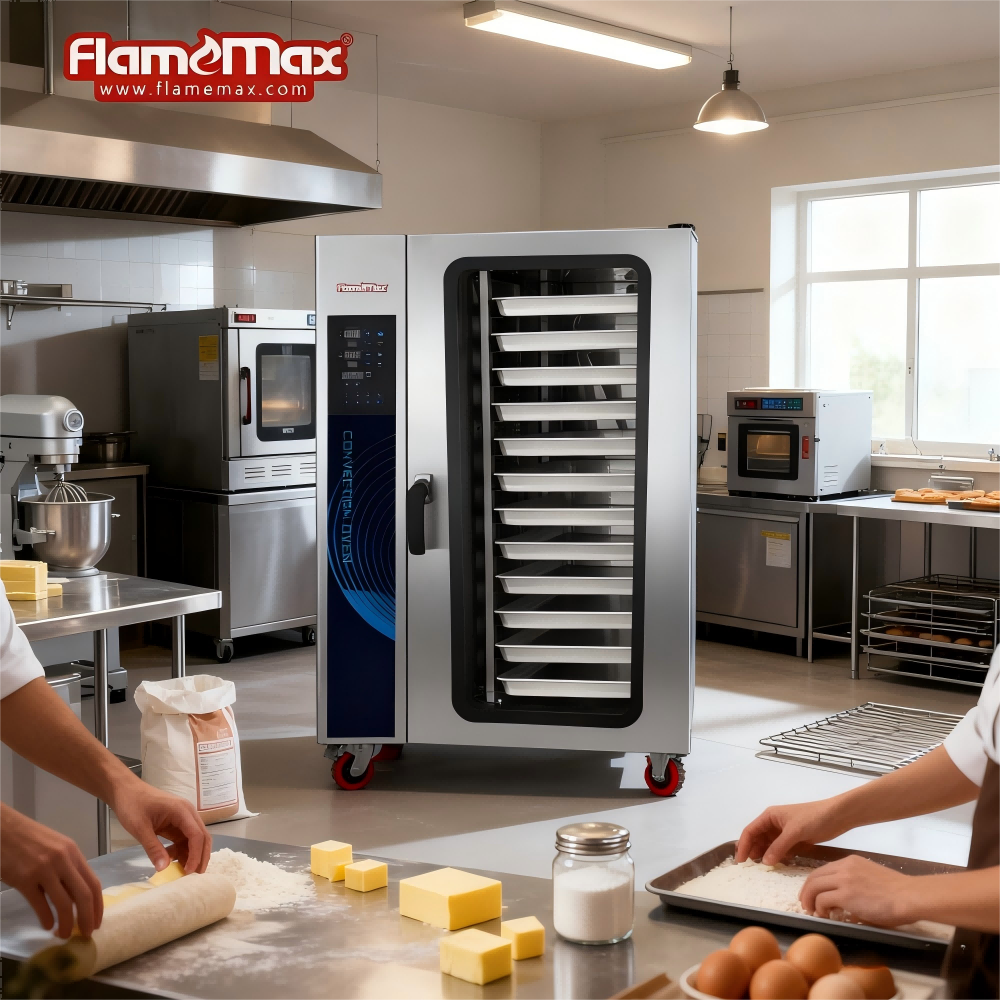
A convection oven is a modern cooking appliance equipped with an internal fan and exhaust system that circulates hot air evenly throughout the cooking chamber. Unlike traditional ovens, this continuous airflow eliminates hot and cold spots, ensuring consistent cooking results across multiple trays.
For commercial kitchens and large-scale operations, convection ovens are especially valuable. They allow wholesalers and foodservice providers to maintain uniform quality, even during high-volume production. As a professional manufacturer and supplier, FLAMEMAX offers customizable convection ovens designed for OEM and ODM projects, meeting diverse market demands.
What are the benefits of a convection oven vs. a conventional oven?
The primary advantage of a convection oven lies in its ability to cook food faster and more evenly. The circulating hot air reduces cooking time by up to 25%, which directly improves kitchen efficiency and throughput.
Additionally, convection ovens enhance browning and crisping, making them ideal for baked goods, roasted meats, and pastries. For suppliers and distributors, this means delivering equipment that improves end-user satisfaction. Compared to conventional ovens, convection ovens also consume less energy, helping businesses reduce operational costs while maintaining high performance.
From a business perspective, investing in customizable convection ovens through reliable OEM and ODM partnerships ensures competitive advantage in global markets.
When to use convection baking?
Convection baking is best suited for cooking processes that benefit from even heat distribution and faster cooking times. It is particularly effective for baking cookies, roasting vegetables, cooking meats, and preparing pastries that require a crisp outer layer.
For large-scale kitchens and wholesalers supplying food chains, convection ovens allow multiple trays to be cooked simultaneously without compromising quality. This increases productivity and consistency, which is critical for brand reputation.
However, convection baking may not be suitable for delicate recipes such as soufflés or cakes that require stable heat without airflow disruption.
What is the temperature difference between convection and regular ovens?
One key difference between a convection oven and a conventional oven is the required cooking temperature. Typically, convection ovens operate at temperatures about 20°C (or 25°F) lower than conventional ovens while achieving the same or better results.
This lower temperature requirement is due to the efficient heat circulation system, which transfers heat more effectively to the food. For manufacturers and suppliers, this feature is a major selling point, as it reduces energy consumption and enhances cooking precision.
For buyers seeking OEM or ODM solutions, offering ovens with accurate temperature control can significantly improve market competitiveness.
When to use conventional oven baking
Conventional ovens, which rely on radiant heat from top and bottom elements, are still useful in certain cooking scenarios. They are ideal for baking cakes, bread, and dishes that require minimal airflow to maintain structure and moisture.
For some traditional recipes, the static heat environment ensures better texture and prevents over-drying. This makes conventional ovens a practical choice for specific applications, even in modern kitchens.
Many suppliers and wholesalers choose to offer both conventional and convection ovens as part of their product range, often through customizable OEM and ODM manufacturing services to meet varied customer needs.
Choosing between a convection oven and a conventional oven depends on cooking needs, efficiency goals, and business scale. For most commercial applications, convection ovens provide superior performance, consistency, and cost savings.


 English
  Español
  Français
  Italiano
  日本語
日本語  Deutsch
  Русский
  한국어
한국어  简体中文
简体中文