
Why Does Your Commercial Rotisserie Oven Deliver Inconsistent Cooking Results?
Restaurants, supermarkets, and food service operators often struggle with uneven roasting, high energy consumption, inconsistent product quality, and excessive maintenance costs. These problems reduce productivity, increase food waste, and negatively affect customer satisfaction. The situation becomes even more challenging when production volumes increase or multiple food varieties must be prepared simultaneously. Choosing equipment based only on price frequently leads to poor heat distribution, unreliable temperature control, and limited production flexibility. A properly engineered commercial rotisserie oven solves these issues through precise heating systems, optimized air circulation, durable food-grade materials, and intelligent controls that improve roasting consistency, cooking efficiency, and long-term operating reliability while supporting commercial food safety requirements.
What Defines a High-Quality Commercial Rotisserie Oven?
A premium commercial rotisserie oven combines uniform heat distribution, precise temperature control, durable 304 stainless steel, efficient motor-driven rotation, and reliable safety protection. As an experienced Manufacturer and Supplier, our company provides OEM, ODM, and Customizable rotisserie oven solutions that maximize cooking consistency, productivity, and return on investment.
Understanding the engineering principles behind a commercial rotisserie oven allows buyers to evaluate equipment beyond marketing claims. The following sections explain how these ovens work, how to maximize their performance, what products they can prepare, and how to select the ideal model for different commercial applications.
How does a commercial rotisserie oven work?
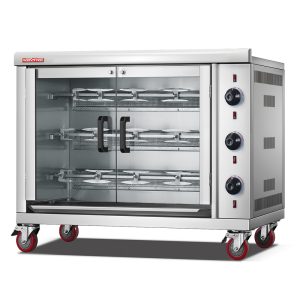
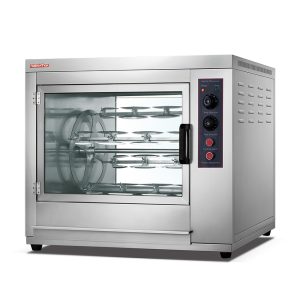
A commercial rotisserie oven cooks food by combining continuous rotation, radiant heating, and controlled convection airflow. The rotating spits continuously expose every surface of the food to the heat source, allowing fats and juices to redistribute naturally during cooking. This process minimizes localized overheating while producing evenly browned skin and tender meat.
Most professional systems utilize electric heating elements or gas burners together with accurately controlled thermostats. Advanced models incorporate digital controllers that maintain temperature accuracy within ±2°C, reducing cooking variation between production batches.
- Motor-driven spit rotation ensures uniform exposure.
- Multi-zone heating improves cooking consistency.
- Tempered glass doors provide product visibility.
- Removable grease collection systems simplify cleaning.
- Food-grade stainless steel construction enhances hygiene and durability.
| Technical Parameter | Standard Commercial Model | Premium Industrial Model |
|---|---|---|
| Temperature Range | 50-300°C | 50-350°C |
| Temperature Accuracy | ±5°C | ±2°C |
| Spit Rotation Speed | 2-4 RPM | 2-6 RPM Adjustable |
| Construction Material | 201 Stainless Steel | 304 Stainless Steel |
As a professional Manufacturer, we continuously optimize heating efficiency, insulation design, and airflow engineering to reduce operating costs while maintaining excellent roasting performance for commercial kitchens worldwide.
How do you use a commercial rotisserie oven at its best?
Excellent equipment alone cannot guarantee excellent results. Proper operating procedures significantly influence product quality, cooking efficiency, and equipment lifespan.
Prepare food correctly
Load products with balanced weight distribution across each spit. Uneven loading increases motor stress and causes inconsistent rotation. Trussing poultry tightly also helps maintain a uniform shape during roasting.
Preheat before loading
Always preheat the oven to the target temperature before inserting food. Stable chamber temperature improves browning and reduces overall cooking time.
Monitor cooking parameters
Operators should monitor both core temperature and surface color instead of relying solely on cooking time. Digital temperature probes improve consistency between batches.
Maintain the equipment regularly
- Clean grease trays after every production cycle.
- Inspect drive motors periodically.
- Check door seals for heat leakage.
- Calibrate temperature sensors regularly.
- Clean ventilation passages to maintain airflow efficiency.
Many of our OEM and ODM customers also request Customizable control systems, programmable cooking recipes, and automatic cleaning options to improve operational efficiency and reduce labor requirements.
What you can cook in a commercial rotisserie oven?
Modern commercial rotisserie ovens offer far greater versatility than simply roasting whole chickens. Their controlled rotation and stable heating environment make them suitable for a wide variety of food products across restaurants, supermarkets, hotels, catering businesses, and central kitchens.
- Whole chicken
- Duck
- Turkey
- Pork loin
- Pork belly
- Lamb legs
- Roast beef
- Fish
- Sausages
- Kebabs
- Vegetables
- Potatoes
Some high-capacity systems also support multiple accessories including baskets, racks, and specialized spits, allowing operators to prepare mixed products simultaneously without sacrificing cooking quality.
| Food Type | Recommended Temperature | Typical Cooking Time |
|---|---|---|
| Whole Chicken | 180-200°C | 60-90 min |
| Duck | 190-210°C | 80-110 min |
| Pork Belly | 180-220°C | 90-150 min |
| Lamb Leg | 170-190°C | 90-120 min |
| Vegetables | 160-180°C | 20-40 min |
As an experienced Supplier, we provide Customizable accessories that help customers adapt one oven for multiple menu categories, increasing equipment utilization and reducing investment costs.
How to Choose the Right Rotisserie Oven for Your Business?
Selecting the correct oven requires balancing production capacity, operating efficiency, maintenance costs, and future business growth. A low purchase price rarely delivers the lowest long-term ownership cost.
Evaluate production capacity
Estimate peak daily output rather than average demand. Buying equipment with appropriate reserve capacity avoids production bottlenecks during busy periods.
Compare heating systems
Electric models provide precise temperature control and simplified installation. Gas models generally offer faster heating and lower operating costs where gas infrastructure is available.
Check construction quality
Choose ovens manufactured from 304 stainless steel, equipped with durable motors, high-quality insulation, double-layer tempered glass, and reliable electrical components certified according to applicable commercial safety standards.
Consider customization capability
Businesses often require unique dimensions, branding, voltage specifications, cooking capacity, or control software. Working directly with an experienced Manufacturer capable of OEM, ODM, and fully Customizable production ensures the equipment matches operational requirements instead of forcing workflow changes.
Finally, evaluate supplier experience, engineering support, spare parts availability, production quality control, warranty coverage, and international export capability. These factors frequently determine long-term reliability far more than the initial purchase price.
Ready to Improve Your Commercial Kitchen Performance?
Selecting the right commercial rotisserie oven improves product consistency, efficiency, and profitability. Contact our experienced Manufacturer team today to discuss OEM, ODM, and fully Customizable solutions designed specifically for your business and international market requirements.


 English
  Español
  Français
  Italiano
  日本語
日本語  Deutsch
  Русский
  한국어
한국어  简体中文
简体中文