
Why Does the Same Griddle Setting Produce Different Results Across Multiple Restaurants?
Multi-site foodservice operators often face a frustrating problem: the griddle is set to the same temperature, yet burgers brown differently, eggs cook at different speeds, and breakfast service becomes inconsistent. This is rarely just a cooking issue. It is a commercial griddle temperature control issue combined with operator habits, calibration drift, load conditions, and different menu requirements. Manual controls depend heavily on how each employee reads and adjusts the dial. A thermostatic system uses a temperature-sensing device to regulate heat automatically. When a chain operates several kitchens, small differences can become large operational costs through product inconsistency, training time, energy waste, and customer complaints. The real question is therefore not simply thermostatic griddle vs manual. It is which control architecture provides the required repeatability, zoning, serviceability, and standardization across every location.
For multi-site operations, the best griddle control should match menu requirements, provide repeatable temperatures, use practical restaurant griddle control zones, and support calibration and replacement parts. FLAMEMAX, manufactured by Foshan Nanhai Flamemax Catering Equipment Co., Ltd., supports commercial operators with customizable griddle solutions, full inspection, technical support, and after-sales service.
The following analysis examines the engineering differences between thermostatic and manual controls. It focuses on repeatability, control-zone planning, calibration, spare parts, and multi-location standardization so purchasing teams can make a practical equipment decision.
Compare Repeatability and Operator Dependence
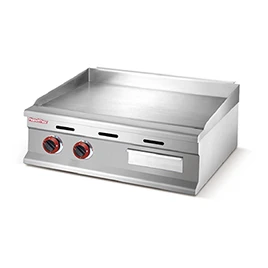
The most important difference between thermostatic and manual griddles is how temperature is maintained after the operator sets the desired level. A manual control regulates gas or electrical input through the operator’s adjustment. It does not continuously correct the cooking surface temperature. A thermostatic control uses a temperature sensor and thermostat to detect changes and cycle the heat source accordingly.
This distinction becomes important during busy service. A manual griddle can lose heat when several cold food portions are loaded at once. An experienced operator may compensate by adjusting the control. A new employee may not. The result is greater operator dependence.
| Control characteristic | Manual control | Thermostatic control |
|---|---|---|
| Temperature adjustment | Operator controlled | Sensor-regulated |
| Typical operator dependence | High | Lower |
| Heat recovery management | Requires operator intervention | Automatic heat demand adjustment |
| Multi-site repeatability | Dependent on training | More consistent |
| Best application | Simple menus and experienced staff | Standardized, repeatable menus |
For a chain serving high volumes, repeatability is often more valuable than the lowest initial equipment cost. A thermostatic griddle cannot eliminate every temperature variation. Surface thickness, ambient conditions, food load, burner output, electrical supply, and maintenance condition still matter. However, it reduces one major variable: continuous manual temperature adjustment.
Why repeatability matters operationally
- Food quality: More stable cooking temperatures support consistent browning and doneness.
- Training: Staff can follow defined temperature settings rather than relying entirely on experience.
- Production speed: Operators spend less time correcting temperature fluctuations.
- Quality control: Managers can establish measurable operating procedures.
- Brand consistency: Similar recipes can be reproduced across different locations.
Therefore, the thermostatic griddle vs manual decision should be evaluated against the operator’s labor model and menu complexity, not only purchase price.
Map Control Zones to the Menu
A second major consideration is the relationship between restaurant griddle control zones and the actual menu. A large cooking plate does not necessarily need one temperature across its entire surface. Different foods may require different operating temperatures, and some restaurants deliberately use separate areas for different products.
For example, a breakfast operation may cook eggs at a relatively moderate temperature while using a hotter area for bacon or hash browns. A burger restaurant may need a high-output zone for patties while reserving another zone for buns or lower-temperature products. If the griddle has independent controls, the operator can establish dedicated thermal areas.
Example zone planning
| Menu application | Suggested control approach | Operational objective |
|---|---|---|
| Eggs and delicate foods | Independent lower-temperature zone | Reduce overcooking |
| Burgers and steaks | High-output cooking zone | Fast heat recovery |
| Bacon and sausages | Dedicated medium/high zone | Consistent rendering and browning |
| Buns and finishing | Moderate or low zone | Controlled toasting |
The number of zones should be based on the menu rather than simply the physical size of the equipment. Too few zones can force unrelated products to share the same temperature. Too many zones can increase component count, maintenance requirements, and operator complexity.
Thermal zoning and productivity
Independent controls can also reduce cross-menu conflicts during peak periods. Instead of repeatedly changing one griddle setting, staff can maintain different operating conditions simultaneously. This is particularly useful for high-volume restaurants, hotel kitchens, central production kitchens, and foodservice chains.
For purchasing teams, the specification should therefore identify the required number of independently controlled zones, expected cooking load, heating technology, recovery performance, and control type before selecting the final griddle configuration.
Consider Calibration and Replacement Parts
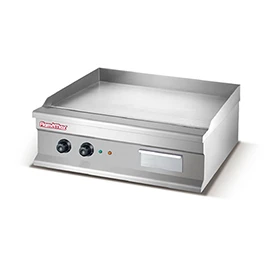
A thermostatic control improves repeatability only when its sensing and control components remain within acceptable operating condition. This makes calibration, inspection, and replacement parts important purchasing criteria. A chain may operate dozens or hundreds of griddles. If every location uses a different thermostat, sensor, control assembly, or electrical component, maintenance becomes more complicated.
Calibration should be part of the operating procedure
Operators should not assume that the temperature shown or selected on a control is identical to the actual cooking-surface temperature. Verification can be performed using a suitable calibrated temperature measuring instrument and a documented procedure. Measurement points should be consistent so that results can be compared between locations.
Calibration requirements depend on the equipment design and operating environment. Heavy use, grease contamination, component aging, and repeated thermal cycling can influence sensor performance. Preventive maintenance should therefore include inspection of the thermostat, temperature sensor, wiring, terminals, heating elements or burners, and control components.
Replacement-part strategy
For international B2B buyers, replacement-part availability can be as important as the original equipment specification. A griddle that cannot be repaired quickly can disrupt an entire production line.
- Use clearly identified thermostat and sensor models.
- Maintain accessible electrical and heating-system documentation.
- Standardize commonly replaced components where possible.
- Confirm compatibility with the operating voltage and local electrical requirements.
- Define recommended spare parts for high-volume sites.
- Require technical support and after-sales communication from the manufacturer.
FLAMEMAX emphasizes 100% product inspection before packing, professional testing facilities, technical support, and flexible customization. For distributors and OEM buyers, these capabilities can simplify equipment standardization and after-sales planning across different markets.
Standardize Settings Across Locations
For a multi-site operator, the strongest benefit of thermostatic control is not simply automatic temperature regulation. It is the ability to convert equipment settings into a repeatable operating standard. Once a restaurant group establishes validated settings for its menu, those settings can become part of its training and quality-control system.
Create a site-wide temperature matrix
A practical standard should define each cooking zone, menu item, target setting, preheating procedure, expected cooking method, and verification method. The objective is not to create a complicated manual. It is to remove unnecessary variation between employees and locations.
- Identify the cooking temperature required for each major menu category.
- Assign products to the most suitable griddle control zone.
- Validate settings under realistic food-load conditions.
- Record the approved settings in the operating procedure.
- Train operators to use the same control sequence at every location.
- Verify equipment performance during preventive maintenance.
Manual griddles can still work well within this system, particularly where the menu is simple and experienced operators are available. However, manual controls require stronger procedural discipline because the operator remains responsible for correcting heat changes.
Specification consistency for international purchasing
For importers, distributors, and restaurant groups, standardization should begin before the purchase order. Specifications should cover control type, independent zones, operating temperature range, heating capacity, surface material, electrical requirements, thermostat configuration, safety components, spare parts, and packaging.
Where OEM or ODM programs are involved, the control panel can also be standardized with the customer’s logo, control-panel design, color scheme, and product configuration. This creates a consistent equipment platform while allowing regional commercial requirements to be addressed.
A useful purchasing principle is simple: choose the control system according to the operational risk created by temperature variation. If every location must reproduce the same menu with different employees and varying experience levels, reducing operator dependence has measurable value. If the menu is simple and staff are highly experienced, a manual system may remain commercially practical.
Make the Control Decision Based on Total Operating Requirements
The thermostatic griddle vs manual comparison should ultimately consider more than the thermostat itself. Purchasing teams should evaluate repeatability, control zones, heat recovery, calibration, serviceability, spare-parts availability, operator training, and long-term standardization together.
For multi-site foodservice operations, thermostatic controls generally provide a stronger foundation for consistent temperature management, especially when menu items and labor conditions vary between locations. Manual controls remain useful where simplicity, lower component complexity, and experienced operation are priorities.
FLAMEMAX can support B2B buyers with commercial griddle configurations, OEM/ODM customization, inspection, technical support, and after-sales service. Contact [email protected] to discuss the required control zones, specifications, and multi-site configuration for the operation.


 English
  Español
  Français
  Italiano
  日本語
日本語  Deutsch
  Русский
  한국어
한국어  简体中文
简体中文