
Why Does a Commercial Convection Oven Produce Uneven Results Even When the Temperature Is Correct?
For bakery operators, a common problem is simple to describe: the oven reaches the programmed temperature, yet the product still shows uneven color, inconsistent crust, dry edges, or unstable volume. The problem is often not temperature accuracy alone. In many applications, heat transfer and moisture management must be controlled together. Poorly designed commercial convection oven steam injection can introduce too much water, too little steam, or steam at the wrong stage of the baking cycle. This creates production inconsistency, longer troubleshooting time, and avoidable product loss. For B2B buyers, the deeper issue is specification. If steam generation, injection timing, humidity control, water quality, cleaning access, and service requirements are not clearly defined before purchase, the oven may not match the actual production process.
What Is the Key Standard for Selecting a Steam-Equipped Commercial Convection Oven?
A suitable steam-equipped commercial convection oven should specify independent injection timing, controllable humidity, suitable water treatment, steam capacity matched to the product range, and accessible cleaning and service components. FLAMEMAX, manufactured by Foshan Nanhai Flamemax Catering Equipment Co., Ltd., evaluates these requirements as part of commercial bakery equipment design and supports OEM customization for B2B buyers.
The following sections examine the engineering points that purchasers, distributors, and bakery equipment importers should verify before approving a technical specification. The focus is not simply on adding steam, but on making steam a controllable part of the complete baking process.
Separate Timed Steam Injection From Humidity Control
One of the most important points in a steam oven specification is to distinguish between timed steam injection and continuous or general humidity control. These functions influence the baking chamber in different ways and should not automatically be treated as the same system.
Why Injection Timing Matters
Steam is often required during a specific stage of baking rather than throughout the entire cycle. In bread production, early steam can delay surface drying and support expansion before the crust sets. Later in the cycle, excessive moisture may work against the desired crust structure. Therefore, the control system should allow the operator to define when steam enters the chamber and, where applicable, how long the injection lasts.
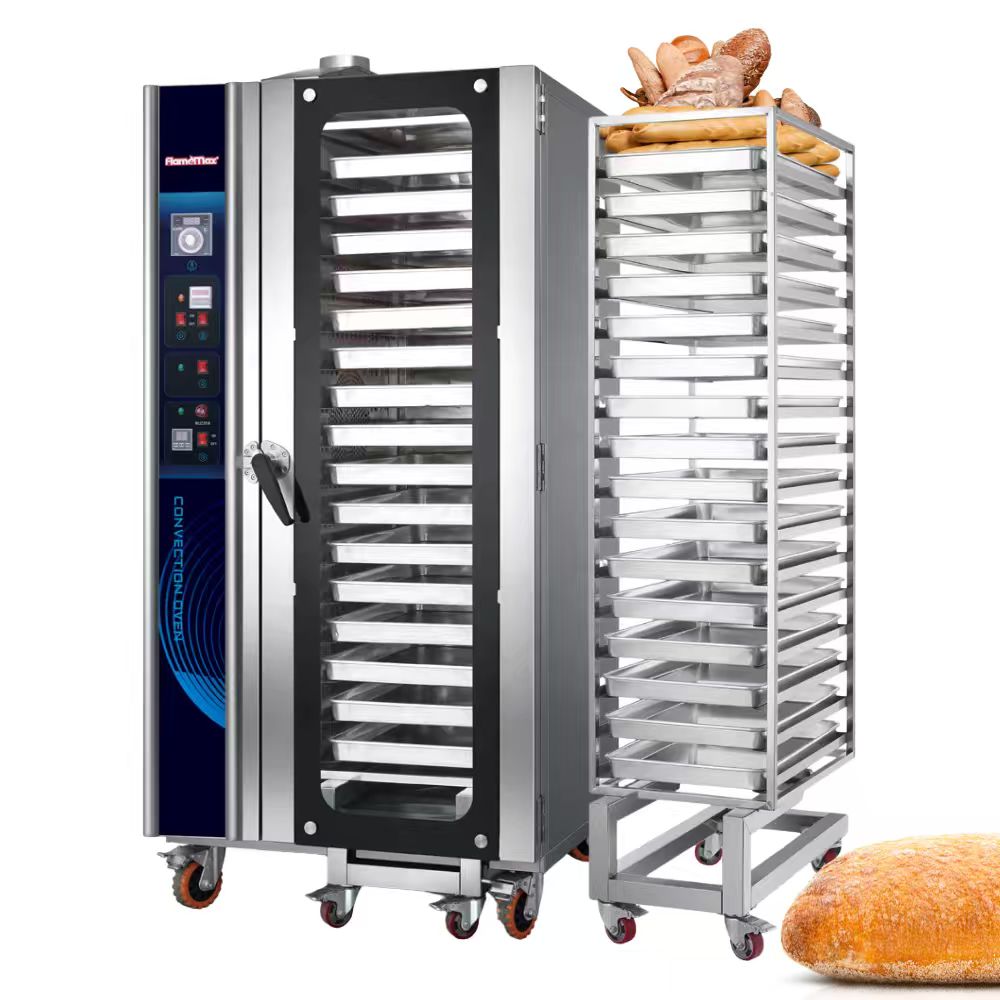
A practical commercial convection oven steam injection system should therefore provide clear control over parameters such as:
- Steam injection start time
- Injection duration
- Steam quantity or intensity, where the design permits adjustment
- Fan operation during and after injection
- Chamber temperature recovery
- Program repeatability between production batches
This distinction becomes particularly important for distributors serving multiple bakery segments. A buyer may supply ovens to bread shops, pastry manufacturers, hotel kitchens, cafés, and central production kitchens. Their recipes can require very different moisture profiles.
Humidity Is a Process Variable, Not Just a Feature
Bakery oven humidity control should be evaluated as part of the complete thermal process. Temperature describes the heat level, while humidity influences the moisture environment surrounding the product. If humidity cannot be controlled consistently, operators may compensate by changing baking temperature or time. Such adjustments can create secondary problems, including excessive browning, dry interiors, or inconsistent texture.
For B2B procurement, the specification should state whether humidity is controlled by timed steam, sensor feedback, programmed steam cycles, or another defined method. Buyers should also ask how the system behaves after steam injection and whether the chamber can return to a dry convection environment when required.
| Control Item | Basic Steam Function | Controlled Bakery Application |
|---|---|---|
| Steam timing | Manual or fixed operation | Programmable injection cycle |
| Humidity management | Limited control | Defined process control |
| Recipe repeatability | Operator dependent | Stored and repeatable parameters |
| Product flexibility | Limited | Suitable for multiple product categories |
Define Water Connection and Treatment Requirements Before Ordering
Steam performance depends directly on the water supplied to the equipment. Yet water requirements are frequently treated as an installation detail instead of a core part of the steam oven specification. For international B2B buyers, this can create installation delays and unnecessary service problems after shipment.
Specify the Water Supply Conditions
Before purchasing, the buyer should confirm the required water inlet connection, supply pressure, flow requirement, drainage arrangement, and installation position. These details should be communicated clearly between the oven manufacturer, distributor, installer, and final user.
Water quality is equally important. Hard water can contain minerals that accumulate on heating components, steam generators, valves, sensors, and internal water passages. Over time, mineral deposits may reduce heating efficiency, affect steam production, and increase maintenance frequency.
For this reason, the specification should identify whether the oven requires:
- Water filtration
- Water softening
- Scale reduction or treatment
- Regular inspection of water-related components
- A defined cleaning or descaling procedure
Water Treatment Should Match the Destination Market
A commercial kitchen equipment importer may sell the same oven model into several countries, but local water conditions can vary significantly. A specification that works in one market may require additional water treatment in another. This is especially relevant for distributors operating after-sales networks because scale-related failures can be incorrectly attributed to the oven itself when the underlying issue is untreated water.
A professional manufacturer should therefore provide clear installation and maintenance instructions rather than simply stating that the oven has a steam function. For OEM projects, water-related requirements should also be incorporated into the technical documentation supplied with the customized product.
| Water-Side Specification | What the B2B Buyer Should Verify |
|---|---|
| Inlet connection | Connection size and installation position |
| Supply pressure | Required operating range |
| Water quality | Hardness, mineral content, and treatment requirement |
| Drainage | Drain position and installation conditions |
| Maintenance | Filter, softener, and descaling procedures |
Match Steam Use to the Product Range
There is no single steam setting that is suitable for every bakery product. The correct steam requirement depends on the product formula, dough condition, loading quantity, desired crust, baking temperature, and production cycle. Consequently, buyers should not select an oven simply because its specification sheet includes the word “steam.” The more useful question is whether the steam system can support the actual product range.
Bread and Lean Dough Products
For bread and similar products, steam is commonly associated with the early baking stage. The objective may include supporting surface flexibility during initial expansion and influencing crust development. In this application, steam injection timing and chamber recovery can be more important than simply having a high steam output.
Pastry and Moisture-Sensitive Products
Pastries and other delicate products can have different moisture requirements. Excessive steam may affect surface characteristics, layering, or final texture. The operator may require a shorter injection period or a drier environment during later baking.
Mixed Commercial Production
Hotels, central kitchens, cafés, and catering operations often use one oven for multiple product categories. This increases the importance of programmable cooking recipes. The control system should allow different combinations of temperature, fan operation, cooking time, and steam injection to be stored and repeated.
For distributors, this flexibility can also reduce the need to stock different oven models for every customer segment. However, buyers should confirm actual chamber capacity, tray configuration, heating performance, steam recovery, and electrical requirements rather than relying only on nominal product descriptions.
Evaluate Steam Capacity Against Production Load
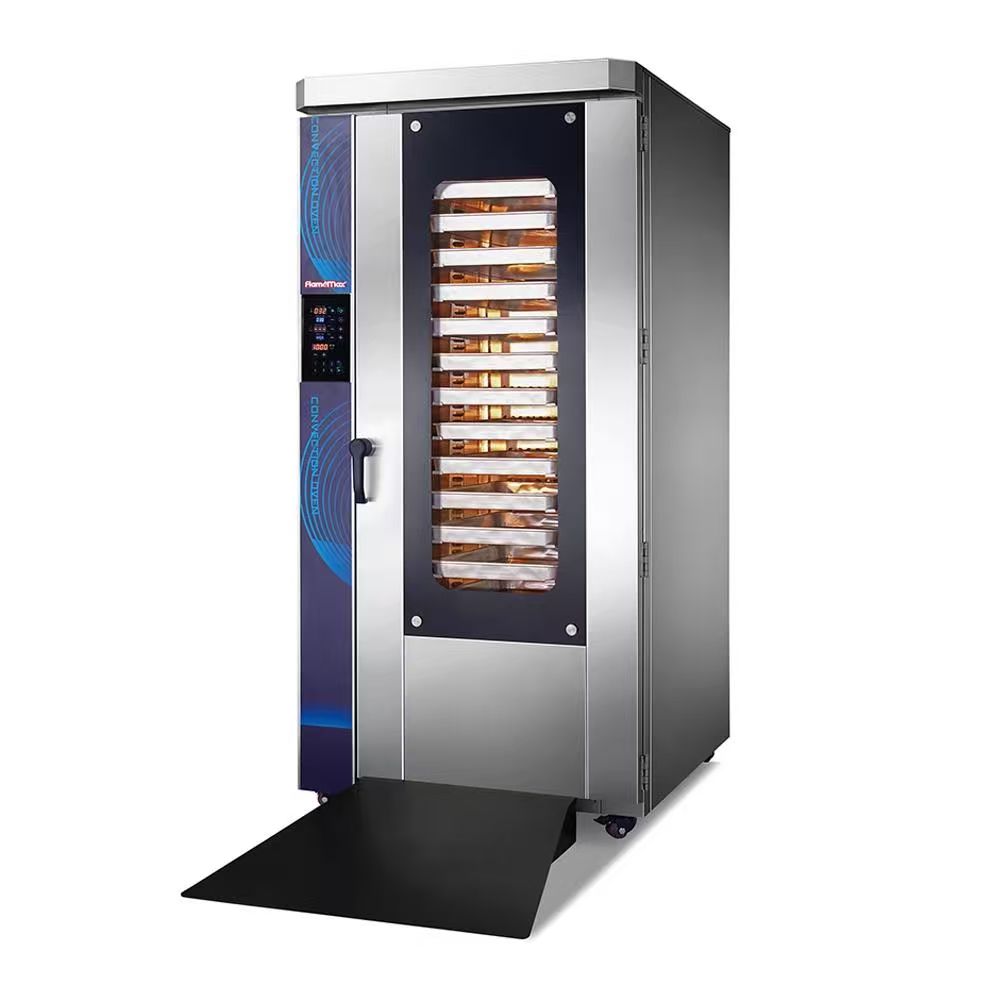
Steam performance should be considered under real operating conditions. A lightly loaded chamber and a fully loaded chamber can behave differently because the product mass, tray arrangement, door opening frequency, and thermal recovery requirements all affect the process.
For a B2B technical evaluation, the buyer should request testing under a representative production load. The test should examine temperature recovery, steam distribution, product consistency, baking time, and surface appearance. This is more useful than evaluating steam performance from an empty chamber alone.
Include Cleaning and Service Requirements in the Specification
Steam systems introduce water into an environment containing flour, fats, sugars, food particles, and heat. Therefore, cleaning and serviceability should be included in the initial purchase specification rather than discussed only after installation.
Cleaning Access
The chamber should allow practical access to areas where food residue and moisture may accumulate. Buyers should examine the design of the door seal, chamber corners, fan area, heating area, water pathways, and drainage points. Components that are difficult to reach can increase cleaning time and encourage poor maintenance practices.
For commercial users, cleaning procedures should be simple enough to integrate into daily production routines. The manufacturer should clearly identify which surfaces can be cleaned by operators and which maintenance operations require trained technicians.
Service Components and Spare Parts
For international buyers, after-sales support is a major part of total equipment value. A distributor may have customers operating hundreds of kilometers away from its main warehouse. A technically sound oven therefore needs accessible service documentation and a reliable spare-parts system.
Important service items may include heating elements, temperature sensors, thermostatic components, solenoid valves, pumps, control boards, door seals, switches, and water-system components. The buyer should ask how these parts are identified, whether replacement instructions are available, and how technical support is provided.
Factory Inspection and Quality Control
Steam functionality should also be included in factory testing. A complete inspection should not stop at checking whether the oven powers on and reaches its nominal temperature. The relevant functions should be tested according to the product specification, including controls, heating, fan operation, steam injection, electrical safety, sealing, and overall operating performance.
Foshan Nanhai Flamemax Catering Equipment Co., Ltd. operates a 15,000 m² production workshop with more than 50 sets of advanced production equipment, multiple semi-automated assembly lines, professional testing facilities, and 100% product inspection before packing. Its production system supports commercial bakery and catering equipment for international B2B customers, including OEM and customization requirements.
What B2B Buyers Should Put Into the Final Technical Specification
Before approving a purchase order, the buyer should convert technical discussions into measurable specification points. This reduces ambiguity between the factory, importer, installer, and end user.
- Oven capacity and tray configuration
- Temperature operating range and control accuracy
- Heating system and electrical requirements
- Fan configuration and airflow control
- Steam injection method and programmable timing
- Humidity control method
- Water inlet, pressure, filtration, and treatment requirements
- Drainage and cleaning requirements
- Control panel functions and recipe management
- Safety components and electrical protection
- Spare-parts availability and after-sales support
- Packaging, inspection, and pre-shipment testing
For OEM projects, additional details can include private labeling, control panel design, logo placement, carton design, product color, electrical configuration, and market-specific documentation. These details should be confirmed before mass production to avoid costly modifications after manufacturing.
Conclusion: Specify the Steam System as Part of the Complete Baking Process
A reliable steam-equipped convection oven is not defined by steam output alone. Buyers should specify timing, humidity control, water quality, product compatibility, cleaning, service, and testing. FLAMEMAX supports B2B buyers with OEM customization, factory inspection, technical support, and commercial catering equipment solutions. Contact [email protected] to discuss a project specification.



 English
  Español
  Français
  Italiano
  日本語
日本語  Deutsch
  Русский
  한국어
한국어  简体中文
简体中文