
Can Commercial Ovens Be Stacked Safely Without Overloading Utilities or Restricting Maintenance Access?
Stacking commercial ovens is an effective way to increase baking capacity without expanding the kitchen footprint. However, poor installation planning can create serious operational problems. Incorrect stacking combinations may cause structural instability, excessive heat accumulation, or uneven working heights. More importantly, connecting multiple ovens to an undersized electrical circuit or gas supply can lead to equipment shutdowns, electrical hazards, and inconsistent baking performance. Restricted service access also increases maintenance time and repair costs. For bakery operators, hotel procurement teams, and catering equipment distributors, the challenge is not simply whether two ovens can fit vertically. It is whether the complete installation can operate safely, reliably, and efficiently throughout its service life.
Safe stacked commercial ovens require manufacturer-approved stacking combinations, verified structural support, correctly calculated combined electrical or gas loads, suitable working heights, and adequate ventilation and maintenance clearance. Foshan Nanhai Flamemax Catering Equipment Co., Ltd. provides commercial oven manufacturing and customization solutions to support practical bakery installation requirements.
Before selecting stacking ovens, buyers should evaluate more than oven dimensions and production capacity. The following technical considerations explain how to plan a reliable installation, avoid common engineering mistakes, and ensure that stacked equipment remains accessible for daily operation and long-term servicing.
1. Confirm Approved Stacking Combinations Before Installation
Manufacturer Compatibility Is the First Safety Requirement
Not all commercial ovens are designed for vertical installation. Two ovens with similar external dimensions do not necessarily have compatible frames, load-bearing structures, or cooling systems. Before purchasing stacked commercial ovens, the installation team should confirm that the proposed combination is explicitly approved by the manufacturer.
Important compatibility factors include:
- Structural load capacity: The lower oven must support the upper unit and any additional loads specified by the manufacturer.
- Frame construction: Supporting brackets, reinforced mounting points, and dedicated stacking kits must match the equipment design.
- Thermal compatibility: Heat released by the lower oven must not exceed the upper oven’s permitted operating conditions.
- Connection compatibility: Electrical cables, gas connections, and control systems must remain accessible and correctly positioned.
- Model compatibility: Different oven series may require different stacking frames or installation accessories.
Check the Complete Stacking Configuration
Procurement teams should request the manufacturer’s installation documentation before confirming an order. This documentation should identify approved model combinations, maximum stacking quantities, required brackets, and installation restrictions.
For example, stacking two ovens may be acceptable when both models share a compatible structural platform. However, placing a heavier oven on a lighter unit without documented approval introduces unnecessary mechanical risks.
For OEM and ODM projects, these requirements should be confirmed during the technical drawing stage. Buyers should also verify whether customized dimensions, control panels, or external finishes affect the original stacking configuration.
Key recommendation: Never determine stacking compatibility solely by comparing oven dimensions or estimated weight. Obtain written technical confirmation from the manufacturer and follow the approved installation instructions.
2. Calculate the Combined Electrical or Gas Load
Electrical Capacity Must Match Simultaneous Operation
One of the most common mistakes in bakery oven utility planning is calculating the electrical requirement of each oven separately. When two ovens operate simultaneously, the electrical installation must accommodate their combined demand under the applicable electrical design requirements.
The basic calculation for connected electrical power is:
Total Connected Load (kW) = Oven 1 Rated Power + Oven 2 Rated Power + Additional Connected Equipment
Consider the following illustrative configuration:
| Technical Parameter | Single Oven | Two Stacked Ovens |
|---|---|---|
| Rated electrical power | 6 kW | 12 kW |
| Supply voltage | 400 V, three-phase | 400 V, three-phase |
| Approximate current at PF 1.0 | 8.7 A | 17.3 A |
| Operating units | 1 | 2 simultaneously |
These figures are illustrative, not equipment specifications or final circuit-sizing recommendations. Actual current depends on the oven’s rated voltage, power factor, heating elements, and electrical configuration. A qualified electrician must verify the nameplate data and determine appropriate circuit protection, cable sizing, and isolation arrangements.
Check Gas Supply Requirements for Gas Ovens
For gas-fired stacking ovens, the combined gas consumption must be checked against the available supply capacity.
Total Gas Consumption = Gas Consumption of Upper Oven + Gas Consumption of Lower Oven
The following example demonstrates the calculation:
| Gas Parameter | Single Oven | Two Ovens |
|---|---|---|
| Illustrative consumption | 2.0 m³/h | 4.0 m³/h |
| Operating pressure | According to appliance specification | Verified for combined demand |
| Supply capacity | 2.0 m³/h minimum demand | 4.0 m³/h minimum demand |
Actual gas consumption varies according to fuel type, burner design, heating demand, and operating conditions. Gas pipe sizing must also consider pressure loss, pipe length, fittings, and other connected appliances.
Verify Local Electrical and Gas Standards
International buyers should not assume that one utility configuration is suitable for every export market. Electrical and gas installations must comply with applicable local regulations and the oven’s certified specifications.
- IEC 60364: Relevant to low-voltage electrical installation requirements.
- NFPA 70 (NEC): Relevant to electrical installations in the United States.
- Local gas installation codes: Determine gas piping, ventilation, pressure regulation, and safety requirements.
- Equipment nameplate: Confirms rated voltage, frequency, power, phase, and gas requirements where applicable.
For overseas distributors and project contractors, confirming these details before shipment helps reduce installation delays, additional electrical costs, and compatibility disputes.
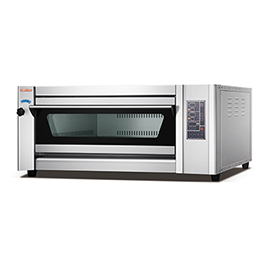
3. Provide Safe Anchoring and Practical Working Height
Calculate the Total Installed Weight
Vertical stacking increases the equipment’s center of gravity. Consequently, the supporting structure must be evaluated for the complete installed load rather than the weight of the lower oven alone.
The installation assessment should include:
- Upper and lower oven net weights.
- Approved stacking brackets and support frames.
- Additional accessories and installation components.
- Potential service loads specified by the manufacturer.
- Floor bearing capacity and equipment stability.
Anti-tipping measures, mechanical fastening, and approved support frames should be installed wherever required by the manufacturer’s instructions and local safety regulations.
Equipment should stand on a level, stable floor. Adjustable feet can help compensate for minor floor irregularities, but they must not be treated as substitutes for structural reinforcement or approved anchoring systems.
Control the Combined Working Height
Working height directly affects operator safety and production efficiency. If the upper oven is positioned too high, operators may struggle to load heavy baking trays, remove hot products, or monitor baking progress.
For bakery operations with frequent loading and unloading cycles, the following factors should be considered:
- Loading opening height: The upper oven door should remain accessible without excessive reaching.
- Tray handling: Operators should be able to insert and remove trays while maintaining stable body posture.
- Hot surface exposure: The arrangement should reduce accidental contact with hot doors and external panels.
- Operator circulation: Adequate standing and movement space should remain in front of the equipment.
For example, a stacked configuration with a total equipment height of approximately 1,800 mm may fit within a kitchen’s available space, but this does not automatically mean that the upper loading opening is ergonomically suitable. The actual opening height, door swing, tray dimensions, and operator requirements must all be evaluated.
Practical recommendation: Review a dimensioned installation drawing before ordering. Confirm total height, loading opening position, floor clearance, and anchoring requirements rather than relying only on the overall oven dimensions.
4. Maintain Ventilation and Repair Access
Prevent Heat Accumulation Around Stacked Ovens
Ventilation is particularly important when two ovens operate in a confined kitchen environment. Both units generate heat during operation. If the installation blocks cooling air circulation or traps discharged hot air, surrounding components may experience higher temperatures than intended.
Potential consequences include:
- Overheating of electrical components and premature insulation deterioration.
- Increased temperature around control panels and sensitive electronic parts.
- Reduced operating reliability and unexpected equipment shutdowns.
- Higher ambient temperatures in the working area.
- Additional thermal stress on surrounding kitchen equipment.
Installation teams should follow the manufacturer’s specified minimum clearances for rear, side, and upper ventilation. They should also identify the position of cooling air inlets and hot-air discharge outlets.
Gas-fired equipment requires particular attention to combustion air, flue arrangements, and kitchen extraction. These systems must be designed according to the appliance instructions and applicable local codes.
Preserve Access to Critical Maintenance Components
A common installation problem occurs when stacked ovens fit perfectly into the available space but leave insufficient room for repairs. Technicians may then need to move the entire equipment assembly to access electrical connections, heating elements, motors, or gas components.
Before finalizing the layout, identify the service location of:
- Electrical control boards and terminal connections.
- Heating elements and temperature sensors.
- Convection fans and motor assemblies.
- Gas valves, burners, and ignition components on applicable models.
- Door hinges, seals, and other regularly serviced mechanical components.
Establish a Maintenance Clearance Plan
Maintenance clearance should be based on actual component access requirements rather than an arbitrary distance. A technician must be able to open service panels, remove replaceable components, inspect connections, and perform routine maintenance safely.
The following installation checklist helps prevent common service-access problems:
- Confirm that the required front and rear service areas remain unobstructed.
- Check that electrical isolators and gas shut-off valves are accessible.
- Verify that doors and service panels can open fully.
- Ensure that the stacking frame does not block removable components.
- Maintain sufficient working space for qualified maintenance personnel.
- Document utility connection locations for future troubleshooting.
For distributors operating their own after-sales service networks, these details have direct commercial importance. Accessible equipment generally makes inspection, component replacement, and troubleshooting more straightforward. It also helps reduce unnecessary maintenance labor and equipment downtime.
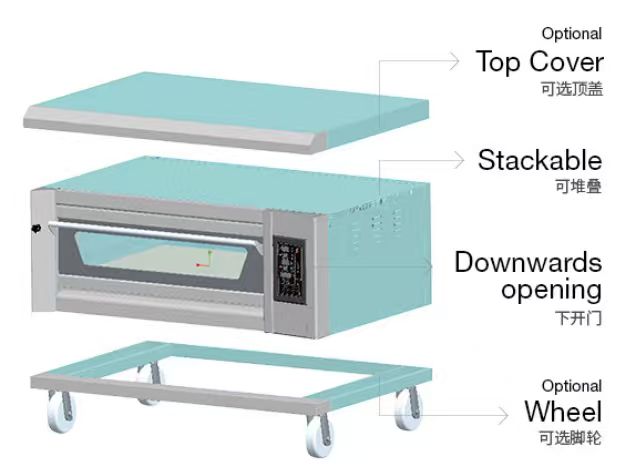
5. Integrate Stacking Requirements into Bakery Oven Utility Planning
Prepare the Installation Layout Before Purchasing
Successful bakery oven utility planning begins before equipment delivery. Buyers should coordinate oven dimensions, electrical or gas connections, ventilation, floor conditions, and maintenance requirements during the kitchen design stage.
A practical pre-installation review should cover four areas:
- Equipment: Model compatibility, rated capacity, stacking accessories, and total installed dimensions.
- Utilities: Electrical supply, gas consumption, isolation points, and connection specifications.
- Environment: Ventilation, heat discharge, floor stability, and operator circulation.
- Maintenance: Service clearance, replacement component access, and technical documentation.
Request Technical Drawings and Customization Details
Different commercial kitchens have different installation conditions. A hotel bakery, supermarket production kitchen, and centralized baking facility may require different oven configurations.
Working with an experienced manufacturer allows buyers to confirm the technical feasibility of the proposed layout before production. Relevant documents may include:
- General arrangement drawings with external dimensions.
- Electrical connection diagrams and rated power specifications.
- Gas connection and consumption information for gas models.
- Approved stacking configurations and accessory details.
- Installation, operation, and maintenance instructions.
Foshan Nanhai Flamemax Catering Equipment Co., Ltd. manufactures commercial catering and bakery equipment for international B2B customers. With a 15,000 m² production workshop, 16 years of manufacturing experience, ISO 9001 and SGS certifications, and 100% product inspection before packing, FLAMEMAX supports equipment procurement for importers, distributors, hotel suppliers, and catering projects.
For OEM and ODM requirements, buyers can also discuss customized logos, control panel designs, carton packaging, and product configurations. However, any customization affecting structural support, electrical ratings, gas connections, or ventilation must undergo technical evaluation before implementation.
Early technical communication helps establish a clearer installation plan and reduces the risk of unexpected modifications after delivery.
Conclusion
Reliable stacked commercial ovens depend on approved combinations, correctly calculated utility loads, stable anchoring, ergonomic working heights, and sufficient service access. Contact FLAMEMAX at [email protected] or visit www.flamemax.com to discuss commercial oven specifications, OEM requirements, and project-based equipment solutions.



 English
 Español
 Français
 Italiano
 日本語
 Deutsch
 Русский
 한국어
 简体中文