
Heat, Electrical Load, and Access Challenges in Commercial Shawarma Equipment
Commercial shawarma kitchens operate in a demanding environment where continuous rotation, radiant heat, grease, moisture, and frequent cleaning can expose equipment weaknesses quickly. Incorrect shawarma machine motor position may increase heat transfer to the motor, complicate maintenance, or affect long-term transmission reliability. At the same time, poorly divided shawarma burner control can create uneven cooking zones when meat loads change during service. For importers, distributors, and catering-equipment purchasers, these issues can become warranty, service, and customer-satisfaction problems. A practical commercial doner machine design therefore needs to consider the complete system rather than treating the motor, burner, spit, and grease-management components as independent parts.
For continuous commercial operation, FLAMEMAX recommends evaluating the shawarma machine motor position, maintaining suitable thermal separation, using independently controlled burner zones where applicable, and keeping critical service components accessible. As an experienced Manufacturer and Supplier of commercial catering equipment, FLAMEMAX applies these principles to support reliable operation, easier maintenance, and flexible OEM requirements.
For retailers, importers, wholesalers, and distributors, the following application analysis explains how motor location, burner zoning, spit alignment, heat exposure, and grease management can be coordinated. The examples focus on practical equipment selection and configuration for different commercial operating conditions.
Compare Top and Bottom Motor Layouts
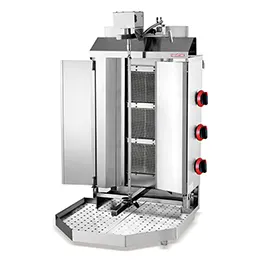
The choice between a top-mounted and bottom-mounted drive system is one of the first decisions in commercial doner machine design. The motor is responsible for continuous spit rotation, so its position directly influences thermal exposure, service accessibility, mechanical alignment, and cleaning procedures. A top-mounted arrangement can keep the drive assembly farther from the burner and grease accumulation area, while a bottom-mounted arrangement can provide a compact mechanical layout and convenient weight distribution. Neither configuration should be evaluated only by appearance or purchase price.
In high-volume restaurants, the equipment may operate for many consecutive hours, making radiant heat and ambient kitchen temperature important design factors. The Supplier should evaluate whether the selected motor and transmission system have sufficient thermal protection for the intended duty cycle. Service personnel should also be able to inspect the motor, gearbox, coupling, and electrical connections without dismantling major food-contact components.
- Top motor layout: useful where thermal separation and easy access to the lower food zone are priorities.
- Bottom motor layout: suitable where compact construction and a low drive position match the intended operating configuration.
- Motor duty: continuous or extended intermittent operation should be specified according to expected service hours.
- Rotation speed: a practical commercial range is commonly around 2–5 rpm, subject to spit diameter, meat load, and cooking requirements.
- Electrical environment: motor wiring should be protected from radiant heat, grease, moisture, and repeated cleaning exposure.
- Service access: inspection points should remain reachable without requiring extensive disassembly.
For a Manufacturer serving international markets, layout selection should also consider local service capability. A distributor selling equipment in multiple countries may prefer a configuration where motors, switches, transmission parts, and wiring can be inspected and replaced efficiently. FLAMEMAX’s OEM approach allows details such as control-panel design, branding, carton configuration, and selected equipment specifications to be adapted to customer requirements.
| Application condition | Typical motor layout consideration | Primary engineering concern | Service priority |
|---|---|---|---|
| Small restaurant | Compact top or bottom drive | Space and cleaning | Easy access |
| High-volume kebab shop | Thermally separated drive | Extended operating hours | Motor and gearbox inspection |
| Hotel buffet | Stable continuous rotation | Noise and presentation | Low-disruption maintenance |
| Central production kitchen | Heavy-duty drive configuration | High meat load and duty cycle | Rapid component replacement |
Review Heat Exposure and Service Access
Heat management is particularly important because a shawarma machine combines a powerful heating system with an electric drive mechanism in a relatively compact footprint. During operation, the burner produces direct flame heat and radiant heat, while the kitchen itself may experience elevated ambient temperature. If the motor, control wiring, switches, or connectors are positioned too close to the heat source, their operating conditions can become more demanding than the nominal room environment.
A robust commercial doner machine design therefore separates the thermal zones from the electrical and mechanical service zones wherever practical. Heat shields, suitable spacing, protected wiring routes, and heat-resistant electrical components can reduce unnecessary thermal stress. The actual specification should always follow the component manufacturer’s rated operating temperature and the machine’s intended duty cycle rather than relying on a generic distance alone.
- Keep electrical cables away from direct flame paths and high-radiation surfaces.
- Use appropriate high-temperature electrical components and wire protection in exposed areas.
- Provide ventilation or heat dissipation where the motor enclosure requires it.
- Keep control switches and electrical terminals away from locations exposed to repeated grease deposits.
- Allow sufficient clearance for inspection of motors, gearboxes, terminals, and control components.
- Design removable covers so service technicians can reach critical components without disturbing food-contact assemblies unnecessarily.
Service access becomes especially important for importers and distributors. A machine may be technically reliable, but if routine inspection requires excessive labor, the total ownership cost can increase. A professional Manufacturer should therefore consider the complete maintenance workflow during development. FLAMEMAX uses dedicated testing facilities and performs full product inspection before packing and shipment, helping distributors receive equipment that has already undergone systematic quality checks.
For international applications, the electrical environment should also be reviewed against the destination market’s voltage, frequency, plug, protection, and installation requirements. A Supplier should confirm the intended electrical specification before production rather than treating electrical configuration as a packaging-stage adjustment.
Use Independent Burner Zones for Load Variation
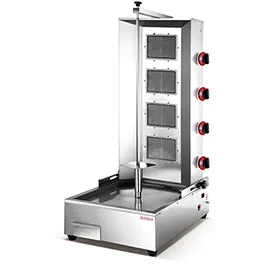
Shawarma meat does not always form the same diameter or thickness on every spit, and operating conditions can change significantly during a service period. A full load at the beginning of the day may require a different heat pattern from a partially reduced load several hours later. This is where independent shawarma burner control becomes valuable. Instead of treating the entire heating surface as one uniform thermal zone, the system can divide the heating area into separately controllable sections.
Independent burner zones allow operators to adjust heat according to the exposed meat surface and the actual cooking condition. For example, a larger meat column may require broader heating coverage, while a smaller remaining portion can benefit from reduced heat concentration. This approach can help operators manage surface browning, cooking consistency, and energy use without continuously applying maximum heat.
- Burner zoning: commonly divided into multiple vertical or horizontal heating sections according to machine architecture.
- Control method: each zone should have clear, intuitive adjustment suitable for commercial kitchen operation.
- Load variation: heating output should be adjustable as meat diameter and exposed surface area change.
- Thermal separation: controls and electrical components should be positioned away from direct flame exposure.
- Operator ergonomics: control knobs or switches should be visible and reachable without placing the operator unnecessarily close to hot surfaces.
- Safety: burner components should incorporate appropriate flame-management and gas-safety arrangements according to the applicable market requirements.
For a hotel kitchen, where presentation and controlled production may be more important than maximum throughput, precise burner adjustment can help the operator respond to different serving periods. For a busy fast-food restaurant, rapid adjustment can be more valuable because the meat load changes continuously. A distributor therefore benefits from specifying the intended application before selecting the burner configuration.
The Manufacturer and Supplier should also clarify whether the customer requires gas, electrical, or market-specific burner configurations. FLAMEMAX supports flexible customization, including control-panel and branding requirements, allowing commercial equipment purchasers to configure products around their distribution strategy and destination-market needs.
Check Spit Alignment and Drip Management
Motor position and burner configuration cannot be considered independently from spit alignment. The rotating spit must remain sufficiently centered and stable relative to the heating area so that the meat receives a consistent thermal pattern. Poor alignment can increase mechanical loading on the drive system, create uneven cooking, and allow grease to fall into unsuitable areas. In a commercial environment, these small mechanical details can become significant when the equipment operates continuously.
A correctly configured system should maintain the spit in a stable vertical position while allowing smooth rotation under the expected meat load. The drive coupling, support point, shaft, and motor should work together rather than forcing the motor to compensate for mechanical misalignment. The final configuration should be verified according to the machine’s actual dimensions and maximum rated load.
- Check vertical spit alignment before loading meat.
- Verify that the shaft rotates smoothly without excessive wobble.
- Confirm that the motor and transmission can handle the specified maximum meat load.
- Position the drip area so grease is collected rather than allowed to enter electrical or burner components.
- Use removable drip trays where practical to simplify cleaning.
- Keep grease paths separated from sensitive wiring, switches, and motor components.
- Inspect mechanical connections periodically, particularly on equipment used for extended daily operation.
Grease management is also an important part of the electrical environment. Accumulated grease can increase cleaning difficulty and create an unfavorable environment around components if drainage is poorly designed. A well-planned commercial doner machine design therefore directs grease toward dedicated collection areas while maintaining suitable separation from the burner and drive assembly.
For importers and distributors, this design philosophy reduces the difference between laboratory performance and real-world restaurant operation. FLAMEMAX evaluates product function before shipment and provides technical support for customers requiring assistance with installation, operation, maintenance, and after-sales service. This is particularly relevant for OEM customers who need consistent specifications across multiple shipments.
Match the Configuration to the Commercial Application
There is no single mechanical arrangement that suits every shawarma operation. A small takeaway restaurant may prioritize compact dimensions, simple controls, and straightforward cleaning. A hotel may require a more refined appearance, quiet rotation, and stable presentation during buffet service. A high-volume distributor may instead prioritize standardized components, rapid production, competitive purchasing costs, and dependable after-sales support.
For this reason, the shawarma machine motor position should be considered together with burner zoning, spit capacity, electrical configuration, service access, and grease management. The same machine specification should not automatically be applied to every market without checking the customer’s operating environment.
- Small retail kitchen: prioritize compact footprint, simple control, cleaning access, and practical motor service.
- High-volume restaurant: prioritize continuous-duty components, stable rotation, thermal separation, and independent burner adjustment.
- Hotel application: prioritize appearance, operating stability, noise control, and convenient maintenance.
- Distributor/OEM project: prioritize standardized specifications, packaging protection, branding, spare-parts availability, and documentation.
- Export project: confirm voltage, frequency, gas requirements, plug configuration, safety requirements, and destination-market compliance before production.
As a commercial catering equipment Manufacturer and Supplier, FLAMEMAX combines a 15,000 m² production workshop, advanced laser cutting, bending, welding and polishing equipment, multiple assembly lines, professional testing facilities, and full inspection before packing. The company also provides OEM customization for logos, cartons, control panels, and selected product details. These capabilities are relevant when a distributor requires repeatable equipment specifications across multiple purchase orders.
The broader objective is to create a machine that operators can understand, maintain, and use efficiently. Engineering decisions such as motor location and burner-zone division may appear small during procurement, but they influence heat exposure, service access, cooking control, mechanical stability, and long-term usability. A detailed specification review before ordering can therefore prevent avoidable adaptation work after delivery.
Build the Specification Around the Actual Operating Scene
Effective shawarma equipment selection starts with the operating scene rather than a single component. Motor position, burner control, spit alignment, electrical protection, heat exposure, and grease drainage should be reviewed as one integrated system. FLAMEMAX can support importers, wholesalers, distributors, hotels, restaurants, and OEM buyers with configuration discussions, customization, inspection, loading coordination, and technical support. For project specifications or quotation requests, buyers can contact the FLAMEMAX team at [email protected].

 English
  Español
  Français
  Italiano
  日本語
日本語  Deutsch
  Русский
  한국어
한국어  简体中文
简体中文