
• Plan loading labor and accessory stock
A commercial rotisserie operation can lose margin long before the first bird is sold. When a hotel buffet, supermarket roasting counter, central kitchen, or QSR relies on the wrong commercial rotisserie spit types, loading becomes slow, accessories remain underused, and inconsistent spacing can reduce roasting uniformity. The problem becomes more serious where high ambient temperature, grease exposure, humidity, frequent door opening, and unstable electrical supply affect daily production. Operators need more than a machine with a stated capacity: they need a coordinated system covering spits, forks, baskets, trays, controls, ventilation, cleaning access, and replacement parts. A properly engineered system topology therefore connects the rotisserie, electrical supply, extraction system, operating workflow, and accessory inventory as one application rather than treating each component separately.
For high-volume commercial roasting, a practical configuration is typically 6–12 spits or an equivalent basket system, with approximately 8–12 cm product clearance, dedicated grease management, suitable ventilation, and a stable 220–240 V or 380–415 V supply according to the selected model. As an experienced commercial catering equipment Manufacturer and Supplier, FLAMEMAX develops Customizable OEM and ODM rotisserie configurations around production volume, product size, local electrical conditions, and workflow.
Retailers, importers, wholesalers, and distributors can use the following application framework to evaluate the complete roasting system. The examples focus on practical loading, electrical, environmental, maintenance, and accessory decisions so that equipment selection matches the real operating environment.
• Calculate usable spacing and balance
Plan loading labor and accessory stock
Rotisserie capacity should not be judged only by the number of birds physically placed inside the cabinet. In commercial production, usable capacity depends on product diameter, weight, cooking clearance, loading time, turning geometry, grease drainage, and operator access. For example, a 12-spit rotisserie may appear suitable for 48 chickens if four chickens are mounted per spit, but this calculation is meaningful only when the selected forks, baskets, and spit spacing can safely support that load without restricting heat circulation.
A professional application assessment therefore starts with the product rather than the machine. For whole chickens, approximately 1.0–1.5 kg per bird may require a different loading configuration from larger 1.8–2.2 kg birds. A retailer serving a continuous lunch period may prioritize fast loading and unloading, while a hotel buffet may prioritize visual presentation and smaller batch flexibility.
- Define average product weight and maximum product diameter before selecting the spit system.
- Allow approximately 8–12 cm of practical clearance between heavily loaded rotating sections where the product size requires it.
- Reserve sufficient front access for gloved operators to remove hot spits and baskets without contacting adjacent surfaces.
- Use balanced loading across the rotating assembly to reduce unnecessary mechanical stress and vibration.
- Keep spare forks, baskets, screws, washers, and fixing components according to the expected daily production volume.
For an importer or distributor, this approach also simplifies spare-parts planning. Instead of offering a generic package of chicken rotisserie accessories, the Supplier can prepare an application-specific accessory list based on the number of machines, average batch size, and local customer requirements.
Compare operating scenarios
| Application | Typical Batch Pattern | Preferred Configuration | Primary Engineering Focus | Accessory Priority |
|---|---|---|---|---|
| Supermarket roasting counter | Continuous small batches | Multiple spits with quick loading | Fast turnover and presentation | Forks, baskets, grease trays |
| Hotel buffet | Scheduled peak periods | Flexible spit/basket combination | Consistency and appearance | Display-friendly accessories |
| QSR or takeaway shop | High-frequency production | High-capacity standard spit system | Speed and repeatability | Spare spits and forks |
| Central kitchen | Large scheduled batches | High-capacity standardized configuration | Labor efficiency and throughput | Bulk accessory inventory |
• Select the right commercial rotisserie spit types
Why commercial rotisserie spit types matter
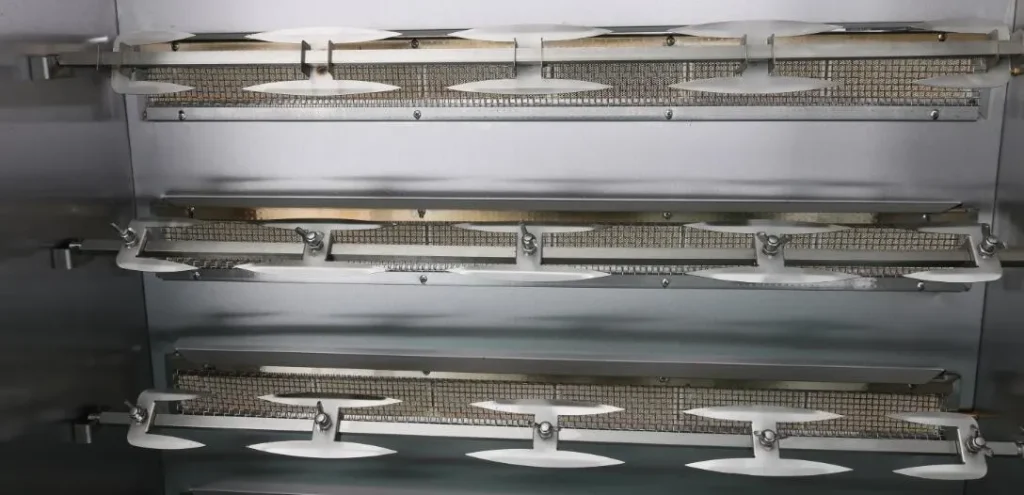
Different products require different mechanical support. A simple pointed spit can work efficiently for uniform whole chickens, but mixed menus may require additional forks, baskets, clamps, or specialty supports. A distributor supplying several restaurant concepts should therefore avoid assuming that one spit configuration will satisfy every end user.
For whole poultry, twin-prong or multi-prong forks can provide stable fixation and reduce unwanted movement during rotation. For smaller or irregular products, a basket can provide better containment and easier loading. When products vary significantly in size, an adjustable configuration can provide greater application flexibility than a fixed arrangement.
- Whole chicken: prioritize secure fork penetration and balanced weight distribution.
- Small poultry portions: consider basket-based loading to prevent product movement.
- Mixed meat products: consider interchangeable supports and adjustable fixing positions.
- High-volume standardized production: use repeatable spit dimensions to simplify operator training.
- Retail display applications: prioritize clean visual presentation and easy accessory removal.
For B2B purchasing, the Manufacturer should also provide dimensional information for each accessory: usable length, shaft diameter, fixing position, material specification, maximum recommended load, and compatibility with the selected rotisserie. This information allows the importer to create a reliable product family rather than selling isolated machines.
• Match electrical architecture to the operating site
Assess electrical environment before shipment
Electrical compatibility is one of the most important application variables in international catering equipment. A machine designed for one market may require a different heating element arrangement, motor specification, plug, cable, control system, or protection configuration for another market. The correct engineering process therefore starts with the destination site’s electrical environment rather than modifying the machine after arrival.
Typical commercial projects may involve 220–240 V single-phase, 220–240 V three-phase, or 380–415 V three-phase electrical environments, depending on the country, facility, and model. Frequency may also be 50 Hz or 60 Hz. These values influence motor behavior, heating performance, control components, and electrical protection.
- Confirm rated voltage and phase before production.
- Confirm 50 Hz or 60 Hz frequency requirements.
- Verify plug and socket standards for the destination market.
- Check available circuit capacity against the equipment’s rated power.
- Provide appropriate circuit protection and grounding according to local electrical requirements.
- Keep power cables away from direct heat and high-temperature external surfaces.
- Use high-temperature-rated electrical components and wiring where the application requires them.
A professional system topology can be understood as: incoming electrical supply → protection device → rotisserie control system → heating system and drive motor, with grounding and safety components integrated into the equipment architecture. In a larger kitchen, this topology should also be considered together with extraction, lighting, refrigeration, and other high-load appliances to avoid creating an overloaded circuit.
• Control heat, humidity, grease, and ventilation
Why environmental challenges change equipment selection
A rotisserie does not operate in a laboratory environment. Commercial kitchens frequently expose equipment to high ambient temperature, cooking grease, steam, humidity, airborne particles, repeated thermal cycling, and frequent cleaning. Coastal or tropical locations can introduce additional humidity and corrosion considerations, while high-volume roasting can create substantial heat and grease emissions.
Ventilation is therefore part of the application solution. The rotisserie should be positioned so that the exhaust path does not interfere with operator movement or draw excessive heat toward control components. Where local regulations require mechanical extraction, the equipment should be coordinated with the kitchen’s extraction system before installation.
- Maintain adequate clearance around ventilation and service areas according to the equipment installation manual.
- Prevent direct exposure of electrical control components to water during cleaning.
- Use appropriate grease collection and drainage procedures.
- Clean grease deposits frequently to reduce contamination and maintain thermal efficiency.
- Consider corrosion-resistant materials or finishes where the kitchen operates in high-humidity environments.
- Avoid positioning the rotisserie directly beside equipment that produces excessive steam or water spray.
For export projects, the Manufacturer can use different material combinations and surface treatments according to application requirements. This is particularly relevant for distributors serving humid coastal markets, high-volume restaurants, or hotel kitchens where equipment appearance and service life directly influence the end customer’s purchasing decision.
• Configure the rotisserie basket system for product flexibility
Rotisserie basket configuration
A rotisserie basket configuration can provide practical advantages when the menu includes products that cannot be easily secured with conventional forks. Wings, portions, vegetables, smaller poultry pieces, and irregularly shaped products can move during rotation if they are mounted directly on a conventional spit. A suitable basket can contain these products while maintaining rotational exposure to the heat source.
However, basket design should not be treated as an accessory afterthought. Basket depth, mesh opening, locking mechanism, handle position, material, weight, and cleaning access all affect usability. A basket that is too deep may reduce thermal exposure, while one that is too shallow may allow product displacement.
- Use mesh openings appropriate to the smallest product being cooked.
- Keep the basket loading weight within the recommended mechanical capacity.
- Balance the product distribution before starting rotation.
- Provide sufficient clearance between the basket and internal heating surfaces.
- Use removable designs where frequent washing is required.
- Maintain spare baskets when daily production requires uninterrupted operation.
For a wholesaler, interchangeable baskets can also broaden the commercial application of one machine platform. The same basic rotisserie can potentially support different menu concepts when the accessory architecture has been engineered for compatibility from the beginning.
• Build labor-efficient loading and unloading procedures
Design around human ergonomics
Equipment capacity is useful only when operators can safely use it at production speed. A rotisserie loaded with heavy hot spits can become physically demanding if the operator must reach too far, lift above shoulder height, or repeatedly twist while handling hot accessories. Human ergonomics should therefore be considered during kitchen layout and equipment specification.
The recommended workflow is to prepare product at a dedicated cold workstation, load accessories before they reach the hot cabinet, transfer the balanced assembly into the machine using the intended handles or support points, and remove cooked product through a defined unloading path. This reduces unnecessary movement and helps separate raw-product handling from cooked-product handling.
- Position preparation tables close enough to reduce unnecessary walking but far enough from heat sources.
- Keep frequently used forks and baskets within convenient operator reach.
- Provide heat-resistant gloves and suitable handling tools.
- Use consistent loading quantities to simplify training and quality control.
- Establish a fixed sequence for loading, cooking, unloading, cleaning, and accessory inspection.
- Train operators to check balance before activating the rotation system.
For large chains and central kitchens, standardizing this sequence can be more valuable than simply increasing machine capacity. Consistent procedures reduce variation between shifts and make it easier for the distributor’s customers to replicate the same operation across multiple locations.
• Develop an OEM and ODM configuration for distributors
Why OEM and ODM capability matters
Importers and distributors often require equipment that fits their own market positioning rather than an unchanged standard product. An experienced Manufacturer can support OEM projects involving branding, carton artwork, control-panel design, labels, accessories, and other agreed specifications. ODM projects can go further by adapting the equipment architecture or developing application-oriented configurations around the distributor’s market requirements.
For example, a distributor may require a consistent brand identity across several catering equipment categories. The rotisserie can then be coordinated with ovens, fryers, griddles, display equipment, and other machines through compatible control-panel styling, color schemes, logos, packaging, and documentation.
- Confirm logo position and application method.
- Confirm carton artwork and packaging requirements.
- Define control-panel language and labeling.
- Confirm voltage, frequency, plug, and cable requirements.
- Define accessory combinations for different customer segments.
- Prepare spare-parts lists for the distributor’s after-sales inventory.
- Establish product inspection criteria before mass production.
A capable OEM/ODM Supplier should also support production quality through documented inspection procedures. For international orders, full inspection before packing helps identify electrical, mechanical, appearance, accessory, and packaging issues before shipment. FLAMEMAX’s manufacturing setup includes advanced production equipment, multiple assembly lines, testing facilities, and product inspection procedures designed for international B2B supply.
• Engineer packaging, warehousing, and after-sales continuity
Protect the system beyond the factory
International transportation introduces another layer of application risk. Rotisserie machines contain metal assemblies, glass or transparent panels on some models, motors, electrical components, and multiple accessories. If packaging does not protect these parts against movement and impact, a correctly manufactured machine can still arrive with avoidable damage.
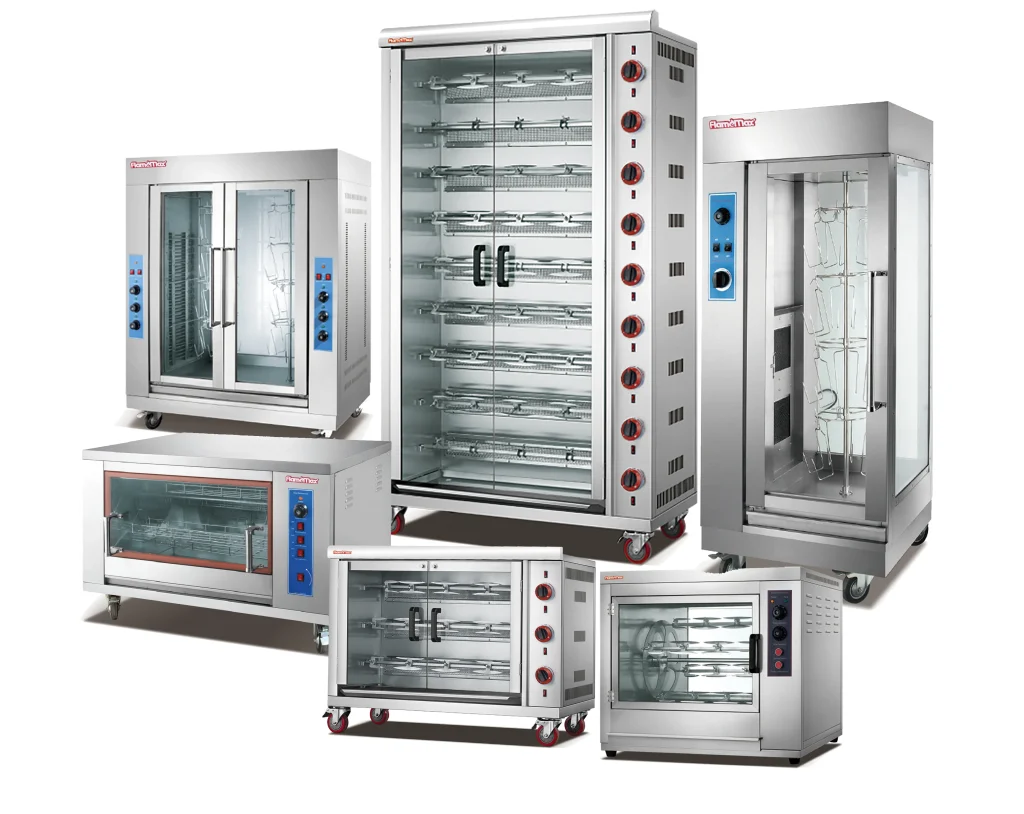
For export projects, the Supplier can evaluate the appropriate combination of thicker multi-layer cartons, plywood, wooden crates, internal cushioning, and accessory separation. The objective is to keep the main machine, removable components, and smaller chicken rotisserie accessories stable during handling and sea or land transportation.
- Separate heavy removable accessories from sensitive panels where appropriate.
- Protect exposed surfaces against scratching and impact.
- Secure internal moving components before shipment.
- Use packaging suitable for the expected logistics route.
- Label accessory packages clearly for easier warehouse receiving.
- Maintain spare-part identification for future service requirements.
- Provide technical support documentation for installation and operation.
For distributors operating multiple warehouses, organized accessory packaging also improves stock control. Spits, forks, baskets, trays, and replacement components can be assigned standardized part references so that service teams can identify the correct component without relying on visual guesses.
• Validate the complete application before mass purchasing
Use a technical specification checklist
Before an importer places a container-scale order, the application should be reviewed as a complete system. The machine’s nominal capacity is only one parameter. A technically suitable project also requires agreement on product dimensions, cooking target, loading method, electrical environment, ventilation, accessory selection, packaging, branding, and service requirements.
- Application: supermarket, hotel, restaurant, QSR, central kitchen, or distributor showroom.
- Product: whole chicken, portions, mixed meat, vegetables, or other rotating products.
- Capacity: target batch quantity and daily production volume.
- Electrical environment: voltage, phase, frequency, plug, and available circuit capacity.
- Environmental conditions: temperature, humidity, grease, steam, and cleaning method.
- System topology: equipment, electrical protection, ventilation, workflow, and service access.
- Accessories: spits, forks, baskets, grease trays, handles, and spare components.
- Customization: logo, color, control panel, carton design, and OEM/ODM requirements.
- Quality control: inspection, functional testing, packaging inspection, and pre-shipment confirmation.
This method allows the Manufacturer and buyer to discuss measurable requirements instead of relying on general descriptions such as “large capacity” or “heavy duty.” It also gives distributors a repeatable specification framework that can be applied when comparing different commercial rotisserie spit types across international suppliers.
• Apply a complete solution to real commercial scenarios
Consider a supermarket roasting counter that needs approximately 100–150 chickens during a busy operating period. The application may prioritize rapid loading, attractive product presentation, short recovery time between batches, and easy cleaning. A hotel buffet serving smaller scheduled quantities may instead require flexible basket and spit combinations, quieter operation, and presentation-oriented accessories. A central kitchen supplying multiple outlets may prioritize standardized batch sizes, repeatability, spare-part availability, and simplified operator training.
These scenarios demonstrate why the same machine specification cannot automatically be treated as the correct solution for every customer. A professional Supplier should translate the end user’s operating data into equipment configuration.
- For retail counters, prioritize visual presentation, fast turnover, and accessory accessibility.
- For hotels, prioritize flexible configurations and clean presentation during service periods.
- For QSR operations, prioritize repeatable loading, production speed, and easy maintenance.
- For central kitchens, prioritize throughput, standardized processes, and spare-part planning.
- For importers, prioritize OEM/ODM flexibility, packaging, documentation, quality inspection, and after-sales support.
With a 15,000 m² production workshop, advanced laser cutting, bending, welding and polishing equipment, multiple assembly lines, professional testing facilities, and 100% product inspection before packing, FLAMEMAX can support B2B customers who require a coordinated commercial catering equipment supply rather than a single standalone machine. Its product range can also cover bakery equipment, cooking equipment, grill equipment, display showcases, and snack equipment, allowing distributors to build broader equipment packages.
• Summarize the purchasing decision around application data
The correct rotisserie solution is determined by the relationship between product, capacity, accessories, electrical conditions, environment, ergonomics, ventilation, and service requirements. For importers, wholesalers, retailers, and distributors, a detailed application specification can reduce configuration errors and create a more reliable OEM or ODM supply program. FLAMEMAX welcomes inquiries covering capacity, market, electrical specifications, accessory needs, and customization requirements.
Which project should be developed next: supermarket roasting, hotel buffet, or central-kitchen production?


 English
  Español
  Français
  Italiano
  日本語
日本語  Deutsch
  Русский
  한국어
한국어  简体中文
简体中文