
Accessory Selection Challenges in Commercial Rotisserie Operations: Matching Spits, Baskets, and Loading Systems to Production Requirements
Commercial rotisserie operators often face inconsistent cooking results, overloaded spits, inefficient loading procedures, and excessive accessory replacement costs when equipment configurations do not match their production requirements. In high-volume supermarkets, hotel kitchens, restaurant chains, and centralized food preparation facilities, variations in bird size, product shape, and daily output can create significant operational challenges. Inadequate spacing may restrict heat circulation, while unsuitable forks or baskets can cause product movement during rotation. Meanwhile, demanding cleaning schedules and limited spare accessory stocks can interrupt production. Without a systematic approach to selecting commercial rotisserie spit types, rotisserie basket configuration, and chicken rotisserie accessories, operators may experience reduced throughput, inconsistent presentation, and higher maintenance expenses. A properly engineered accessory plan helps address these challenges before equipment installation and large-scale procurement.
For commercial rotisserie applications, a practical starting point is to select spit length and load capacity according to the equipment model, maintain approximately 20–40 mm of clearance between adjacent products where the chamber design permits, and match forks or baskets to the food dimensions. Electrical compatibility, ventilation, cleaning access, and rotation balance must also be verified. FLAMEMAX, an experienced commercial kitchen equipment Manufacturer, provides configuration guidance for different production environments.
For retailers, importers, wholesalers, and distributors, accessory selection should be treated as part of the complete equipment solution rather than an isolated purchasing decision. The following application scenarios explain how product dimensions, mechanical loading, labor requirements, and maintenance planning can be coordinated to improve operational consistency and support more reliable bulk procurement.
1. Match Accessories to Bird Size and Food Type
Configure Spits, Forks, and Baskets for Different Products
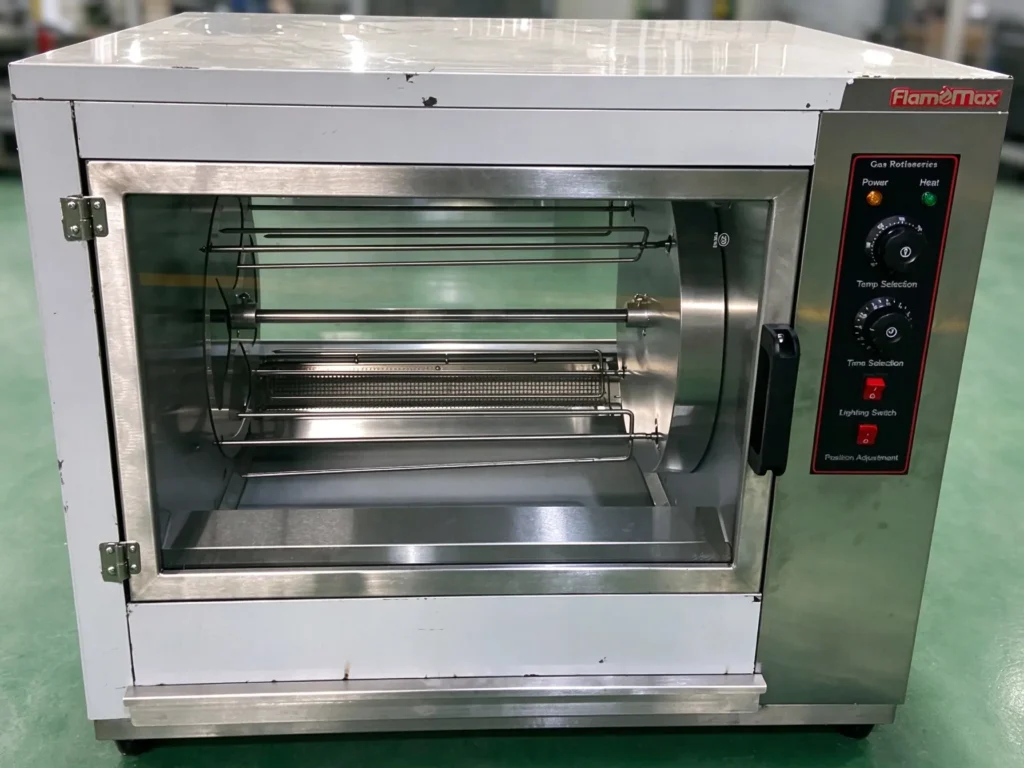
Product dimensions are the first consideration when specifying accessories for a commercial Rotisserie Oven. Whole chickens, duck, small poultry portions, kebabs, and irregularly shaped meat products require different support arrangements. A two-prong fork may provide adequate restraint for a compact, evenly shaped bird, while a four-prong fork may offer more stable contact for larger products. The appropriate choice depends on the bird’s dimensions, weight, cavity structure, and the manufacturer’s recommended loading method.
For supermarkets preparing several standardized batches each day, a uniform spit-and-fork combination can simplify training and improve loading consistency. Hotels and restaurants that prepare mixed menus may benefit from interchangeable spits, baskets, and dedicated forks. A basket can be useful for smaller portions, wings, vegetables, or products that cannot be secured reliably with conventional forks. However, basket dimensions and mesh openings must be compatible with the food being prepared.
Technical Selection Criteria
- Small poultry: Select appropriately sized retaining forks or compact baskets that limit product movement during rotation.
- Medium whole chickens: Match fork spacing to the bird’s body width and use symmetrical restraint to reduce movement.
- Large poultry or duck: Verify maximum permitted product weight, spit loading capacity, and clearance from adjacent products.
- Mixed food portions: Consider baskets or specialized supports designed for the intended food dimensions and cooking method.
- Material selection: Specify food-contact-compatible stainless steel suitable for the expected temperature, cleaning chemicals, and operating frequency.
For every application, the selected accessory must fit the equipment’s actual drive interface and support geometry. A component that physically enters the cooking chamber is not necessarily compatible with the drive coupling, support bearings, or retaining mechanism. A professional Manufacturer should therefore confirm model compatibility before accessories are ordered in bulk.
2. Calculate Usable Spacing and Balance
Determine Practical Loading Capacity
Nominal chamber dimensions do not represent the entire usable cooking area. Operators must account for the rotating envelope, spit length, fork projections, basket depth, door clearance, heating elements, and the movement of the product throughout the rotation cycle. Insufficient clearance can cause contact between adjacent birds or between the food and chamber surfaces. Excessive loading may also restrict heat circulation and create uneven browning.
For example, a supermarket rotisserie station preparing approximately 36 medium chickens per batch may require a different accessory arrangement from a hotel kitchen preparing 12 larger birds. The supermarket application prioritizes repeatable loading, fast turnaround, and consistent product spacing. The hotel application may prioritize larger product dimensions, presentation quality, and flexibility for different menus. Neither configuration should be selected from product count alone; the usable chamber geometry and rated load must also be checked.
Mechanical Balance and Spit Arrangement
Rotational balance is particularly important when a spit carries multiple products. Uneven distribution can increase mechanical stress, cause unstable rotation, and accelerate wear on drive components. Operators should distribute products symmetrically and remain within the equipment manufacturer’s rated loading limits. The motor’s rated capacity must not be interpreted as permission to exceed the permitted spit or chamber load.
- Measure the usable spit length after accounting for the coupling, end supports, and retaining components.
- Confirm product-to-product clearance throughout a complete rotation, not only when the spit is stationary.
- Use symmetrical loading and secure each product against movement during rotation.
- Verify the maximum permitted accessory load and total food weight against the equipment specification.
- Perform a controlled rotation test before production to identify interference, wobbling, or abnormal noise.
These checks help distributors prepare accurate product specifications and reduce installation problems for customers operating multiple rotisserie units.
3. Plan Loading Labor and Accessory Stock
Design the Accessory Mix Around Production Throughput
Accessory selection directly affects labor productivity. In a high-volume supermarket, staff may need to load, unload, clean, and prepare multiple batches within a short service window. Standardized fork assemblies and clearly identified baskets can reduce handling variation and make training easier. In a hotel kitchen, where production volumes fluctuate with occupancy and banquet schedules, a more varied accessory inventory may be necessary to accommodate different menu requirements.
Procurement teams should calculate accessory quantities using the number of active spits, the number of equipment units, the expected batch frequency, and the time required for washing and cooling. Maintaining only one set per machine can create bottlenecks if used accessories cannot be cleaned and returned before the next loading cycle. Conversely, excessive inventory increases purchasing costs and warehouse requirements.
Example of Accessory Inventory Planning
The following figures are illustrative planning assumptions, not universal equipment specifications. Actual quantities should be adjusted according to operating schedules and cleaning procedures.
| Application | Example Daily Output | Operating Priority | Suggested Stock Approach |
|---|---|---|---|
| Supermarket rotisserie counter | 120–240 chickens | Rapid batch turnover | One active set plus sufficient backup sets for the cleaning cycle |
| Hotel kitchen | 30–80 poultry portions | Menu flexibility | Standard spit sets plus selected baskets and specialized forks |
| Restaurant chain central kitchen | 200–500 chickens | Repeatable large-batch production | Standardized interchangeable accessories and planned replacement stock |
| Small independent restaurant | 20–60 chickens | Space and cost control | A core accessory set with limited backup components based on usage |
Use a Simple Stock Calculation
A practical inventory model starts with the number of accessories required for simultaneous production and adds enough replacement sets to cover cleaning, inspection, and unexpected damage. If four spits are operating simultaneously and each requires two retaining forks, the minimum active inventory is eight forks. Additional stock should reflect cleaning turnaround time, spare-part availability, and the consequences of a production interruption.
- Record the number of active spits, forks, baskets, and retaining components for each equipment model.
- Separate clean, ready-to-use accessories from items awaiting washing, inspection, or repair.
- Keep critical replacement parts available for high-throughput equipment.
- Use standardized part numbers and labels to simplify purchasing across multiple locations.
For importers and wholesalers, a coordinated accessory package can simplify warehouse management, improve product compatibility, and create a more complete equipment offering for commercial customers.
4. Specify Cleaning and Replacement Requirements
Design for Hygiene and Routine Maintenance
Rotisserie accessories are exposed to grease, food residues, repeated heating cycles, moisture, and cleaning chemicals. Their surface finish, joint design, and accessibility influence how easily staff can remove contamination. Accessories with complex joints or difficult-to-access retaining points may require additional manual cleaning. Where operationally appropriate, detachable forks, removable baskets, and simple mechanical connections can improve cleaning access and reduce handling complexity.
Food-contact materials must be suitable for the intended application, and the cleaning method should follow the equipment manufacturer’s instructions. Stainless steel grades, surface finishes, weld quality, and component construction should be assessed against the operating environment rather than selected by appearance alone. Strong cleaning chemicals, incompatible detergents, or inappropriate abrasive tools may damage surfaces or accelerate corrosion, depending on the material and exposure conditions.
Establish Replacement Criteria
Replacement should be based on condition and operating requirements rather than an arbitrary universal service life. Bent spits, cracked welds, loose retaining mechanisms, severe corrosion, damaged basket mesh, and worn drive interfaces may compromise safe operation or food handling. Staff should remove questionable components from service until they have been assessed.
- Inspect spits for straightness, deformation, and damage around the coupling interface.
- Check forks for secure attachment, intact prongs, and reliable product retention.
- Examine baskets for damaged mesh, failed joints, and sharp edges that could affect handling.
- Verify that accessories remain compatible with the original equipment model after replacement.
- Document inspection results and establish replacement intervals using actual operating conditions.
For distributors supplying multiple customers, keeping model-specific replacement parts and accessory records can reduce maintenance delays. A consistent spare-parts policy also helps customers maintain production continuity without replacing entire assemblies when only an approved component requires renewal.
5. Adapt the Equipment Configuration to the Electrical and Operating Environment
Verify Power Supply and Control Compatibility
Accessory selection is primarily a mechanical decision, but the complete rotisserie installation must also match the site’s electrical environment. Commercial kitchens may operate with different supply voltages, frequencies, phase arrangements, protective devices, and earthing systems. Motorized rotation systems and electronically controlled ovens must be specified according to the exact equipment model and the electrical conditions at the installation site.
For international procurement, a configuration suitable for one market should not automatically be assumed compatible with another. Importers should verify the rated voltage, frequency, phase, connected load, plug or terminal arrangement, and applicable local electrical requirements before confirming an order. The electrical specification of the oven must also remain consistent with the drive motor and any associated control equipment.
Account for Heat, Grease, and Ventilation
Commercial kitchens commonly present high ambient temperatures, grease accumulation, moisture exposure, and demanding cleaning conditions. These challenges can affect electrical enclosures, connectors, wiring, ventilation paths, and mechanical components. The installation must provide the clearances, exhaust arrangements, and environmental protection specified by the equipment manufacturer.
- Confirm site supply voltage and frequency against the equipment nameplate.
- Verify phase requirements and protective earthing before commissioning.
- Check that electrical components and wiring are rated for their specified operating temperatures.
- Maintain the required ventilation, exhaust clearance, and access for maintenance.
- Keep electrical connections protected from grease, water, and cleaning chemicals according to the equipment design.
- Require qualified personnel to inspect and commission the electrical installation in accordance with applicable local regulations.
These checks are especially important for international distributors managing installations across several markets. A technically suitable accessory package cannot compensate for an incorrectly specified power supply or an unsuitable installation environment.
6. Select the Right System Topology for Different Commercial Applications
Single-Unit, Multi-Unit, and Centralized Production
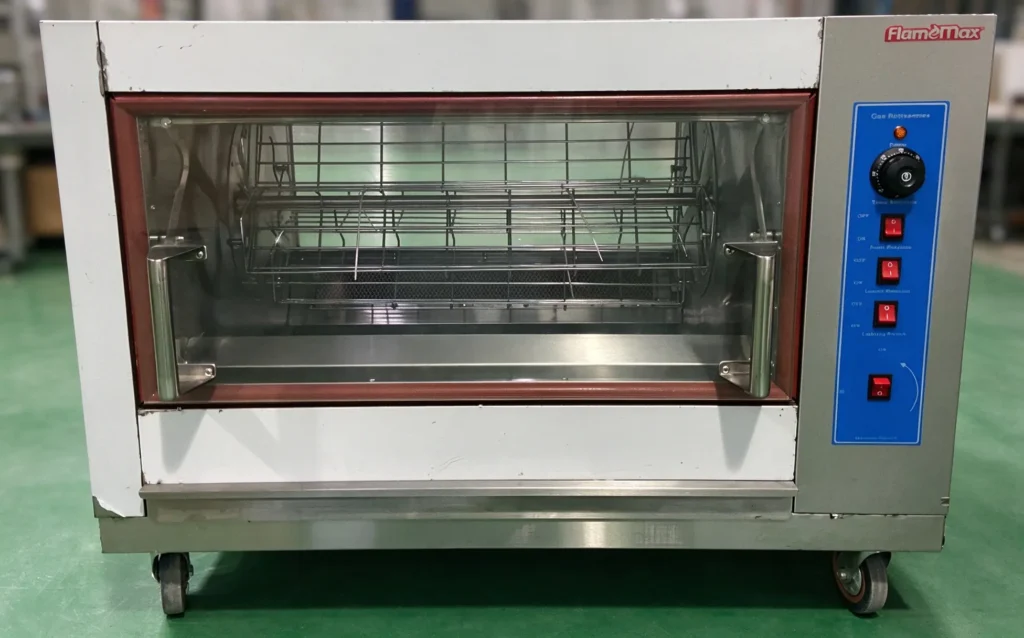
The system topology describes how rotisserie equipment, loading stations, cleaning processes, and supporting kitchen operations are organized. A single-unit restaurant installation generally requires a compact workflow, a limited accessory inventory, and straightforward manual handling. A supermarket with several ovens may require standardized accessory dimensions, designated loading areas, and coordinated cleaning schedules. A centralized production facility may need repeatable batch configurations, documented inspection procedures, and a larger inventory of interchangeable components.
In a single-unit configuration, the priority is to keep the required accessories accessible while minimizing unnecessary stock. For a multi-unit installation, standardization becomes more valuable because it simplifies staff training, spare-parts procurement, and routine maintenance. Centralized kitchens may benefit from accessory identification by equipment model, batch type, and intended product dimensions. However, components should only be shared between units when their dimensions, load ratings, drive interfaces, and manufacturer specifications are confirmed to match.
Application-Based Configuration Checklist
- Restaurant: Prioritize easy handling, compact storage, and a core set of compatible accessories.
- Hotel: Provide flexibility for varying product sizes, banquet volumes, and menu requirements.
- Supermarket: Focus on standardized loading, predictable batch throughput, and rapid cleaning turnaround.
- Central production kitchen: Emphasize repeatability, documented loading limits, spare-part availability, and coordinated maintenance.
- Multi-location distributor: Standardize model identification, accessory specifications, packaging, and replacement-part ordering where technically appropriate.
For large purchasing programs, the equipment and accessory schedule should be confirmed before production and shipment. This reduces the risk of receiving visually similar but mechanically incompatible components and makes future replenishment easier to manage.
7. Build a Complete Accessory Specification for Bulk Procurement
Prepare a Repeatable Technical Ordering Process
Professional purchasing requires more than identifying the number of spits or baskets. Buyers should provide the oven model, intended food type, typical product weight, target batch quantity, operating frequency, and any special cleaning requirements. Drawings, photographs, dimensions, or an existing accessory sample can help clarify interfaces and reduce ambiguity during specification review.
For OEM and private-label projects, importers should also confirm the required branding, packaging configuration, labeling, and spare-parts identification. A coordinated specification allows the Manufacturer to assess whether the proposed accessory combination matches the equipment’s mechanical design and intended operating conditions. It also supports consistent procurement across future orders.
Recommended Procurement Information
- Equipment model, chamber dimensions, and compatible drive interface.
- Required commercial rotisserie spit types and quantities per machine.
- Fork dimensions, prong arrangement, retaining method, and supported product range.
- Basket configuration, mesh design, usable dimensions, and intended food applications.
- Material requirements, surface finish, cleaning method, and inspection criteria.
- Electrical supply requirements for the complete oven installation, including voltage, frequency, and phase.
- Required chicken rotisserie accessories, spare-part quantities, and replenishment schedule.
- OEM logo, carton design, export packaging, and shipment coordination requirements.
FLAMEMAX supplies commercial catering equipment for international B2B customers and can assist with reviewing equipment configurations and accessory requirements. Final selections should be confirmed against the relevant product drawings, rated capacities, installation conditions, and approved specifications before bulk production.
Conclusion
A well-planned rotisserie accessory configuration improves loading consistency, operational efficiency, maintenance planning, and procurement accuracy. FLAMEMAX supports importers, wholesalers, and distributors with commercial equipment configuration and OEM requirements. For model-specific recommendations on spits, baskets, forks, and replacement accessories, contact [email protected] or visit www.flamemax.com to discuss project specifications.



 English
 Español
 Français
 Italiano
 日本語
 Deutsch
 Русский
 한국어
 简体中文