
How Can You Choose the Right Rotisserie Oven Capacity Without Losing Production Efficiency?
Many restaurant owners and foodservice distributors face the same challenge: the oven looks large enough, but actual output cannot meet peak orders. The problem is often caused by incorrect capacity calculation, poor chicken spacing design, slow heat recovery, or difficult loading operations. A wrong decision can lead to uneven roasting, longer waiting times, higher energy costs, and customer complaints. Choosing the correct commercial rotisserie oven capacity requires more than checking the number of spits. It requires a technical evaluation based on chicken size, batch cycle, production demand, and operator workflow.
Our company recommends selecting rotisserie oven capacity based on chicken weight, loading spacing, hourly output, heat recovery performance, and kitchen workflow requirements. With over 20 years of manufacturing experience, we help customers choose the ideal commercial rotisserie oven solution.
This guide explains the key engineering factors behind professional rotisserie oven selection. We will analyze capacity calculation methods, heating performance, operator safety, and practical production requirements to help you make a reliable investment decision.
Technical Guidelines for Selecting Rotisserie Oven Capacity
A professional capacity evaluation should follow several important technical standards. The correct oven size is determined not only by how many chickens fit inside, but also by how efficiently the machine can maintain roasting quality during continuous operation.
Chicken Size and Spacing
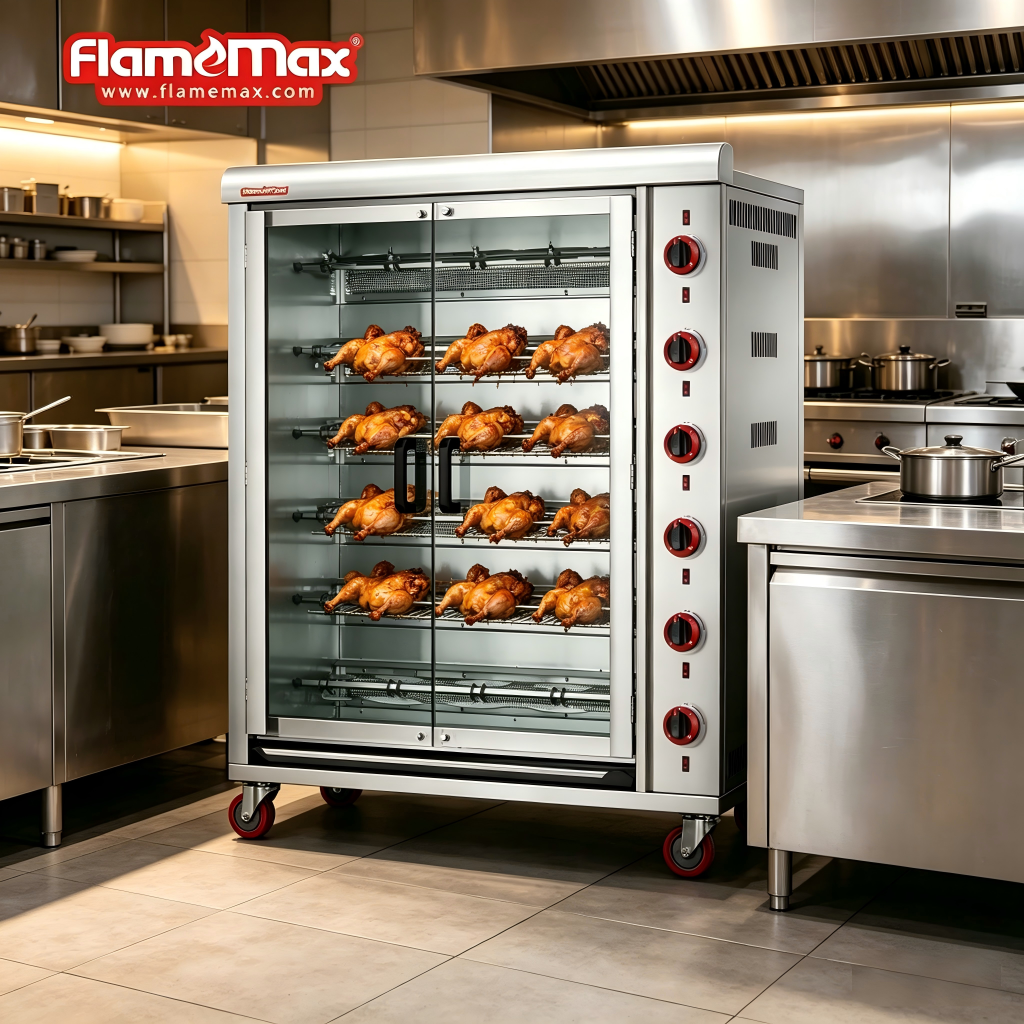
The first factor affecting rotisserie oven capacity is the actual chicken size. Many buyers calculate capacity using a maximum loading number, but this method can create problems when chicken weight changes. A 1.0 kg chicken and a 1.8 kg chicken require completely different internal spacing conditions.
The roasting chamber must maintain sufficient distance between each chicken to ensure proper hot air circulation and consistent heat penetration. Overloading the spit system may reduce airflow, increase cooking time, and create uneven skin color.
Professional manufacturers usually evaluate capacity according to:
- Chicken weight range: normally from 1.0 kg to 2.5 kg per bird depending on the market.
- Spit loading distance: adequate spacing is required to avoid contact between products.
- Cooking chamber volume: larger volume does not always mean higher efficiency.
- Rotating speed control: stable rotation improves roasting uniformity.
For example, a compact model may handle smaller chickens efficiently, while a large supermarket production line requires more spacing allowance for heavier birds.
| Chicken Weight | Recommended Spacing | Typical Application |
|---|---|---|
| 1.0-1.3 kg | 80-100 mm between products | Small restaurants and takeaway shops |
| 1.5-2.5 kg | 120-150 mm between products | Supermarkets and high-volume kitchens |
Batch Time and Recovery
Cooking capacity should always be measured together with batch time. A rotisserie oven that holds many chickens but requires a long recovery period may deliver lower real production output.
The key technical indicators include cooking cycle time, temperature recovery speed, and heating power stability. When the door opens during loading or unloading, the internal temperature drops. A high-performance oven must quickly restore the target temperature to maintain consistent results.
Both gas rotisserie oven and electric rotisserie oven designs have different recovery characteristics. Gas models usually provide strong heating power and fast temperature response, making them suitable for continuous commercial production. Electric models offer precise temperature control and stable operation, which can be advantageous in locations with strict ventilation requirements.
| Heating Type | Typical Power Range | Main Technical Advantage |
|---|---|---|
| Gas Rotisserie Oven | 15-40 kW | Fast heating recovery and high-volume production |
| Electric Rotisserie Oven | 8-30 kW | Accurate temperature control and easy installation |
When selecting equipment, buyers should calculate the complete production cycle:
- Loading preparation time.
- Preheating time.
- Cooking duration.
- Unloading and cleaning time.
- Recovery time before the next batch.
This calculation provides a more realistic hourly output than simply counting chicken positions.
Peak Demand Buffer
A common purchasing mistake is selecting an oven based only on average daily sales. Commercial kitchens rarely operate at average demand throughout the day. Lunch hours, dinner periods, holidays, and promotional events often create sudden production peaks.
A professional capacity plan should include a peak demand buffer. This means the oven should have additional capacity to handle temporary increases without affecting food quality or delivery speed.
For example, if a restaurant normally sells 80 chickens per hour but weekend demand reaches 110 chickens per hour, selecting equipment based only on 80 chickens creates unnecessary operational pressure.
Recommended evaluation factors include:
- Daily sales forecast
- Maximum hourly demand
- Future business expansion plan
- Kitchen space limitation
- Labor availability
A correctly sized commercial rotisserie oven should provide enough reserve capacity while avoiding unnecessary energy consumption from an oversized chamber.
Loading Ergonomics
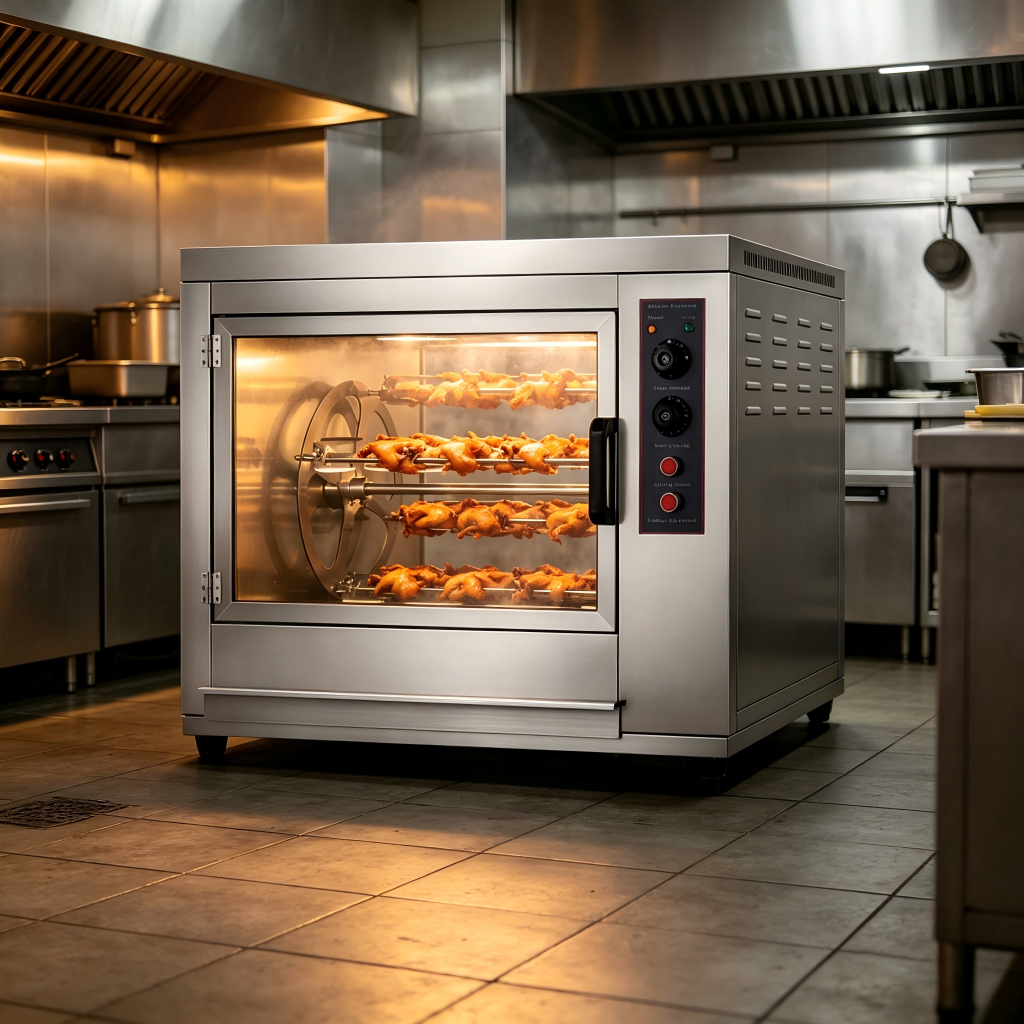
Capacity is also directly related to operator efficiency. A technically large oven may reduce productivity if employees cannot load and unload products safely and quickly.
Good ergonomic design includes comfortable loading height, easy-access doors, stable spit handling systems, and simple cleaning procedures. These details influence daily operation more than many buyers expect.
Operators usually repeat the same actions hundreds of times each week. Poor design can increase labor fatigue and create safety risks. A professional rotisserie oven should allow workers to complete loading tasks with minimal movement and without excessive lifting force.
Important ergonomic features include:
- Front-opening glass door for clear product monitoring.
- Removable spits for faster cleaning and maintenance.
- Balanced rotating mechanism to reduce operator effort.
- Accessible control panel for quick temperature adjustment.
How Professional Manufacturers Evaluate Capacity Requirements
Experienced manufacturers do not recommend equipment only by model size. They analyze the customer’s complete operation, including menu type, production schedule, available energy supply, and local market requirements.
Our engineering team evaluates:
- Expected chickens per batch
- Required chickens per hour
- Kitchen installation conditions
- Energy efficiency targets
- Cleaning and maintenance requirements
This approach helps customers avoid two expensive mistakes: buying an undersized oven that cannot support growth, or purchasing an oversized machine that wastes energy and space.
Conclusion: Select Capacity Based on Real Production Needs
The best rotisserie oven capacity depends on chicken size, batch speed, peak demand, and operator efficiency. Contact our technical team today for a customized commercial rotisserie oven solution designed for your market.



 English
  Español
  Français
  Italiano
  日本語
日本語  Deutsch
  Русский
  한국어
한국어  简体中文
简体中文