
Why Does My Conveyor Pizza Oven Produce Uneven Pizza?
When a production line delivers pizzas with burnt edges, pale centers, inconsistent crust texture, or different bake times, the problem is rarely just the oven. It usually starts with poor control of belt speed, chamber temperature, airflow, heat transfer, and product loading. For a restaurant chain, central kitchen, or food manufacturer, these variations quickly become waste, customer complaints, and higher labor costs. The real question is not simply how does a conveyor pizza oven work, but whether its thermal system can deliver the same result every cycle. A properly engineered conveyor pizza oven must balance temperature, residence time, airflow, and belt loading. Buyers also need to evaluate construction, controls, cleaning access, energy efficiency, and after-sales support before choosing a Manufacturer or Supplier.
Our company recommends selecting a conveyor pizza oven based on four core factors: controlled belt speed, stable chamber temperature, optimized heat transfer, and repeatable airflow. As an experienced pizza oven Manufacturer and Supplier, our company can provide Customizable, OEM, and ODM solutions according to product size, throughput, recipe, and production-line requirements.
To understand what makes a reliable pizza conveyor oven, we need to look inside the baking process. The following sections explain the main engineering variables, practical operating ranges, and purchasing checkpoints that determine whether an oven performs consistently in commercial production.
How Does a Conveyor Pizza Oven Work? Core Engineering Principles
Belt Speed and Chamber Temperature
The basic operating principle of a conveyor pizza oven is straightforward: the product enters the heated chamber, travels continuously on a conveyor belt, receives controlled thermal energy, and exits after a defined residence time. The engineering challenge is maintaining the correct relationship between belt speed and chamber temperature.
A faster belt reduces residence time. The oven must therefore deliver more effective heat transfer within a shorter period. A slower belt increases residence time but may cause excessive browning, moisture loss, or topping damage if temperature and airflow are not adjusted accordingly.
| Operating Variable | Typical Commercial Range | Primary Effect |
|---|---|---|
| Conveyor speed | Approximately 2–12 m/min | Controls residence time and throughput |
| Chamber temperature | Approximately 200–350°C | Controls baking intensity and crust development |
| Residence time | Approximately 3–15 min | Determines total thermal exposure |
These figures are engineering reference ranges, not universal recipe settings. A thin-crust pizza and a thick, heavily topped pizza can require very different conditions. A professional Supplier should therefore validate the oven against the buyer’s actual dough thickness, topping load, target output, and finished-product specifications.
Air Impingement or Convection
Heat transfer is another major difference between conveyor oven designs. Traditional convection systems circulate hot air around the product. Air impingement systems use higher-velocity air jets directed toward the food surface. The stronger airflow can increase the convective heat-transfer coefficient and reduce baking time.
For pizza production, airflow must be controlled carefully. Excessive velocity may disturb lightweight toppings or dry the surface too quickly. Insufficient airflow can create cold spots, uneven browning, and inconsistent crust formation.
A well-designed oven normally divides the chamber into controlled heating zones. Each zone can have independent temperature and airflow management. This allows the process to be tuned according to the product stage.
- Entry zone: stabilizes the product and begins surface heating.
- Middle zone: provides the main baking energy and promotes crust development.
- Finishing zone: controls final browning, cheese melt, and surface color.
Buyers should ask the Manufacturer for actual airflow data, temperature mapping, and test-bake results rather than relying only on a rated chamber temperature. A displayed temperature of 300°C does not guarantee that the pizza surface receives uniform thermal energy.
Repeatability and Operator Training
Commercial baking equipment is valuable only when different operators can achieve the same result. Repeatability should therefore be treated as a core purchasing criterion, not an optional feature.
Modern conveyor ovens typically use digital controllers, programmable recipes, variable-speed drives, and temperature sensors. These systems reduce manual adjustment and make production parameters easier to reproduce.
A practical recipe may define:
- Set temperature for each heating zone.
- Conveyor speed or target residence time.
- Fan or impingement-air settings.
- Top and bottom heat balance.
- Product loading pattern.
Operator training remains important. Even a highly automated pizza conveyor oven can produce inconsistent results if operators overload the belt, place products too close together, change recipes without updating settings, or fail to clean airflow openings.
A good OEM project should include clear operating procedures, recipe documentation, cleaning instructions, and basic troubleshooting guidance. This reduces dependence on individual operator experience and supports consistent production across multiple locations.
Menu Changeover
Restaurants and food manufacturers rarely produce only one pizza specification. Different dough weights, diameters, topping combinations, and crust styles can require different thermal profiles. Menu changeover therefore has a direct effect on production efficiency.
A useful conveyor system should allow operators to adjust key parameters quickly without lengthy mechanical intervention. Recipe memory, variable-speed control, independent heating zones, and accessible cleaning points can significantly reduce changeover time.
For example, a thin-crust product may require a shorter residence time and stronger surface heat, while a thicker product may require longer exposure with a carefully controlled temperature profile. The goal is not simply to increase temperature. The goal is to match heat input, residence time, moisture removal, and surface browning.
When comparing equipment, buyers should test at least two or three representative products. Record changeover time, energy consumption, finished-product consistency, and operator actions. This provides a more useful comparison than evaluating the oven from an empty-chamber demonstration.
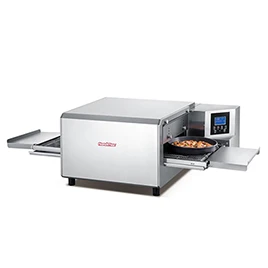
Conveyor Pizza Oven Heat Transfer: What Buyers Should Measure
Temperature Uniformity
Temperature stability inside the chamber is more important than the maximum temperature printed on the specification sheet. A high-quality system should minimize temperature variation across the effective baking width and maintain stable conditions during continuous loading.
Buyers should request temperature mapping or commissioning data where appropriate. Multiple thermocouple points can identify hot zones and cold zones. This is especially important for wide conveyor ovens, where edge-to-center variation can become significant.
The following comparison illustrates why system design matters:
| Feature | Basic Conveyor Oven | Production-Grade System |
|---|---|---|
| Heating control | Single-zone control | Multi-zone independent control |
| Air management | General circulation | Controlled convection/impingement |
| Speed adjustment | Limited manual adjustment | Variable-speed drive |
| Recipe control | Manual settings | Programmable recipes |
| Process validation | Basic visual inspection | Temperature and bake testing |
Top Heat, Bottom Heat, and Crust Development
Pizza quality depends on more than air temperature. The product receives energy through convection, radiation, and conduction. The conveyor belt also affects bottom heat transfer and crust formation.
Different belt materials produce different thermal behavior. A metal belt can transfer heat rapidly to the dough base, while other conveyor constructions may provide different release, airflow, and cleaning characteristics. The correct selection depends on the product and process.
For buyers, the key question is whether the entire thermal system has been engineered around the pizza recipe. A machine with a powerful burner or heating element is not automatically a better oven. Controlled heat transfer is more important than headline heating power.
Energy Efficiency and Production Throughput
Energy cost becomes significant when an oven operates for many hours per day. Buyers should evaluate thermal efficiency, insulation quality, heat recovery, standby performance, and actual energy consumption under production load.
Throughput should also be calculated from the real production condition rather than the empty-belt specification. A useful calculation considers:
- Pizza diameter and spacing
- Number of rows across the belt
- Conveyor speed
- Average baking time
- Actual loading efficiency
For example, increasing conveyor speed may appear to increase capacity, but if the pizza cannot receive sufficient heat during the shorter residence time, product rejection may increase. The best design balances throughput, bake quality, energy consumption, and process stability.
Food Safety, Cleaning, and Maintenance
A commercial conveyor pizza oven should be designed for practical sanitation and routine maintenance. Grease, cheese, flour, and topping particles can accumulate around the conveyor, air passages, and chamber surfaces. If airflow openings become restricted, heat-transfer performance can change.
Important purchasing checkpoints include:
- Removable or accessible conveyor components
- Easy-access inspection points
- Cleanable airflow channels
- Food-contact materials appropriate for the application
- Electrical and thermal safety protection
- Emergency stop and over-temperature protection
Depending on the target market, the equipment may also need to satisfy applicable electrical, gas, machinery, food-contact, or sanitation requirements. Buyers should identify the destination-country requirements before finalizing an OEM or ODM specification.
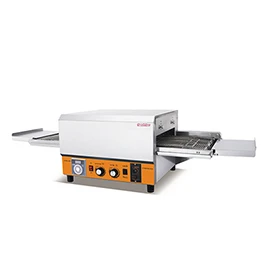
How to Choose the Right Conveyor Pizza Oven Manufacturer
Choosing a Manufacturer is not simply about comparing oven dimensions and quoted prices. The supplier should understand the complete baking process and be able to translate the recipe into measurable engineering parameters.
Before placing an order, ask for:
- Test-baking using your actual pizza recipe.
- Recommended temperature and belt-speed ranges.
- Heating-zone and airflow configuration.
- Electrical or gas consumption data.
- Cleaning and preventive-maintenance procedures.
- Spare-parts availability and technical support.
- Customization capability for belt width, voltage, controls, and production capacity.
A capable Supplier should also explain why a particular specification is recommended. If the supplier cannot connect chamber temperature, belt speed, airflow, and product results, the buyer may be purchasing hardware rather than a validated production solution.
Customizable, OEM, and ODM Requirements
For international buyers, standard equipment is not always sufficient. Voltage, frequency, conveyor width, chamber length, heating method, control language, safety configuration, and installation conditions can vary by market.
A technically experienced OEM/ODM partner can modify these elements while maintaining the underlying thermal design. Customizable options may include multi-zone heating, special conveyor configurations, recipe controls, exhaust arrangements, and integration with upstream or downstream equipment.
The important point is to customize based on measurable production requirements, not cosmetic preferences. Every modification should be evaluated for its impact on heat transfer, airflow, energy consumption, maintenance, and production consistency.
Final Takeaway: What Makes a Good Pizza Conveyor Oven?
A reliable pizza conveyor oven is a controlled thermal process, not simply a heated conveyor. Evaluate temperature uniformity, belt speed, airflow, repeatability, cleaning, energy use, and technical support. Contact our company for test baking and a Customizable OEM/ODM solution matched to your production requirements.


 English
  Español
  Français
  Italiano
  日本語
日本語  Deutsch
  Русский
  한국어
한국어  简体中文
简体中文