
When a Gas Convection Oven with Touch Screen Creates Supply Chain Risk
For importers, hotel-supply distributors, and commercial kitchen wholesalers, a gas convection oven with touch screen can become a supply chain problem when the product looks competitive but the Manufacturer lacks process control. A delayed shipment, unstable gas system, incompatible electrical components, or incomplete export documentation can quickly turn a profitable order into a cost overrun. The risk becomes greater when buyers depend on an unknown Supplier for OEM or ODM production without verifying factory capability. Poor temperature consistency may also create quality claims, while weak after-sales support can damage the distributor’s reputation. Therefore, procurement should evaluate not only the oven itself, but also quality control, production capacity, compliance documentation, spare-parts availability, packaging, and long-term service capability before placing a commercial order.
A qualified gas convection oven Supplier should combine stable manufacturing capacity, verified quality control, appropriate compliance documentation, reliable touchscreen controls, export experience, OEM/ODM capability, and responsive after-sales service. Foshan Nanhai Flamemax Catering Equipment Co., Ltd. provides these capabilities through a 15,000 m² factory, structured inspection procedures, customization services, and international support.
For procurement managers and engineering wholesalers, the real sourcing decision goes beyond price. The following sections reveal the practical supply-chain checkpoints, technical details, and commercial safeguards experienced buyers should examine before committing to a long-term gas convection oven program.
1. Industry Trend & Market Access for the Middle East, Africa and South America
Demand for commercial baking and foodservice equipment continues to create opportunities for importers across the Middle East, Africa, and South America. However, market access is rarely determined by product price alone. A gas convection oven with touch screen must be matched with local gas requirements, electrical specifications, installation conditions, documentation, and customer expectations.
For an overseas distributor, the first step is to identify the destination-market requirements before production. Depending on the country and product configuration, buyers may need to review requirements related to CE marking, electrical safety, gas safety, EMC, labeling, customs documentation, or locally applicable conformity procedures. Certification requirements should always be confirmed for the exact destination, model, and configuration rather than assumed from another market.
| Market Area | Key Procurement Considerations | Typical Commercial Focus |
|---|---|---|
| Middle East | Gas type, voltage, heat management, documentation, installation environment | Durability, appearance, customization, hotel and bakery applications |
| Africa | Price positioning, spare parts, voltage stability, packaging, bulk supply | Cost efficiency, reliability, fast replenishment |
| South America | Local technical requirements, gas compatibility, language labeling, customs documents | OEM branding, distributor support, product differentiation |
A professional Supplier should therefore support the buyer with specification confirmation before mass production. FLAMEMAX serves international markets including Africa and South America and can provide Customizable configurations for different distribution strategies. For importers seeking OEM or ODM programs, early communication about destination-market requirements can significantly reduce compliance risk and avoid costly modifications after production.
2. Key Technical Specifications for Touchscreen Gas Convection Ovens
A touchscreen interface is only one component of a commercial gas convection oven. Procurement teams should evaluate the complete thermal, mechanical, electrical, and control system. A professional Manufacturer should clearly define the oven’s capacity, tray dimensions, temperature range, heating method, gas consumption, power requirements, fan configuration, insulation, control system, and safety components.
The touchscreen should provide practical operating functions rather than simply improving appearance. Depending on the model, useful functions can include temperature setting, timer control, cooking programs, parameter adjustment, and status monitoring. Buyers should ask whether the interface is intuitive for operators, whether parameters can be protected from accidental changes, and whether replacement control components are available through the Supplier.
| Specification Area | What Buyers Should Verify | Supply-Chain Risk if Ignored |
|---|---|---|
| Heating System | Gas type, burner configuration, ignition and safety system | Installation failure or performance complaints |
| Temperature Control | Setpoint range, stability, sensor configuration | Product inconsistency |
| Touchscreen | Interface functions, programming, component availability | After-sales downtime |
| Electrical System | Voltage, frequency, wiring, protective components | Electrical compatibility risk |
| Construction | Stainless-steel grade, insulation, door and chamber structure | Durability claims |
| Packaging | Carton, plywood or wooden-crate protection | Transit damage |
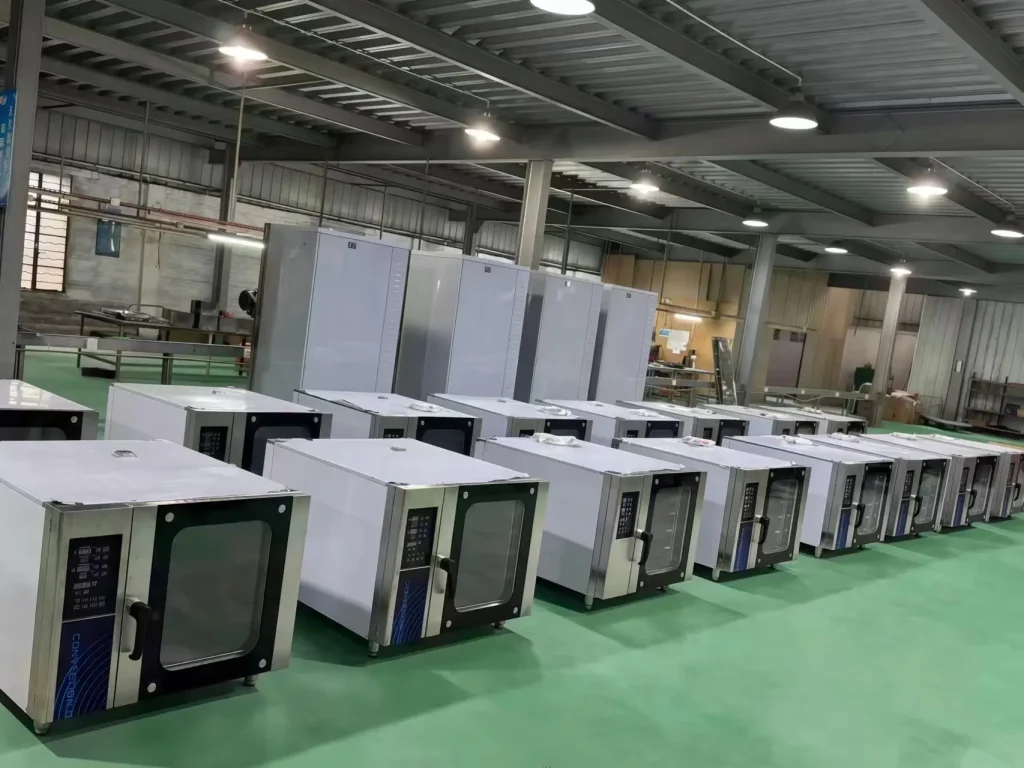
For commercial procurement, the buyer should also request a complete technical specification sheet and confirm that the final production model matches the approved specification. FLAMEMAX uses advanced laser cutting, bending, welding, and polishing equipment and conducts 100% product inspection before packing. This process is particularly relevant for distributors selling under their own brands, because consistent construction and appearance directly affect their downstream reputation.
3. Cross-Border Procurement Pain Points & Risk Prevention
International procurement introduces risks that cannot be identified from a product photograph or quotation. One common problem is specification ambiguity: the buyer may compare two gas convection ovens with similar external dimensions while their burners, controls, insulation, electrical systems, accessories, or production standards are substantially different.
Another issue is supplier dependency. A trading company may offer a low initial price but lack its own production controls, making it difficult to guarantee consistency during repeat orders. Buyers should investigate the actual Manufacturer, factory scale, production equipment, testing procedures, inspection system, and engineering capability.
A practical risk-prevention process should include:
- Confirm the exact technical specification and destination-market requirements.
- Verify the Manufacturer and production location.
- Review available certificates and compliance documents applicable to the target market.
- Approve samples, packaging, labels, manuals, and control-panel details.
- Define quality inspection criteria before mass production.
- Confirm payment terms, lead time, shipping documents, and responsibilities in writing.
- Establish a spare-parts and after-sales procedure before shipment.
Buyers should also consider commercial risk rather than focusing exclusively on unit price. A slightly cheaper oven can become more expensive if it causes high return rates, missing components, delayed spare parts, or inconsistent repeat orders. FLAMEMAX supports OEM and ODM cooperation with customizable logos, carton designs, control-panel designs, and color options, allowing distributors to establish clearer product specifications before production begins.
4. Trial Order Strategy for Overseas Distributors
For an importer entering a new supply relationship, a trial order is an important supplier qualification stage rather than simply a small purchase. It allows the distributor to evaluate product quality, packaging, documentation, communication, delivery performance, and after-sales responsiveness before committing to larger volumes.
A structured trial order can begin with a limited quantity representing the distributor’s intended commercial application. The buyer should use the trial period to verify actual cooking performance, touchscreen operation, gas compatibility, temperature stability, packaging protection, installation instructions, and spare-parts accessibility.
The trial-order process can be organized into five steps:
- Specification approval: Confirm model, configuration, voltage, gas type, accessories, branding, and packaging.
- Sample verification: Inspect the finished unit against the approved specifications.
- Production inspection: Confirm that mass-produced units maintain the approved quality standard.
- Market testing: Collect feedback from end users, chefs, installers, and sales teams.
- Supplier review: Evaluate quality, communication, delivery, documentation, and service before scaling volume.
This approach is particularly useful for distributors pursuing OEM or ODM business. Instead of immediately placing a large order based on a quotation, the buyer creates measurable criteria for evaluating the Supplier. FLAMEMAX can provide Customizable solutions for branding and product presentation, while its inspection and production infrastructure supports the transition from trial orders to repeat commercial supply.
5. Long-Term Supply Chain Cooperation & Service Support
A successful commercial kitchen equipment program requires more than a factory that can manufacture the first shipment. For distributors, the long-term value of a Manufacturer is determined by its ability to maintain product consistency, communicate efficiently, supply replacement components, support technical issues, and coordinate repeat orders.
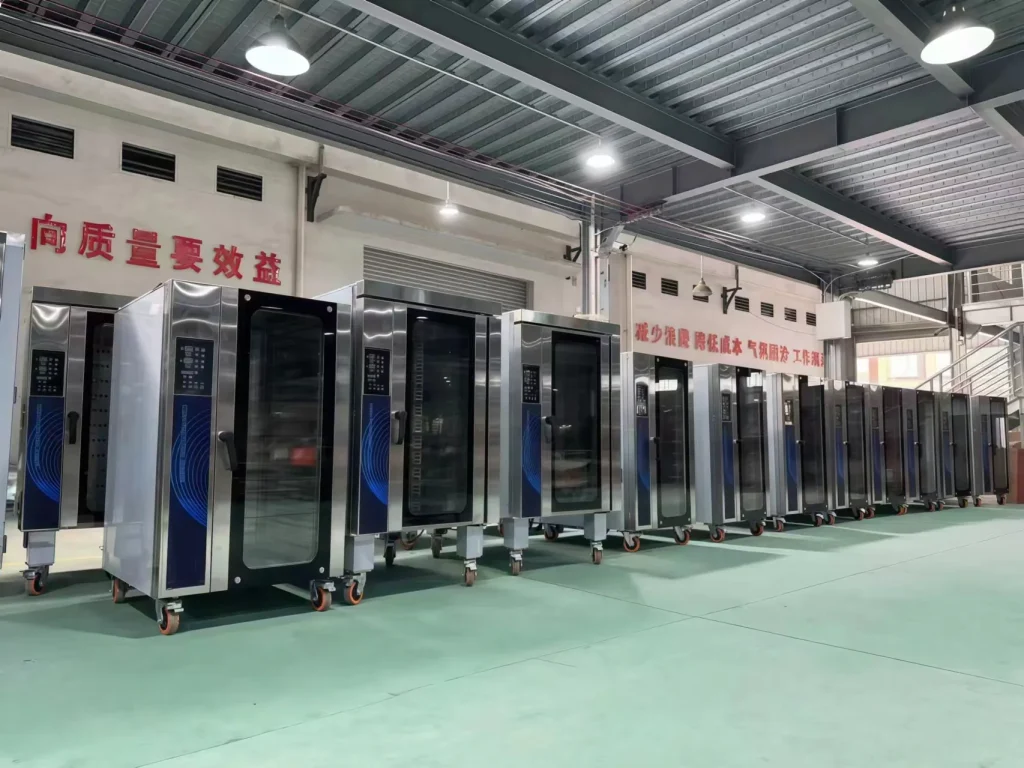
FLAMEMAX operates a 15,000 m² production workshop with more than 50 sets of advanced production facilities, more than 10 semi-automatic assembly production lines, professional testing facilities, a multifunctional warehouse system, and an international service team. Its production process includes 100% inspection before packing, while packaging can be adapted with thicker cartons, plywood, or wooden-crate solutions according to transportation requirements.
For overseas distributors, service support should be incorporated into the purchasing agreement rather than discussed only after a problem occurs. A practical long-term framework should define:
- Spare-parts availability and recommended stock levels.
- Technical support for installation and troubleshooting.
- Response procedures for warranty claims.
- Replacement-part identification and ordering processes.
- Packaging standards for repeat shipments.
- OEM branding consistency across future production batches.
- Communication procedures for product updates and engineering changes.
FLAMEMAX provides 24-hour online technical support and after-sales service and offers flexible customization for international buyers. For a distributor developing a private-label range, this creates a more structured foundation for long-term OEM and ODM cooperation. The objective should be a repeatable supply chain with controlled specifications, predictable quality, stable lead times, and responsive service rather than a series of disconnected transactions.
6. Procurement Checklist Before Placing a Commercial Order
Before selecting a gas convection oven with touch screen, purchasing managers can use a standardized checklist to reduce procurement risk. The following points should be confirmed before the purchase order becomes binding:
- Manufacturer verification: Confirm factory identity, production capability, engineering resources, and export experience.
- Technical approval: Confirm oven capacity, dimensions, gas configuration, electrical specification, temperature control, touchscreen functions, and accessories.
- Compliance review: Confirm the certificates, declarations, test reports, labels, and documentation required by the destination market.
- Quality control: Define inspection standards, acceptable tolerances, appearance requirements, and functional testing procedures.
- OEM/ODM approval: Confirm logos, packaging, control panels, colors, manuals, and other customization requirements.
- Logistics planning: Confirm packing method, loading arrangement, shipping documents, and delivery responsibilities.
- Service planning: Establish spare-parts availability, warranty procedures, technical support, and escalation channels.
This checklist is especially valuable for buyers managing multiple brands or importing containers of commercial kitchen equipment. It converts supplier evaluation from a price-driven process into a structured total cost of ownership assessment. The result is a clearer comparison between Manufacturers and a lower probability of unexpected costs after shipment.
7. Why Factory Capability Matters in OEM and ODM Purchasing
OEM and ODM buyers have different requirements from standard catalog purchasers. A distributor building its own brand needs control over product appearance, documentation, packaging, and repeat-order consistency. An engineering wholesaler may require a different configuration for a hotel project, bakery chain, or foodservice group.
For this reason, a capable Manufacturer should have sufficient engineering and production resources to turn commercial requirements into controlled production specifications. FLAMEMAX combines manufacturing facilities with flexible customization, professional testing, warehouse coordination, and international service capabilities.
The distinction between a Supplier and a manufacturing partner becomes especially important when order volumes increase. A suitable partner should be able to manage:
- Production scheduling for repeat orders.
- Controlled procurement of components and materials.
- Quality consistency between batches.
- OEM branding and packaging requirements.
- Technical changes without uncontrolled specification deviations.
- Pre-shipment inspection and documentation.
- After-sales support across international markets.
For distributors in the Middle East, Africa, and South America, these capabilities can provide a more stable foundation for expanding a commercial kitchen equipment portfolio. The procurement objective is not simply to identify a low-cost oven, but to establish a reliable supply relationship that can support sales growth, repeat purchasing, and customer service over multiple product cycles.
Conclusion: Build the Right Supply Chain Before Scaling Orders
Choosing a gas convection oven with touch screen should begin with supplier verification, technical evaluation, compliance review, and service planning. Buyers seeking OEM, ODM, and customizable solutions can contact FLAMEMAX at [email protected] to discuss specifications, trial orders, branding, and long-term supply cooperation.


 English
  Español
  Français
  Italiano
  日本語
日本語  Deutsch
  Русский
  한국어
한국어  简体中文
简体中文