
Supply Chain Risks Behind Rapid Cook Oven Procurement at the 140th Canton Fair
For commercial kitchen equipment importers and wholesale distributors, sourcing a Rapid Cook Oven involves more than comparing quotations. Delayed production, inconsistent cooking performance, unreliable components, and unclear delivery schedules can disrupt seasonal sales and damage customer relationships. At the 140th Canton Fair, buyers evaluating a Manufacturer or Supplier must look beyond attractive demonstrations and competitive prices. A poorly managed procurement decision can lead to costly rework, shipment delays, warranty disputes, and unexpected after-sales expenses. These problems become particularly serious for distributors managing multiple retail outlets, hotel projects, or private-label product lines. The solution is to assess the complete supply chain, from engineering validation and production capacity to quality inspection, export packaging, and technical support, before placing a bulk order.
What Defines a Reliable Rapid Cook Oven Supplier?
A qualified Rapid Cook Oven Supplier should demonstrate consistent cooking performance, documented quality control, dependable production capacity, transparent lead times, export-ready packaging, and responsive after-sales support. Foshan Nanhai Flamemax Catering Equipment Co., Ltd. (FLAMEMAX) offers commercial catering equipment manufacturing, OEM and ODM cooperation, Customizable product options, and factory-based quality inspection to support professional importers, distributors, and engineering wholesalers.
What Experienced Buyers Should Evaluate Before Ordering
Behind a successful Canton Fair meeting are procurement considerations that experienced buyers rarely leave to chance. The following sections examine how live product demonstrations, manufacturing capabilities, supplier communication, and commercial follow-up can help purchasing teams reduce uncertainty. For importers planning wholesale orders or developing private-label ranges, these practical insights provide a framework for evaluating potential suppliers beyond the exhibition floor.
1. Fresh from the Oven at the Canton Fair: Live-Baking Bagels and Pizzas with the FLAMEMAX Rapid Cook Oven
Live baking provides buyers with a practical way to evaluate a Rapid Cook Oven under observable operating conditions. At a trade exhibition, freshly prepared bagels and pizzas can help demonstrate heating performance, surface browning, texture, and the consistency of finished products. These results matter to distributors supplying cafés, convenience stores, bakeries, hotels, and quick-service restaurants, where repeatable cooking outcomes directly affect customer satisfaction.
For a procurement team, however, a successful demonstration should be the starting point rather than the final purchasing decision. Buyers should ask the Manufacturer to clarify the operating temperature range, rated power, applicable cooking programs, installation requirements, and recommended cleaning procedures. Where available, technical specifications and test records should support the demonstration.
Questions to Ask During a Live Demonstration
- Performance verification: Can the Supplier demonstrate repeatable results across several batches?
- Technical specifications: Are voltage, frequency, rated power, dimensions, and capacity clearly documented?
- Commercial suitability: Does the oven fit the buyer’s intended menu, service volume, and kitchen layout?
- Operational efficiency: Are preheating, cooking, and cleaning procedures practical for everyday commercial use?
- Quality assurance: Can the factory explain its inspection process and provide relevant test documentation?
For bulk purchasers, the objective is to translate an impressive demonstration into measurable acceptance criteria. This approach helps establish a reliable basis for supplier comparison, sample approval, and future purchase orders.
2. From Croissants to Pizzas: Let the Taste Speak—Live Demonstrations at the FLAMEMAX Booth
Different bakery products place different demands on commercial cooking equipment. Croissants require appropriate heat distribution and careful control of browning, while pizzas demand sufficient heating performance to develop the desired crust and melt toppings effectively. Demonstrating several products allows buyers to assess whether a Rapid Cook Oven can accommodate their customers’ operating requirements without relying on a single showcase recipe.
For international distributors, product versatility can influence inventory planning and sales opportunities. An oven suitable for multiple menu applications may appeal to a broader customer base, although the final assessment should always reflect the equipment’s documented capabilities and intended use. Buyers should confirm which cooking modes are supported and whether different products require separate settings, accessories, or preparation procedures.
Turning Product Demonstrations into Procurement Evidence
Professional purchasing teams can structure their evaluation around the following steps:
- Identify the main food categories and service conditions relevant to the target market.
- Agree on representative recipes, product sizes, and preparation conditions for testing.
- Observe cooking consistency across multiple cycles rather than relying on one finished sample.
- Record any limitations, operating requirements, or additional accessories needed.
- Compare the observed results with the manufacturer’s specifications and the buyer’s acceptance criteria.
FLAMEMAX supports B2B cooperation across commercial catering equipment categories, with OEM and ODM options for buyers developing differentiated product ranges. Depending on project requirements and technical feasibility, customization discussions may cover branding, packaging, control panel appearance, and other agreed design details. Written confirmation is essential before these options are incorporated into a commercial order.
3. Thank You for Visiting the FLAMEMAX Booth at the 140th Canton Fair: Tasting, Connecting, and Collaborating
Trade exhibitions create opportunities for manufacturers and international buyers to discuss product performance, market demand, distribution strategies, and long-term cooperation. A tasting session can introduce the practical applications of commercial cooking equipment, while direct discussions help purchasing teams understand the supplier’s manufacturing capabilities and service arrangements. For importers and hotel supplies distributors, these conversations can provide useful context for determining whether a prospective partner fits their business model.
After meeting a Supplier at the Canton Fair, buyers should move from general discussion to a documented evaluation. A clear record of product models, quotation validity, minimum order quantities, production lead times, warranty conditions, and shipping terms helps prevent misunderstandings. When a project involves private labeling, the buyer should also establish the responsibilities for artwork approval, product identification, and packaging design.
Recommended Post-Exhibition Follow-Up Process
- Document requirements: Confirm the models, quantities, destination market, and intended applications.
- Request quotations: Obtain itemized prices and clarify the applicable trade terms, payment schedule, and quotation validity.
- Review compliance: Identify the destination country’s applicable electrical safety, food-contact, labeling, and import requirements.
- Validate customization: Approve logos, control panel designs, carton artwork, and other agreed specifications before production.
- Establish communication: Confirm the responsible contacts for order coordination, inspection, shipment, and after-sales support.
FLAMEMAX operates a 15,000-square-meter production workshop and reports 16 years of commercial kitchen equipment manufacturing experience. Its manufacturing resources include production equipment, assembly lines, testing facilities, and warehouse operations. These capabilities provide a starting point for discussions about order planning and production coordination; buyers should still verify model-specific capacity, current schedules, and contractual commitments before confirming a purchase order.
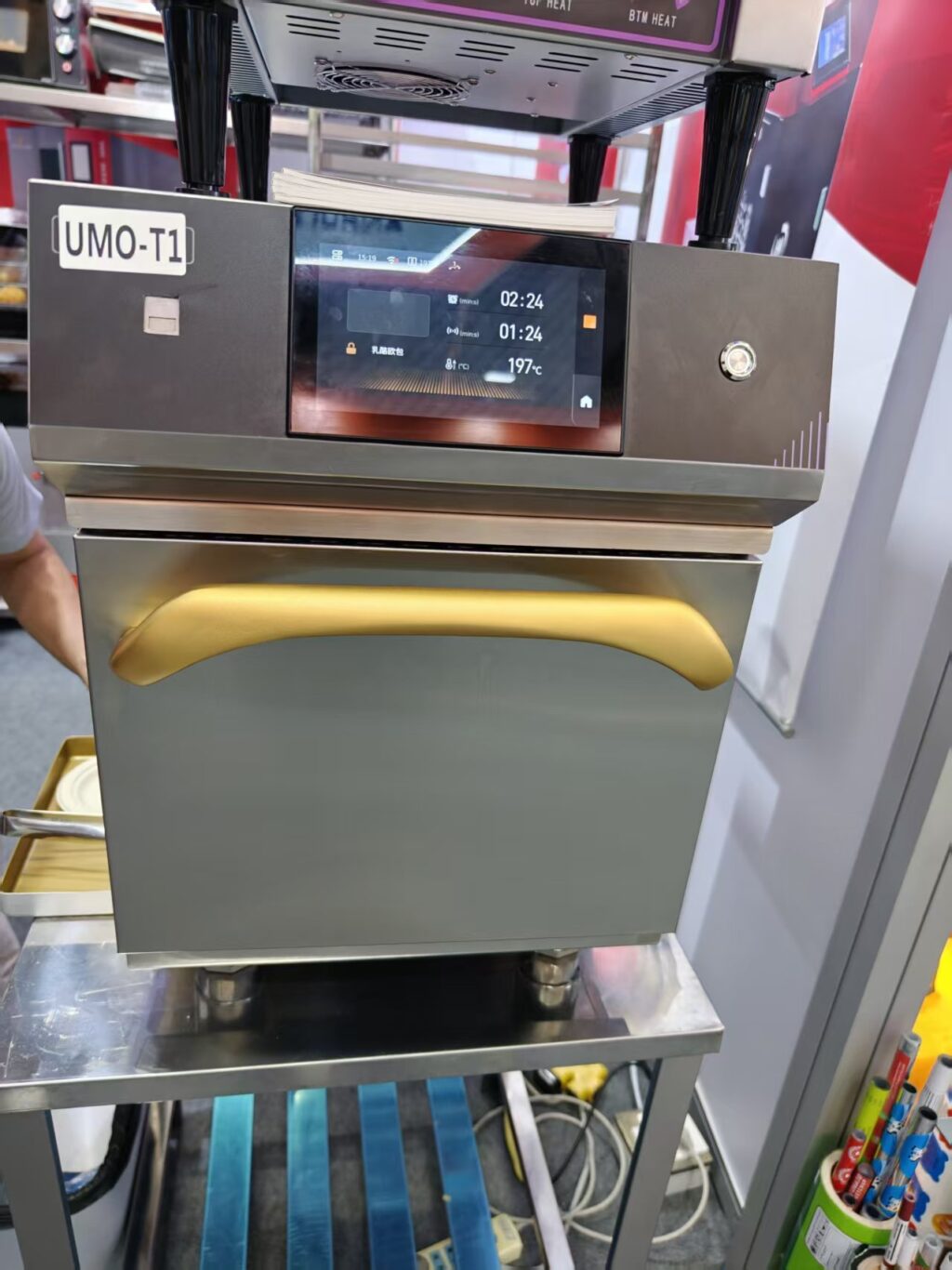
4. Crispy Croissants in Minutes: Showcasing Real-World Cooking Performance at the Canton Fair
For commercial buyers, the value of a Rapid Cook Oven depends on how reliably it performs in the intended operating environment. A visually appealing croissant is useful evidence of a successful cooking cycle, but it does not establish the full performance profile of a machine. Purchasing teams should evaluate repeatability, operating procedures, ease of cleaning, user controls, and suitability for the expected service volume. Actual cooking times depend on the equipment configuration, food size, starting temperature, recipe, and operating conditions.
Before placing a wholesale order, buyers should request relevant technical documentation and determine whether a pre-shipment inspection is appropriate. FLAMEMAX states that its products undergo 100% inspection before packing. The purchase agreement should define the scope of the applicable inspection, the records to be supplied, and the procedure for handling nonconforming products. These details help convert a general quality commitment into a verifiable commercial requirement.
Key Quality and Compliance Checkpoints
| Audit checkpoint | Evidence to request | Procurement benefit |
|---|---|---|
| Product performance | Operating manual, specifications, and applicable test records | Confirms suitability for the intended application |
| Production quality | Inspection checklist, sample approval records, and defect-handling procedure | Reduces the risk of inconsistent bulk deliveries |
| Factory management | Relevant factory audit records and current certification documents | Supports supplier qualification and due diligence |
| Regulatory compliance | Applicable declarations, certificates, and technical files for the destination market | Helps identify potential import or market-access barriers |
| Shipment readiness | Packing list, carton specifications, and agreed shipping documentation | Improves shipment coordination and receiving efficiency |
Understanding Certification and Regulatory Requirements
Certification requirements should be verified for the specific product model and destination country. Buyers may need to assess applicable electrical safety standards, electromagnetic compatibility requirements, food-contact materials rules, and local labeling obligations. A certificate held by a factory does not automatically establish that every product complies with every destination-market requirement. Where applicable, buyers should verify the issuing body, certificate scope, model identification, validity, and supporting documentation.
FLAMEMAX identifies its factory as ISO 9001 and SGS certified. Procurement teams should request current supporting documents and clarify their exact scope during the supplier qualification audit. This is particularly important for importers selling through regulated distribution channels or supplying institutional projects. A documented compliance review can reduce the risk of customs delays, rejected deliveries, corrective costs, and disputes over regulatory responsibilities.
5. Wrapping Up the 140th Canton Fair: FLAMEMAX Connects with Global Partners Over Freshly Baked Delights
The end of an exhibition marks the beginning of the more detailed work required to establish a dependable supply relationship. Buyers must compare quotations, assess production capacity, review technical requirements, and calculate the full cost of bringing equipment into their markets. A competitive unit price is important, but it should be considered alongside freight, insurance, duties, local compliance costs, spare parts, and after-sales obligations.
For distributors operating across multiple cities or neighboring countries, the ability to coordinate repeat orders can be as important as the first shipment. Buyers should discuss realistic production schedules, forecast-sharing arrangements, packaging consistency, and procedures for reporting defects. When selecting a Manufacturer for OEM or ODM cooperation, they should also establish ownership and approval procedures for branding artwork, product specifications, and other agreed design materials.
Comparing the Commercial Factors That Influence Total Procurement Cost
| Cost or risk factor | Questions for the Supplier | Potential business impact |
|---|---|---|
| Unit purchase price | What quantities, specifications, and terms does the quotation cover? | Establishes a fair basis for supplier comparison |
| Freight and packaging | What packing options and shipment arrangements are available? | Affects landed cost and transit damage exposure |
| Compliance expenses | Which documents, tests, and approvals are required? | Influences market-entry costs and delivery schedules |
| Warranty and spare parts | What coverage, exclusions, and parts arrangements apply? | Affects after-sales expenses and customer confidence |
| Production lead time | When will production begin, and what milestones govern dispatch? | Influences inventory availability and sales planning |
Building a Practical Supplier Evaluation Scorecard
A structured scorecard helps purchasing teams compare candidates using consistent criteria instead of relying solely on exhibition impressions. The following framework can be adapted to different purchasing priorities.
| Evaluation category | Suggested weighting | Assessment focus |
|---|---|---|
| Product quality and performance | 30% | Demonstration results, inspection records, and technical suitability |
| Total landed cost | 25% | Quoted price, freight, duties, packaging, and related costs |
| Manufacturing and delivery capability | 20% | Verified capacity, lead times, and production planning |
| Compliance and documentation | 15% | Applicable certificates, test records, and export documentation |
| Service and customization | 10% | Warranty support, spare parts, OEM/ODM feasibility, and communication |
Note: These percentages are an illustrative purchasing framework, not independently verified performance ratings for FLAMEMAX or any other Supplier.
Managing Commercial Risk Before the Purchase Order
Experienced buyers should make sure that key commercial expectations are written into the quotation, sales contract, or purchase order. The documents should identify the exact model, agreed specifications, order quantity, payment milestones, delivery terms, inspection arrangements, warranty conditions, and responsibility for required compliance documentation.
Additional safeguards may include an approved reference sample, a documented change-control procedure, and written authorization for any deviation from the agreed specification. For large orders, a defined pre-shipment inspection and acceptance process can help resolve discrepancies before goods leave the factory. Clear procedures reduce exposure to quality disputes, delivery delays, unexpected costs, and other avoidable commercial risks.
Conclusion: Choose a Supplier That Supports Long-Term Growth
Successful Rapid Cook Oven procurement requires more than an attractive demonstration or a low quotation. Evaluate the Manufacturer, verify specifications and compliance, define inspection requirements, and confirm after-sales responsibilities. Contact FLAMEMAX at [email protected] or visit www.flamemax.com to discuss wholesale orders, OEM/ODM projects, and Customizable commercial kitchen equipment solutions.



 English
 Español
 Français
 Italiano
 日本語
 Deutsch
 Русский
 한국어
 简体中文