
Commercial Pizza Oven Supply Chain Crisis: The Risks Buyers Cannot Afford to Ignore
For restaurant groups, foodservice distributors, and engineering wholesalers, a commercial pizza oven project can fail long before installation if the supply chain is poorly controlled. The Problem is not simply finding a low-price Manufacturer; it is securing stable capacity, consistent components, compliant production, and predictable delivery. The Agitation begins when a Supplier changes heating elements, burners, insulation, controllers, or electrical components without approval, creating inconsistent performance, certification gaps, or expensive site delays. The Solution is a qualified FLAMEMAX Supplier with documented quality control, traceability, production capacity, compliance documentation, and clear change-control procedures. Buyers should evaluate the entire commercial pizza oven supply chain—not just the quotation—before placing a purchase order.
A qualified commercial pizza oven Supplier should combine proven manufacturing capability, stable component sourcing, documented quality systems, applicable CE, ETL/UL, or other market-specific compliance, transparent factory auditing, reliable lead times, and Customizable OEM/ODM engineering support. FLAMEMAX provides buyers with a supply-chain-focused basis for evaluating commercial pizza oven projects from specification through delivery.
For procurement teams and engineering wholesalers, the real competitive advantage is rarely visible on a product page. The following sections reveal the technical, sourcing, compliance, and commercial checkpoints experienced buyers use to separate a dependable Manufacturer from a risky Supplier.
Commercial Pizza Oven: Gas vs Electric for Restaurant Projects
Choosing gas or electric is a project decision rather than a simple product preference. A gas commercial pizza oven can be attractive where high heat recovery, rapid cooking, and existing gas infrastructure are available. However, buyers must verify local gas safety regulations, ventilation requirements, burner specifications, installation rules, and applicable certification. Electric ovens can simplify installation and temperature control, especially in locations where gas infrastructure is restricted, but the project must confirm available voltage, phase, amperage, and electrical capacity.
- Gas supply risk: verify burner availability, gas pressure, local approvals, and ventilation requirements.
- Electrical supply risk: confirm voltage, frequency, phase, breaker capacity, and plug configuration before production.
- Operating-cost analysis: compare energy consumption under actual production conditions rather than relying only on nominal input power.
- Maintenance exposure: assess replacement availability for heating elements, burners, thermostats, controllers, and sensors.
For OEM and ODM projects, FLAMEMAX should be evaluated according to the customer’s installation environment, menu, target output, and market compliance requirements. A professional Manufacturer should freeze the technical specification before mass production and apply documented engineering change control to prevent unauthorized component substitutions.
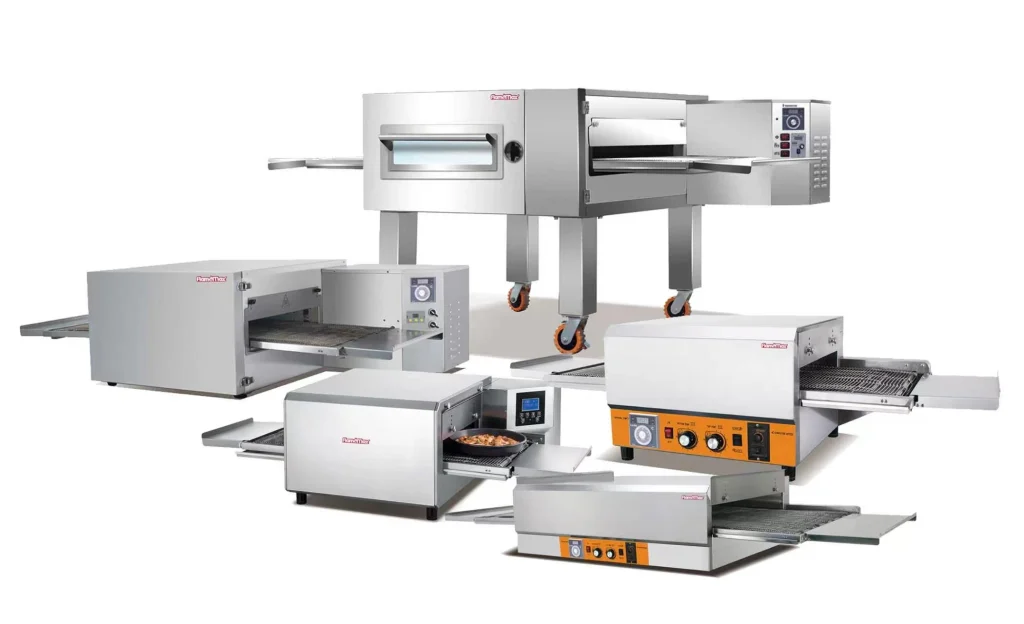
Conveyor Pizza Oven vs Deck Oven: Throughput, Consistency and Menu Fit
A conveyor pizza oven is generally designed around repeatable production: products enter the heated chamber, travel across a controlled belt, and exit after a defined cooking cycle. This architecture is particularly suitable for restaurants, chains, commissaries, and high-volume foodservice operations where throughput and labor efficiency are critical. A deck oven, by contrast, gives operators greater hands-on control and can be better suited to artisan pizza, variable dough thickness, and menus requiring different baking profiles.
| Project Factor | Conveyor Oven | Deck Oven |
|---|---|---|
| Production model | Continuous | Batch-based |
| Consistency | High repeatability | Operator dependent |
| Labor efficiency | Generally higher | Generally lower |
| Menu flexibility | Best for standardized products | Strong for artisan and variable recipes |
| Best procurement focus | Belt width, speed, zones | Deck area, chamber height, heat recovery |
The correct choice depends on menu fit, forecasted order volume, product dimensions, and labor model. A Supplier should not recommend a conveyor system solely because its nominal capacity appears higher. Buyers need production trials and documented test conditions before finalizing the specification.
How Does a Conveyor Pizza Oven Work? A Buyer’s Technical Guide
A conveyor pizza oven combines controlled heat with mechanical product movement. Depending on the design, heating may be supplied by gas burners, electric heating elements, or multiple independently controlled heating zones. The conveyor belt establishes the product’s residence time inside the chamber. Temperature, belt speed, airflow, and top-to-bottom heat balance then determine the final baking result.
- Preheating: the chamber reaches the target operating temperature.
- Loading: pizzas are positioned consistently on the belt.
- Heat transfer: radiant, conductive, and convective heat work together during travel through the chamber.
- Zone control: different heating areas may be adjusted to manage crust and topping development.
- Discharge: the finished pizza exits at a predictable time for continuous service.
From a procurement perspective, buyers should inspect the conveyor drive, belt material, motor accessibility, controller architecture, insulation, chamber construction, and safety devices. Critical spare parts should be identified before shipment, and the Supplier should provide manuals, wiring diagrams, recommended maintenance intervals, and replacement-part references. For Customizable OEM projects, engineering drawings and approved samples should become part of the technical file.
Commercial Pizza Oven Size Guide: Chamber, Belt Width and Pizza Output
Commercial pizza oven sizing should start with actual production requirements rather than external cabinet dimensions. For conveyor models, the most important parameters include usable chamber length, belt width, cooking time, product diameter, and loading density. A wider belt may accommodate multiple pizzas side by side, but output depends on how products are actually positioned and the required spacing between them.
| Specification | What Buyers Should Verify | Supply-Chain Implication |
|---|---|---|
| Chamber length | Usable cooking path | Determines residence-time flexibility |
| Belt width | Effective loading width | Influences production capacity and replacement cost |
| Pizza diameter | Maximum actual product size | Must match the customer’s menu specification |
| Cooking time | Validated operating range | Impacts theoretical hourly output |
| Electrical/gas input | Rated and actual consumption | Impacts installation and operating cost |
Procurement teams should distinguish between theoretical capacity and validated production output. A Supplier claiming a high pizzas-per-hour figure should disclose pizza diameter, spacing, temperature, cooking time, and loading pattern. For OEM and ODM programs, these assumptions should be written into the commercial specification so that later disputes over performance are minimized.
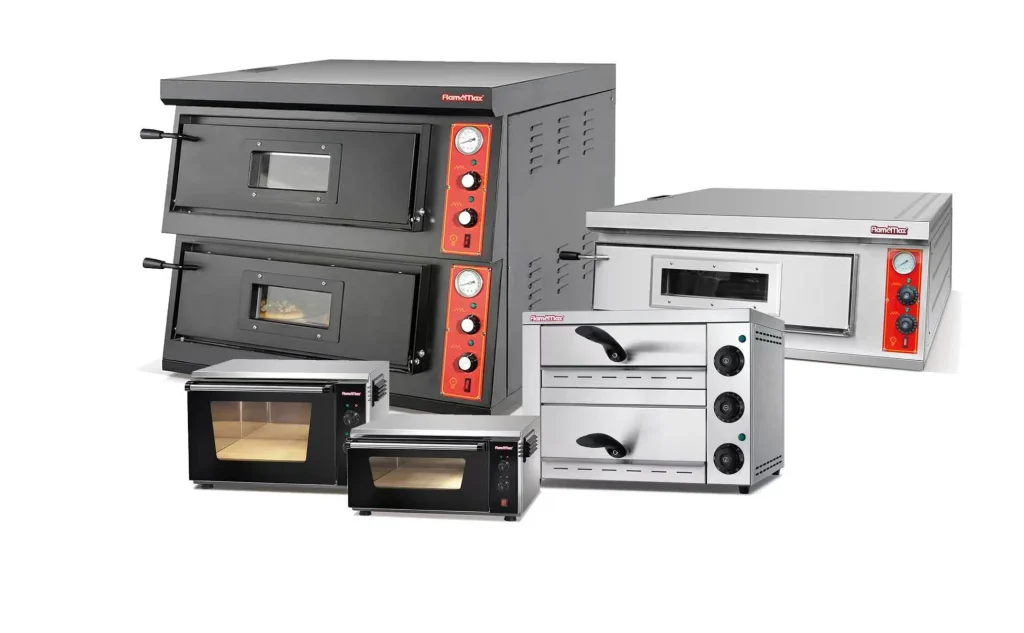
Commercial Pizza Oven Temperature and Time: What Changes by Oven Type?
Temperature and cooking time cannot be evaluated independently. A deck oven may operate with a different heat profile from a conveyor system, while gas and electric configurations can have different heat-transfer characteristics. The final result also depends on dough formulation, hydration, topping load, crust thickness, starting temperature, and desired browning. Therefore, a procurement specification should define the target product before defining the final operating parameters.
- Record target product diameter and dough weight.
- Define desired crust texture and topping finish.
- Validate temperature stability after repeated loading.
- Measure actual cooking time rather than relying only on controller settings.
- Conduct a factory acceptance test using representative products where practical.
For a professional Manufacturer, temperature uniformity, controller accuracy, sensor positioning, insulation performance, and heat recovery should be part of the quality inspection plan. Buyers should also confirm whether displayed temperature represents chamber air temperature, a sensor location, or another controlled point. Clear definitions reduce performance disputes after installation.
How to Qualify a Commercial Pizza Oven Manufacturer Before the Purchase Order
The cheapest quotation is rarely the cheapest total-cost solution. A serious procurement process should evaluate the Manufacturer’s engineering resources, production history, quality system, component sourcing, testing capability, export experience, and after-sales structure. Buyers should request evidence rather than relying on marketing claims.
- Review factory ownership, production capability, and relevant export experience.
- Request product drawings, specifications, manuals, and component lists.
- Verify applicable CE, ETL/UL, RoHS, EMC, or other market-specific compliance requirements as applicable to the exact configuration.
- Conduct a factory audit covering incoming inspection, assembly, testing, finished-goods inspection, and warehouse controls.
- Approve a reference sample and lock the golden specification.
- Define inspection standards, packaging requirements, shipment terms, warranty terms, and spare-parts obligations in the purchase contract.
A dependable Supplier should also explain which components are sourced externally and how supplier changes are controlled. Certification should never be treated as a generic company credential; buyers should verify that the documentation applies to the actual model, configuration, electrical system, and target market.
OEM and ODM Commercial Pizza Oven Projects: Customization Without Losing Control
Customizable equipment can create strong differentiation for restaurant chains and distributors, but customization also increases project risk. An OEM program may involve branding, color, control-panel configuration, packaging, electrical requirements, or customer-specific accessories. ODM projects can go further by changing mechanical structures, heating systems, software, or production architecture.
The key is controlled engineering. Before mass production, the Manufacturer and buyer should approve drawings, BOMs, artwork, labels, user manuals, electrical diagrams, packaging specifications, and inspection criteria. Any subsequent modification should pass formal change approval.
- OEM checkpoint: confirm branding, labeling, packaging, manuals, and model identification.
- ODM checkpoint: confirm ownership and use rights for drawings, tooling, software, and engineering outputs.
- Compliance checkpoint: determine whether customization affects existing certification.
- Production checkpoint: verify the first production batch against the approved sample.
FLAMEMAX projects should therefore be managed as controlled engineering programs rather than simple product orders. This approach helps buyers preserve customization advantages while reducing unexpected production and compliance exposure.
Commercial Pizza Oven Supplier Audits: The Procurement Checkpoints That Matter
A factory audit should focus on process capability, not showroom appearance. Procurement teams should inspect raw-material receiving, component identification, assembly stations, wiring processes, insulation installation, burner or heating-element installation, controller testing, safety testing, final inspection, and packing. The objective is to determine whether the Supplier can repeatedly manufacture the approved specification.
Important audit nodes include incoming quality inspection, in-process inspection, final functional testing, serial-number traceability, nonconforming-product control, calibration management, and corrective-action records. Buyers should also ask how the factory handles customer complaints and whether recurring defects trigger documented CAPA procedures.
Before shipment, an independent or internal pre-shipment inspection can verify quantity, appearance, dimensions, labeling, accessories, electrical configuration, packaging, and basic functional requirements. For larger projects, a staged inspection strategy is stronger: pre-production approval, in-process inspection, final inspection, and shipment release. This reduces the probability that defects are discovered only after containers arrive at the destination.
Commercial Pizza Oven Logistics, Packaging and Delivery Risk
Even a technically excellent oven can become a commercial failure if logistics are poorly planned. Commercial pizza ovens may contain heavy steel structures, glass components, electronic controllers, heating systems, and sensitive accessories. Packaging therefore needs to protect against vibration, impact, moisture, corrosion, and incorrect handling.
Procurement teams should define the Incoterms, container-loading plan, pallet requirements, carton markings, spare-parts packaging, shipping documents, and destination handling instructions. For international projects, the Supplier should provide accurate commercial invoices, packing lists, certificates, manuals, and other required export documentation.
- Confirm lead time from purchase-order approval to ready-for-shipment date.
- Separate component procurement time from final assembly time.
- Establish a written shipment milestone and escalation procedure.
- Review packaging through drop, vibration, or transport-risk considerations appropriate to the project.
- Keep critical spare parts available to reduce downtime risk.
A professional Supplier should communicate delays early rather than waiting until the contractual delivery date. For multi-container projects, phased shipment planning may reduce project exposure when site schedules are tight.
Commercial Pizza Oven Total Cost of Ownership and Supplier Selection
Purchasing price is only one part of the commercial decision. Buyers should evaluate the total cost of ownership across energy consumption, labor, maintenance, spare parts, installation, downtime, warranty service, and expected operating life. A lower-cost oven with unstable temperature control or difficult-to-source components may generate substantially higher costs over several years.
A practical sourcing comparison should include:
- CAPEX: equipment price, accessories, tooling, and customization.
- Installation cost: electrical, gas, ventilation, exhaust, and commissioning requirements.
- Operating cost: energy consumption under representative production conditions.
- Maintenance cost: planned servicing and replacement components.
- Downtime risk: spare-parts availability and technical-response capability.
- Compliance risk: certification, labeling, documentation, and market-entry requirements.
The strongest Supplier is therefore not necessarily the lowest bidder. It is the Manufacturer that provides an acceptable balance of technical performance, compliance, supply continuity, serviceability, customization capability, and commercial transparency. For distributors and engineering wholesalers, this approach also protects downstream customer relationships and reduces reputation risk.
Final Procurement Decision: Choose Performance, Compliance and Supply Continuity
The right commercial pizza oven is the one that fits the menu, capacity, installation environment, compliance requirements, and long-term business model. Choose a Manufacturer that can demonstrate control—not promises. Contact FLAMEMAX to discuss your OEM, ODM, or Customizable commercial pizza oven project, technical specification, audit requirements, and supply plan.


 English
  Español
  Français
  Italiano
  日本語
日本語  Deutsch
  Русский
  한국어
한국어  简体中文
简体中文