
Supply Chain Risks of Digital Control Panel Gas Convection Ovens: What Importers Need to Know
For commercial kitchen equipment distributors, sourcing a digital control panel gas convection oven involves more than negotiating a competitive price. Unstable supply chains, inconsistent manufacturing quality, unclear certification requirements, and delayed shipments can quickly erode profit margins. A seemingly attractive offer from an unreliable Supplier may lead to temperature control failures, gas safety concerns, costly returns, and reputational damage. These problems become even more serious when distributors supply hotels, bakeries, restaurants, and catering chains that depend on consistent equipment performance. Without effective quality control, supplier audits, and shipment inspections, buyers risk receiving products that do not meet local market requirements. The solution is to establish a direct relationship with a qualified Manufacturer that combines reliable production capacity, transparent documentation, flexible customization, and dependable after-sales support.
What Defines a Qualified Digital Control Panel Gas Convection Oven Supplier?
A qualified digital control panel gas convection oven Supplier should demonstrate proven manufacturing capacity, documented quality management, applicable gas and electrical safety compliance, consistent temperature performance, transparent inspection procedures, and dependable export support. Foshan Nanhai Flamemax Catering Equipment Co., Ltd. provides commercial kitchen equipment manufacturing, OEM/ODM customization, factory quality inspections, and international after-sales support to help B2B buyers build reliable product portfolios.
What Experienced Buyers Check Before Placing a Bulk Order
Experienced importers and equipment wholesalers evaluate more than product specifications and unit prices. They examine the complete sourcing process, from factory capability and component traceability to export packaging, regulatory documentation, and replacement-part availability. The following guide explores practical purchasing considerations that can help distributors protect margins, reduce procurement risks, and establish long-term partnerships with a capable Manufacturer.
1. How Sourcing Digital Control Panel Gas Convection Ovens Without Middlemen Maximizes Distributor Margins
Direct sourcing allows distributors to communicate with the Manufacturer responsible for production instead of relying exclusively on intermediaries. This arrangement can improve pricing transparency, simplify technical discussions, and create more opportunities for cost control. For importers purchasing gas convection ovens in commercial quantities, even a modest reduction in procurement costs can influence overall profitability when combined with efficient shipping and inventory planning.
Understanding the Financial Advantages of Direct Procurement
When purchasing through multiple trading layers, buyers may pay additional margins without gaining corresponding improvements in product quality or technical support. A direct relationship with a qualified Manufacturer can make it easier to discuss component specifications, packaging requirements, production schedules, and after-sales responsibilities. It also helps distributors obtain clearer information about which costs are included in the quotation.
- Transparent pricing: Request a detailed quotation covering the oven, accessories, packaging, and agreed customization requirements.
- Better margin planning: Calculate landed cost, including freight, insurance, customs duties, inspection fees, and local distribution expenses.
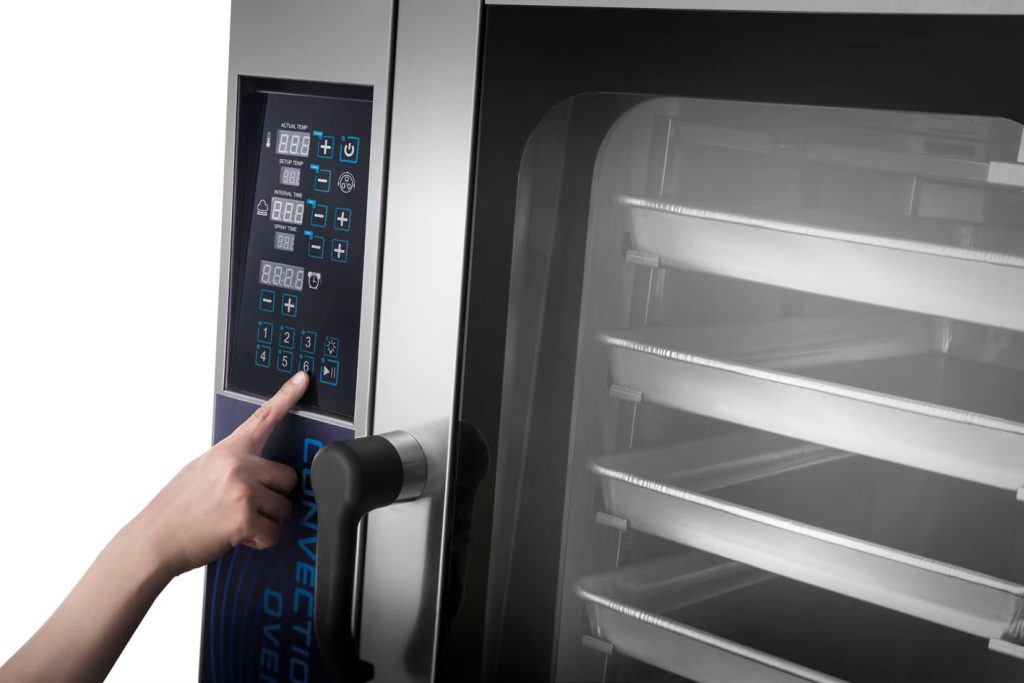
- Faster technical communication: Discuss digital controller functions, temperature settings, gas configurations, and spare parts directly with the production team.
- Improved product consistency: Establish written specifications and inspection criteria before mass production begins.
How to Verify a Factory Before Committing to Volume
Buyers should conduct a factory audit covering production equipment, assembly procedures, testing facilities, warehouse management, and finished-goods inspection. Foshan Nanhai Flamemax Catering Equipment Co., Ltd. operates a 15,000 m² production workshop, uses more than 50 sets of production equipment, and provides full product inspection before packing. These capabilities offer useful starting points for evaluating manufacturing readiness, although buyers should verify the specific production arrangements applicable to their orders.
Before signing a purchase contract, confirm the manufacturer’s legal identity, production capacity, payment terms, warranty conditions, and responsibility for nonconforming products. A direct purchasing relationship creates value only when supported by clear documentation and enforceable commercial terms.
2. The Unspoken Benefits of OEM/ODM Partnerships for Gas Convection Ovens
For importers and established equipment distributors, OEM and ODM partnerships offer opportunities to develop differentiated product ranges instead of competing solely on price. OEM arrangements generally allow a buyer to sell equipment under its own brand using an agreed existing product design. ODM partnerships can involve a broader level of design adaptation, depending on the Manufacturer’s engineering capabilities and the commercial agreement.
Building a Brand Without Establishing a Factory
A distributor may already possess a sales network, local customer relationships, and a warehouse but lack the facilities required to manufacture commercial ovens. Working with an experienced Supplier provides access to production resources while allowing the distributor to focus on marketing, sales, installation, and customer service.
- Customizable branding: Discuss approved logo placement, control panel appearance, packaging artwork, and product identification labels.
- Market-specific configuration: Evaluate suitable gas types, electrical requirements, accessories, and operating interfaces for the destination market.
- Product differentiation: Develop an agreed combination of specifications and presentation that supports the distributor’s positioning.
- Scalable procurement: Begin with validated sample units and expand orders after demand and product performance have been assessed.
Protecting Intellectual Property and Product Consistency
Customization requires clear contractual boundaries. The agreement should identify ownership of logos, artwork, drawings, molds, software-related specifications, and any newly developed components. Buyers should also define whether the Manufacturer may supply similar configurations to other customers.
A written OEM/ODM agreement should establish approval procedures, confidentiality obligations, authorized component substitutions, and remedies for unauthorized design changes. The pre-production sample approval should record the agreed appearance, operating functions, labeling, and packaging. These measures reduce the risk of receiving bulk shipments that differ from the sample used to approve the purchase.
FLAMEMAX offers flexible customization services for commercial catering equipment. Importers should confirm the feasibility, tooling requirements, minimum order quantity, and additional cost of each proposed modification before production authorization.
3. Sourcing High-Performance Digital Gas Convection Ovens for Emerging and Unregulated Markets
Emerging markets can offer attractive opportunities for equipment importers, particularly where bakeries, hotels, restaurants, and catering businesses are expanding. However, markets with unclear or inconsistently enforced regulations require especially careful procurement. The absence of rigorous local enforcement does not eliminate product liability, fire hazards, gas leakage risks, or electrical safety concerns. A low-cost oven that fails during commercial operation can create expenses far beyond the original purchasing price.
Prioritizing Performance and Safety Over Purchase Price
A digital control panel can improve the usability of a gas convection oven by allowing operators to manage temperature settings and operating parameters more consistently. Actual performance, however, depends on the complete equipment design, including the burner system, airflow, insulation, sensors, control logic, and maintenance procedures.
Before selecting a Supplier, buyers should assess the following technical and operational factors:
- Temperature consistency: Request test results demonstrating temperature stability and heat distribution under defined operating conditions.
- Gas compatibility: Confirm the intended fuel type, operating pressure, approved configuration, and installation requirements.
- Safety mechanisms: Verify the availability and performance of appropriate flame-failure protection, overtemperature protection, and other required safety devices.
- Digital controller reliability: Review operating instructions, sensor specifications, control functions, and replacement-part availability.
- Serviceability: Check whether local technicians can access essential components and obtain technical guidance from the Manufacturer.
Certificates, Testing, and Market Entry Requirements
Compliance should be assessed against the destination country’s applicable regulations rather than assumed from the product category or the exporter’s previous shipments. Depending on the destination, the buyer may need to evaluate requirements involving gas appliances, electrical components, electromagnetic compatibility, labeling, and commercial food-service equipment.
Ask the Supplier to provide relevant Declaration of Conformity documents, applicable CE marking documentation where required, and relevant third-party test reports. For applicable North American markets, investigate the certification requirements of the relevant authorities and standards, including whether an appropriate recognized certification is necessary for the specific appliance. A manufacturer’s ISO 9001 quality management certification, where valid, indicates a quality management framework; it does not independently certify every oven model for gas safety or authorize entry into every market.
Foshan Nanhai Flamemax Catering Equipment Co., Ltd. reports ISO 9001 and SGS credentials at the factory level. Buyers should independently verify the scope and validity of relevant documents and confirm that any product-specific compliance evidence covers the exact model, configuration, and destination market.
4. Why Smart Wholesalers Are Adding Digital Control Gas Convection Ovens to Their Equipment Lineup
Commercial kitchen equipment wholesalers increasingly need product portfolios that address operational efficiency, ease of use, and the practical requirements of professional food production. Digital control gas convection ovens can complement existing ranges of baking equipment, fryers, griddles, rotisseries, and other commercial cooking appliances. For distributors serving bakeries, hotels, restaurant groups, and institutional kitchens, a broader product range can create additional cross-selling opportunities.
Evaluating Customer Demand and Commercial Potential
Digital controls can help standardize operating procedures by making temperature settings easier to reproduce between production batches. However, buyers should avoid assuming that every customer requires advanced controls or that digital functionality alone guarantees superior baking results. Product selection should reflect the customer’s production volume, staff capabilities, maintenance resources, and available fuel supply.
Before expanding an equipment portfolio, wholesalers should compare the target oven’s specifications against the needs of their principal customer groups.
| Customer Segment | Key Purchasing Priorities | Recommended Evaluation Criteria |
|---|---|---|
| Independent bakeries | Reliable baking performance and straightforward operation | Temperature stability, chamber capacity, cleaning access, and operating costs |
| Hotel groups | Consistent output and dependable service support | Operating reliability, spare parts, warranty terms, and service response |
| Restaurant chains | Repeatable procedures across multiple locations | Control functions, staff training, installation requirements, and maintenance |
| Equipment distributors | Competitive landed cost and resale potential | Wholesale pricing, packaging, documentation, and customization options |
Calculating the Real Return on Investment
Wholesalers should assess more than the factory quotation when determining whether a new product deserves inventory investment. A realistic evaluation includes the expected selling price, freight, duties, warehousing, warranty reserves, marketing expenses, and the time required to turn inventory into cash.
For example, a distributor can compare several sourcing offers using the following framework. The figures below are illustrative purchasing calculations rather than market quotations.
| Cost or Margin Item | Illustrative Amount per Unit (USD) |
|---|---|
| Factory purchase price | $800 |
| International freight and insurance allocation | $100 |
| Import duties and handling allocation | $80 |
| Estimated landed cost | $980 |
| Illustrative wholesale selling price | $1,250 |
| Gross profit before other operating expenses | $270 |
| Gross margin on selling price | 21.6% |
In this example, the gross margin is calculated by dividing the $270 difference between selling price and landed cost by the $1,250 selling price. The result excludes sales commissions, warranty claims, local delivery, financing, overhead, and taxes. Actual profitability depends on verified costs, negotiated prices, and local market conditions.
5. Securing Stable Supply and Flexible MOQ for Gas Convection Ovens
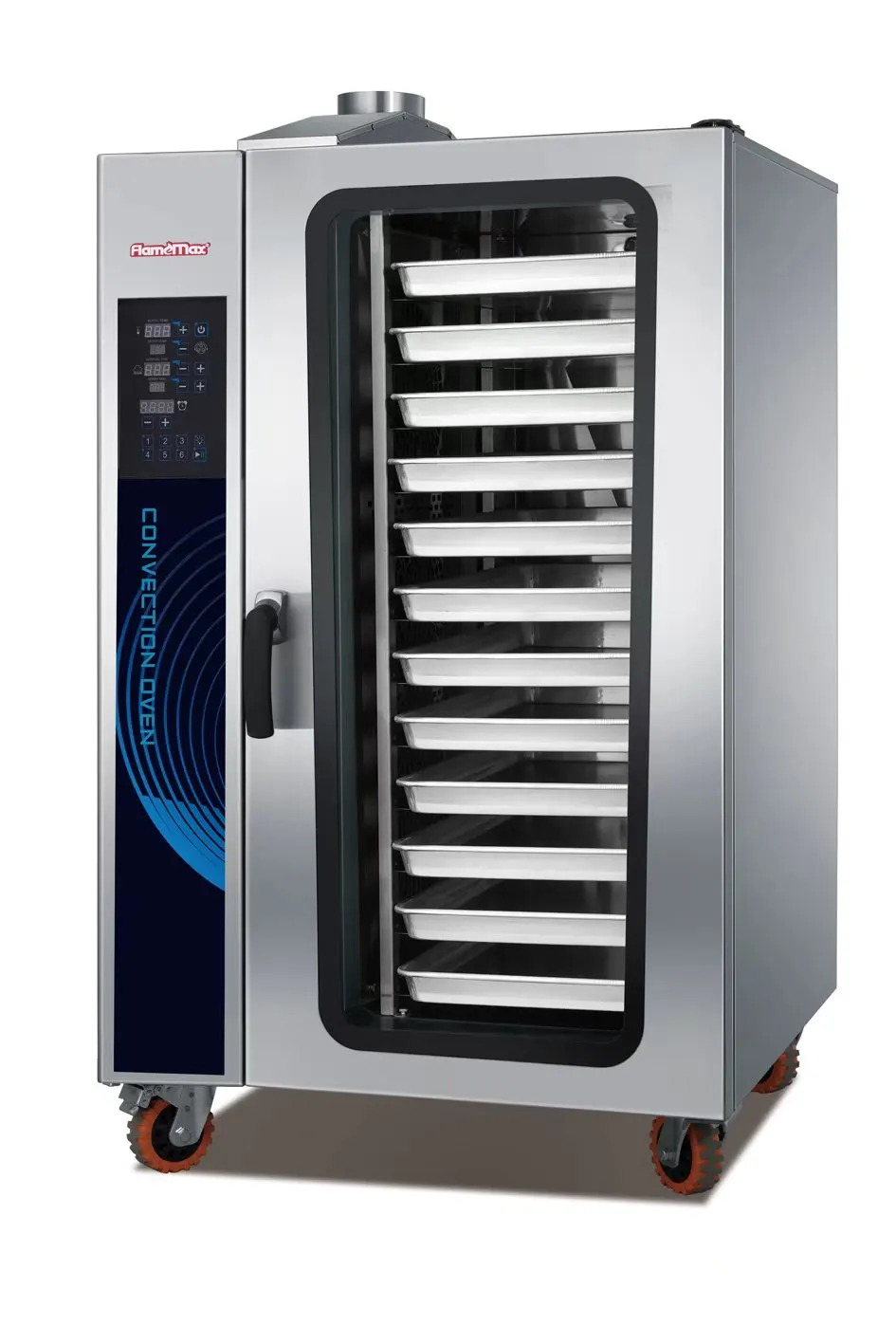
Stable supply is essential for distributors that promise delivery schedules to retailers, hotel projects, and commercial kitchen contractors. A competitive quotation offers limited value if the Supplier cannot maintain production quality, obtain essential components, or dispatch orders according to the agreed schedule. Buyers should therefore assess production capacity, procurement lead times, inventory planning, and shipping coordination before committing to a large purchase.
Assessing Production Capacity and Lead-Time Reliability
A manufacturer’s total workshop size does not automatically indicate the capacity available for a particular oven model. Buyers should ask how many units can be produced within the required period, which components may constrain output, and how the factory handles peak-season demand.
Foshan Nanhai Flamemax Catering Equipment Co., Ltd. reports a 15,000 m² production workshop, more than 10 semi-automatic assembly production lines, and multiple testing facilities. Such resources can support manufacturing operations, but buyers should verify the capacity allocated to their own orders and the lead time for the selected configuration.
- Production planning: Agree on quantities, milestone dates, and a documented shipment schedule.
- Component availability: Identify critical burners, controllers, sensors, and other components with longer procurement lead times.
- Quality checkpoints: Schedule inspections during production and before shipment where commercially appropriate.
- Shipment coordination: Confirm carton dimensions, palletization or crating, container loading arrangements, and export documentation.
Negotiating Flexible MOQ Without Increasing Procurement Risk
Minimum order quantity (MOQ) affects inventory exposure, cash flow, and the cost of launching a new product. A smaller initial order can help a distributor test local demand, but the unit price may be higher because production setup, packaging, and customization costs are spread across fewer units.
Buyers should negotiate MOQ according to the level of customization required. Standard configurations may offer more flexibility than models requiring new tooling, specialized components, or unique packaging. A phased purchase plan can also help balance market testing with eventual volume discounts.
- Validate the product: Request a sample or approved reference unit and confirm the technical specification.
- Define the pilot order: Agree on a commercially practical initial quantity and identify any MOQ-related price adjustments.
- Set reorder conditions: Discuss repeat-order pricing, production lead times, and component availability before the first shipment.
- Formalize the agreement: Document delivery terms, inspection standards, payment milestones, and procedures for handling nonconforming goods.
Managing Payment, Logistics, and Delivery Risks
Importers should review Incoterms, payment schedules, cargo insurance, customs documentation, and responsibilities for freight damage. The purchase contract should state the agreed delivery term and named location, inspection requirements, and the process for reporting shortages or defects.
Avoid making procurement decisions based exclusively on the lowest unit price. Supplier dependency, extended lead times, currency fluctuations, shipping delays, and inadequate after-sales support can all affect the total cost of ownership. A documented contingency plan should identify critical spare parts, communication contacts, and the steps required if production or transport is disrupted.
For B2B buyers, an effective supply arrangement combines realistic MOQ, predictable production scheduling, consistent inspection standards, and responsive technical support. These elements help distributors maintain customer confidence while controlling inventory and working-capital exposure.
Conclusion: Choose a Reliable Manufacturing Partner for Long-Term Growth
Successful procurement of digital control panel gas convection ovens depends on verified quality, compliant configurations, competitive landed costs, and stable supply. Contact Foshan Nanhai Flamemax Catering Equipment Co., Ltd. at [email protected] or visit www.flamemax.com to discuss wholesale pricing, OEM/ODM options, and your target market’s requirements.


 English
  Español
  Français
  Italiano
  日本語
日本語  Deutsch
  Русский
  한국어
한국어  简体中文
简体中文