
Which Commercial Bakery Oven Is Right for Your Production: Deck Oven, Rack Oven, or Rotary Oven?
Choosing the wrong commercial bakery oven can create serious operational problems. A deck oven may deliver excellent crust quality, but its batch-based workflow can limit output during peak demand. A rack oven offers efficient tray loading, yet inconsistent airflow or poor temperature control may affect product uniformity. A rotary oven can support high-volume production, but its footprint, energy consumption, and maintenance requirements may increase operating costs. For bakery equipment importers, distributors, and commercial bakery operators, these differences directly affect profitability. The challenge is not simply comparing purchase prices. It is identifying which oven matches production capacity, product specifications, available floor space, and labor efficiency. Understanding deck oven vs rack oven and deck oven vs rotary oven is essential before making a long-term purchasing decision.
What Is the Best Standard for Choosing a Commercial Bakery Oven?
The best commercial bakery oven is determined by production volume, product consistency, available floor space, energy efficiency, and maintenance requirements. Deck ovens are suitable for artisan bread and pizza, rack ovens offer flexible batch baking, and rotary ovens support high-volume production. Foshan Nanhai Flamemax Catering Equipment Co., Ltd. is a professional Manufacturer and Supplier of commercial bakery equipment, offering flexible solutions for wholesale buyers and OEM/ODM projects.
Understanding the Technical Differences Between Deck, Rack, and Rotary Ovens
Before comparing individual performance factors, buyers should understand how each oven transfers heat and handles baking loads. These fundamental differences determine the oven’s suitability for specific bakery operations.
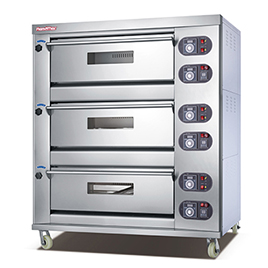
Deck Oven: Direct Heat and Independent Baking Zones
Deck ovens use stationary baking chambers with heated decks. Heat is transferred through a combination of conduction, convection, and radiation. Depending on the design, heating elements or burners provide independent control over upper and lower heat.
This configuration is particularly useful for artisan bread, pizza, baguettes, and products requiring a crisp bottom crust. Stone or refractory decks can improve heat retention and support consistent baking results.
- Heating method: Upper and lower heating elements or burners.
- Temperature control: Independent top and bottom heat adjustment, depending on the model.
- Loading method: Manual loading using trays, baking pans, or a peel.
- Best application: Artisan bread, pizza, pastries, and specialty baked products.
The main limitation is batch-based production. Operators must load and unload each chamber manually, which can increase labor requirements in high-volume environments.
Rack Oven: Forced Convection and Full-Rack Baking
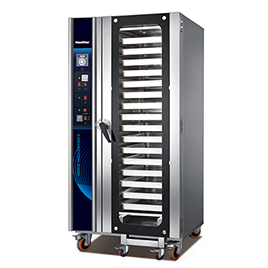
Rack ovens use a forced-air circulation system to distribute heat throughout the baking chamber. A fan moves heated air around a rotating or stationary rack, depending on the oven design. The rack typically holds multiple trays, allowing a large quantity of products to be baked in one cycle.
The main advantage is flexible loading. Operators can prepare a full rack outside the oven and move it into the chamber using a trolley. This workflow reduces manual tray handling and supports organized production.
- Heating method: Forced hot-air convection.
- Loading method: Full-rack trolley loading.
- Heat distribution: Controlled airflow across multiple tray levels.
- Best application: Bread rolls, cookies, cakes, pastries, and mixed bakery products.
However, rack oven performance depends heavily on fan design, airflow direction, rack rotation, and chamber sealing. Poorly engineered airflow can create uneven browning between upper and lower trays.
Rotary Oven: Rotating Rack and High-Capacity Production
Rotary ovens are designed for continuous and high-volume batch production. A loaded rack rotates inside the chamber while hot air circulates around the products. This combination helps minimize temperature differences between tray positions.
Many rotary ovens feature programmable controls, steam injection, and automated rack rotation. These features make them suitable for industrial bakeries and centralized production facilities.
- Heating method: Forced convection with rack rotation.
- Loading method: Full trolley or rack loading.
- Control system: Programmable baking parameters, depending on configuration.
- Best application: High-volume bread, buns, pastries, and standardized bakery products.
Rotary ovens generally require more installation space and may involve higher initial investment. Buyers should evaluate utility requirements, ventilation, and service access before selecting a model.
Throughput and Batch Size: Which Oven Delivers Higher Production Efficiency?
Throughput refers to the quantity of finished products produced within a specific period. It is one of the most important indicators when comparing commercial bakery ovens.
Deck ovens operate through individual baking chambers. Their output depends on chamber capacity, baking time, loading speed, and the number of decks. Multiple decks can increase total production, but operators must still manage separate batches.
Rack ovens improve throughput by accommodating multiple trays within a single baking cycle. A full-rack trolley can be loaded outside the chamber, reducing downtime between batches. This is particularly advantageous for bakeries producing standardized products in medium-sized batches.
Rotary ovens are generally more suitable for large-scale production. Rack rotation and forced convection help maintain consistent baking conditions across a high tray count. When production demand is stable, this configuration can improve labor efficiency and reduce repetitive handling.
Typical Batch Capacity Comparison
The following figures are illustrative examples for equipment selection. Actual capacity varies according to oven dimensions, tray specifications, product size, loading density, and baking cycle.
| Technical Parameter | Deck Oven | Rack Oven | Rotary Oven |
|---|---|---|---|
| Typical tray capacity | 4–12 trays per chamber | 16–36 trays per rack | 16–36 trays per rotating rack |
| Typical baking temperature | 50–300°C | 30–300°C | 30–300°C |
| Loading method | Manual tray or peel loading | Rack trolley | Rotating rack trolley |
| Production scale | Small to medium batches | Medium to large batches | Large to industrial batches |
| Labor efficiency | Moderate | High | High |
Important: Tray capacity alone does not determine actual throughput. A bakery producing delicate pastries may require longer baking cycles than a bakery producing bread rolls. Buyers should calculate output using actual product weight, baking time, and unloading intervals.
How to Calculate Required Baking Capacity
A practical capacity calculation can help prevent overinvestment or insufficient production capacity.
Estimated hourly output = Products per batch × 60 ÷ Total cycle time in minutes
For example, if a rack oven produces 240 bread rolls per batch and requires 30 minutes for baking, loading, and unloading, its theoretical output is approximately 480 bread rolls per hour.
This calculation assumes continuous operation and does not include additional downtime. Actual production should account for preparation, operator efficiency, and product quality requirements.
Floor Space and Loading: Which Oven Fits the Bakery Layout?
Available floor space is a major consideration for commercial bakery equipment buyers. An oven must fit the production area without restricting movement, ingredient handling, or ventilation.
Deck Oven: Compact Installation and Flexible Configuration
Deck ovens are often suitable for bakeries with limited space. Their modular structure allows multiple chambers to be stacked vertically. This arrangement can increase production capacity without requiring a large floor footprint.
However, manual loading requires sufficient front clearance. Operators need room to handle baking trays, loading peels, and finished products safely. Buyers should also consider the height of stacked chambers and the accessibility of upper decks.
Rack Oven: Efficient Trolley-Based Workflow
Rack ovens require space for both the oven and the rack trolley. Their workflow is efficient when the bakery has a dedicated staging area for loading and unloading.
The trolley-based system reduces the need to transfer individual trays into the chamber. However, narrow aisles, sharp turns, and insufficient door clearance can make rack movement difficult.
Rotary Oven: Installation Planning for Large Production Facilities
Rotary ovens generally require more installation space than deck ovens. Their design may include a larger chamber, rack rotation mechanism, exhaust system, and service access areas.
Before purchasing, buyers should verify:
- Overall dimensions: Width, depth, and height of the installed equipment.
- Door clearance: Space required for rack trolley entry and removal.
- Utility connections: Electrical power, gas supply, water, and drainage where applicable.
- Ventilation: Exhaust requirements and ambient heat management.
- Service clearance: Access to motors, fans, burners, and control components.
A professional Supplier should provide installation drawings and utility specifications before shipment. These documents help importers, contractors, and bakery operators prepare the installation site accurately.
Product Consistency: Which Oven Provides More Uniform Baking Results?
Product consistency is critical for bakeries supplying supermarkets, hotel chains, franchise restaurants, and wholesale customers. Differences in color, texture, moisture content, and product dimensions can lead to customer complaints and product rejection.
Heat Transfer and Baking Uniformity
Deck ovens are effective for products requiring strong bottom heat and controlled crust formation. Their independent upper and lower temperature adjustment allows operators to fine-tune the baking profile. However, products positioned in different chambers may experience variations if temperature settings or heat recovery conditions differ.
Rack ovens rely on forced convection. Their uniformity depends on air velocity, airflow distribution, fan performance, and temperature recovery. A properly designed circulation system can reduce differences between tray levels.
Rotary ovens add rack rotation to forced convection. This helps expose products to different positions within the chamber during baking. The result can be more consistent color and texture across a full rack, especially in standardized production.
Temperature Control and Programmable Baking
Modern commercial bakery ovens may use digital controllers, programmable recipes, and independent temperature sensors. These systems allow operators to repeat established baking processes.
Important technical parameters include:
- Temperature accuracy: The difference between the set temperature and actual chamber temperature.
- Temperature recovery: The time required to restore the baking temperature after loading.
- Airflow uniformity: The distribution of hot air throughout the chamber.
- Steam injection: The ability to control crust development in bread products.
- Recipe memory: The ability to save baking time, temperature, and steam settings.
For buyers comparing deck oven vs rack oven or deck oven vs rotary oven, the correct choice depends on the required product characteristics. Artisan bread may benefit from deck heat, while standardized rolls and pastries may be better suited to convection or rotary systems.
Maintenance Complexity: Which Oven Has Lower Long-Term Operating Costs?
Equipment maintenance directly affects production uptime, labor costs, and the total cost of ownership. Buyers should evaluate not only the initial purchase price but also the availability of spare parts, service support, and cleaning requirements.
Deck Oven Maintenance
Deck ovens generally have a relatively straightforward structure. Common maintenance tasks include cleaning baking surfaces, inspecting heating elements or burners, checking temperature sensors, and examining door seals.
For stone-deck models, operators should follow the manufacturer’s cleaning instructions to avoid damaging the refractory surface. Excessive moisture or improper cleaning chemicals may affect deck performance.
Rack Oven Maintenance
Rack ovens require regular inspection of circulation fans, heating components, rack trolleys, bearings, and door seals. Fan performance is especially important because airflow directly influences baking uniformity.
Grease and flour deposits should be removed according to the recommended cleaning schedule. Blocked airflow passages can reduce heating efficiency and create uneven baking conditions.
Rotary Oven Maintenance
Rotary ovens contain additional mechanical components, including rack rotation drives, motors, chains, bearings, and associated transmission systems, depending on the design.
These components require periodic lubrication, inspection, and adjustment. The maintenance workload may be higher than that of a basic deck oven, but this should be evaluated against the oven’s production capacity and labor savings.
| Maintenance Factor | Deck Oven | Rack Oven | Rotary Oven |
|---|---|---|---|
| Mechanical complexity | Low to moderate | Moderate | Moderate to high |
| Key maintenance points | Heating elements, decks, seals | Fans, trolley, sensors, seals | Drive system, motor, bearings, fans |
| Cleaning workload | Moderate | Moderate | Moderate to high |
| Spare parts planning | Heating components and sensors | Fans, sensors, control components | Motors, drive components, sensors |
Professional technical support and reliable spare parts supply are essential for minimizing unexpected downtime. Buyers should confirm warranty terms, maintenance instructions, and after-sales service availability before placing bulk orders.
Technical Standards and Compliance: What Should Buyers Verify?
International bakery equipment procurement requires attention to electrical safety, machinery safety, food-contact materials, and destination-market requirements. Compliance requirements differ by country and product configuration.
Electrical and Machinery Safety
Buyers should verify applicable requirements, including:
- IEC 60335-1: General safety requirements for household and similar electrical appliances, where applicable to the equipment classification.
- IEC 60335-2-42: Particular requirements for commercial electric forced-convection ovens, steam cookers, and steam-convection ovens, where applicable.
- IEC 60204-1: Electrical equipment of machinery requirements, where applicable to industrial machinery.
- CE marking: Relevant conformity requirements for equipment entering the European market.
- UL or ETL certification: Requirements that may apply to equipment supplied to North American markets.
These standards should not be treated as universally applicable to every oven. The correct requirements depend on the equipment classification, intended use, electrical configuration, and destination market.
Food Safety and Construction Materials
Commercial bakery ovens should use suitable food-contact materials and hygienic construction practices. Buyers should review the specifications of stainless steel components, insulation materials, cleaning surfaces, and steam-related components.
For European-market food-contact applications, Regulation (EC) No. 1935/2004 may be relevant to materials intended to contact food. Applicable local regulations should also be verified.
A reliable Manufacturer should provide product specifications, electrical diagrams, operating manuals, and supporting compliance documentation where required.
How to Select the Right Oven for Different Bakery Applications
There is no single oven configuration suitable for every bakery. The best selection is based on the production process and target products.
Choose a Deck Oven for Artisan Baking and Specialty Products
- Artisan bread and baguettes.
- Pizza and products requiring strong bottom heat.
- Small and medium-sized bakeries.
- Production environments requiring independent chamber control.
Choose a Rack Oven for Flexible Medium-to-Large Batch Production
- Bread rolls and sandwich bread.
- Cookies, cakes, and pastries.
- Hotels, central kitchens, and wholesale bakeries.
- Operations requiring efficient trolley-based loading.
Choose a Rotary Oven for High-Volume Standardized Production
- Industrial bakeries.
- Large-scale bread and bun production.
- Centralized bakery facilities supplying multiple outlets.
- Businesses requiring high batch capacity and consistent results.
For importers and distributors, a product portfolio containing deck ovens, rack ovens, and rotary ovens can cover different customer segments. Selecting a factory with flexible OEM/ODM capabilities also helps support private-label distribution and regional market requirements.
Conclusion: Make the Right Commercial Bakery Oven Investment
Deck ovens excel in artisan baking, rack ovens support flexible batch production, and rotary ovens deliver high-volume efficiency. Foshan Nanhai Flamemax Catering Equipment Co., Ltd. provides commercial bakery equipment solutions for wholesale buyers. Contact [email protected] or visit www.flamemax.com for product specifications, OEM/ODM options, and factory quotations.


 English
 Español
 Français
 Italiano
 日本語
 Deutsch
 Русский
 한국어
 简体中文