
High Humidity, Heavy Production Loads, and Electrical Constraints in Commercial Bakeries
Commercial bakeries in humid coastal markets face a difficult combination: unstable ambient humidity, high kitchen temperatures, limited production space, and demanding daily output. When the wrong oven is selected, inconsistent heat recovery can create uneven crust color, poor pastry lift, excessive cake moisture loss, and unnecessary energy consumption. The problem becomes more serious when the bakery operates on a 380–415 V, 3-phase, 50 Hz electrical supply and must manage high ambient temperature, high relative humidity, and corrosive coastal air. The consequence is not simply a baking-quality issue; it affects labor efficiency, product consistency, electrical loading, and total operating cost. This is why comparing deck oven vs convection oven should begin with the production environment, not simply the oven’s advertised power or capacity.
For humid commercial bakeries, we recommend a 3-phase 380–415 V, 50 Hz system, independent temperature control, robust insulation, and production capacity matched to 70–85% of peak demand. As a specialist oven manufacturer, we provide highly professional deck oven and convection oven engineering for bread, pastry, and cake production.
Retailers, importers, wholesalers, and distributors should continue reading: the following sections use practical production cases to show how oven selection, electrical design, workflow, and product characteristics can be matched to the real operating environment.
Heat Transfer Differences: Why Product Structure Determines Oven Selection
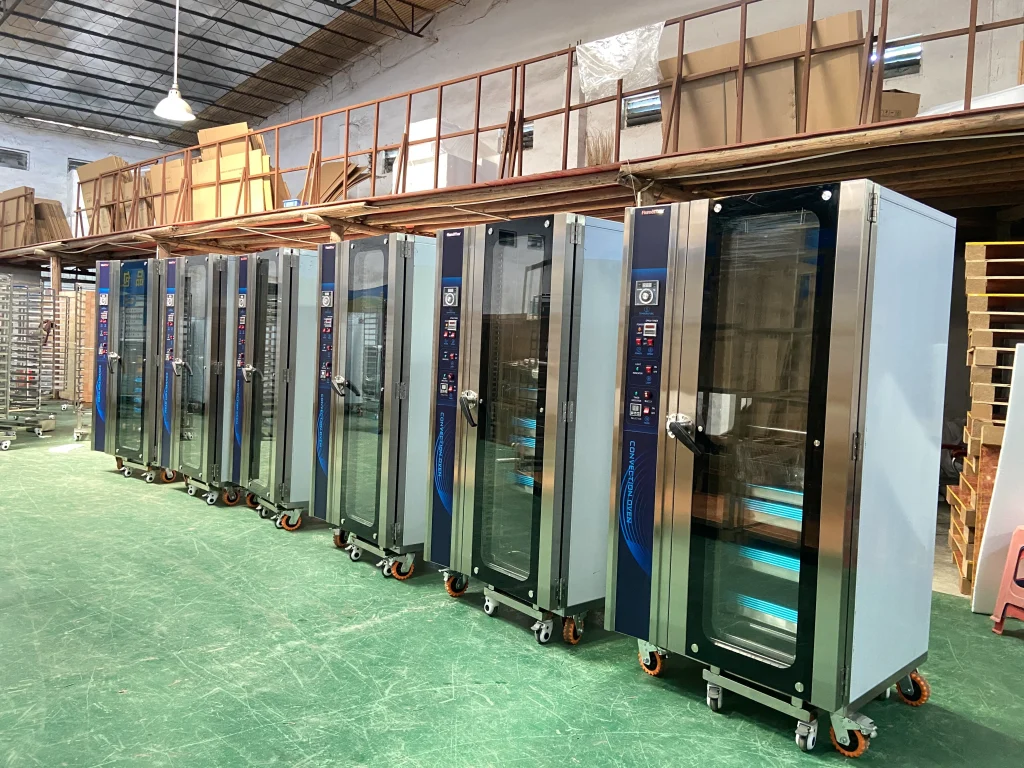
The fundamental difference in deck oven vs convection oven selection is the way thermal energy reaches the product. A deck oven transfers a significant portion of heat through conduction from the heated baking deck and radiation from the oven chamber. This creates a stable thermal environment that is particularly valuable for bread products requiring strong bottom heat and controlled crust development. A convection oven, by contrast, uses a fan-driven airflow system to circulate hot air around the product. The result is faster and more uniform air-side heat transfer, particularly when several trays are loaded simultaneously.
In engineering terms, the choice should consider product mass, moisture content, surface area, loading density, and desired crust characteristics. For example, a 60–80 mm thick artisan loaf behaves very differently from a thin laminated pastry or a sponge cake. The oven’s heat-transfer method influences how quickly the surface dries, how rapidly the internal temperature rises, and how effectively the product maintains its desired shape.
- Deck oven: typically preferred when strong bottom heat, controlled radiation, and independent deck-zone management are important.
- Convection oven: typically preferred when multi-tray production, rapid airflow-based heating, and flexible batch scheduling are priorities.
- For bread, target stable chamber temperature with sufficient thermal recovery after loading rather than relying only on maximum rated temperature.
- For delicate products, evaluate fan speed and airflow distribution because excessive air velocity can dry exposed surfaces prematurely.
- For high-volume production, specify temperature recovery performance after door opening as a purchasing criterion.
Thermal Recovery Under Real Production Conditions
Laboratory temperature stability does not necessarily represent production performance. Opening the oven door can introduce a large volume of cooler, humid air. In a bakery operating at 30–35°C ambient temperature with 70–90% relative humidity, the thermal load on the oven is substantially different from a climate-controlled factory. A strong oven design therefore requires adequate insulation, efficient heating elements or burners, reliable controls, and a chamber geometry that minimizes thermal dead zones.
For a deck oven, the thermal mass of the deck can help stabilize baking conditions between batches. This is useful for products such as sourdough, baguettes, pizza-style breads, and hearth loaves. For a convection oven, rapid air circulation can accelerate recovery, but airflow must be balanced to prevent hot spots or excessive surface drying. A professional manufacturer should therefore evaluate the complete thermal system rather than simply comparing rated kW.
Bread, Pastry, and Cake Use Cases: Matching Oven Technology to Product Mix
Product mix is often the decisive factor in deck oven vs convection oven selection. A bakery focused primarily on crusty bread may benefit from the thermal behavior of a deck oven, while a retail bakery producing cookies, Danish pastries, muffins, cakes, and multiple tray-based products may achieve greater flexibility with a convection oven. The right solution may also be a combination of both technologies rather than selecting one system for every product.
| Application | Preferred Oven | Typical Operating Range | Key Engineering Requirement | Production Priority |
|---|---|---|---|---|
| Artisan bread | Deck oven | 200–250°C | Strong deck heat and stable chamber temperature | Crust and oven spring |
| Baguette | Deck oven | 220–250°C | Balanced top/bottom heat and steam capability | Thin crisp crust |
| Danish pastry | Convection oven | 165–190°C | Controlled airflow and even tray heating | Layer definition |
| Cookies | Convection oven | 150–180°C | Uniform airflow across trays | Batch consistency |
| Sponge cake | Convection oven | 150–175°C | Stable temperature with moderate airflow | Volume and moisture retention |
| Pizza-style bread | Deck oven | 250–300°C | High deck temperature and radiant heat | Bottom browning |
Bread Production
For bread, the deck oven often provides a stronger process advantage because the baking surface directly contributes thermal energy to the dough. This is especially important for heavy dough pieces where rapid bottom heat supports expansion before the crust fully sets. Steam, when required, can also help delay surface drying and improve crust appearance. A bakery producing 500–1,000 kg of bread per day should evaluate deck loading area, number of chambers, steam system capacity, and temperature recovery as a complete package.
- Use independent top and bottom heat control where product diversity is high.
- Consider 2–4 deck configurations for bakeries requiring different products at different temperatures.
- Maintain consistent dough piece weight to reduce thermal variation between batches.
- For humid environments, ensure steam and exhaust systems are designed to prevent uncontrolled condensation around electrical components.
Pastry and Cake Production
Pastry and cake production often favors the convection oven because multiple trays can be processed efficiently. The moving air improves heat transfer to tray surfaces and can reduce positional differences between shelves when the airflow system is correctly engineered. However, more airflow is not automatically better. Laminated pastry can suffer from premature surface drying, while sponge cake can develop an undesirable skin if airflow is excessive.
For cakes, the control system should provide stable temperature regulation rather than aggressive cycling. For pastry, fan design, fan speed, tray spacing, and exhaust management become important. A professional manufacturer should be able to provide application guidance rather than simply supplying an oven from a standard catalog.
Labor and Loading Workflow: The Oven Must Fit the Human Process
Oven capacity should never be calculated only from chamber dimensions. The practical question is how operators move dough from preparation to baking, baking to cooling, and cooling to packaging. In a busy retail bakery, every unnecessary movement increases labor time and creates opportunities for loading errors. The best deck oven vs convection oven decision is therefore partly an ergonomics decision.
A deck oven can provide an efficient workflow when products are loaded directly onto the deck using a peel or loading system. However, operators must manage hot surfaces and product positioning carefully. A convection oven normally uses racks and trays, which can simplify batch handling, particularly when standardized tray sizes are used throughout the facility.
- Keep the main loading path as short as practical, ideally under 5–8 m between proofing/cold storage and the oven.
- Design rack and tray heights around the operator’s normal working zone to reduce repetitive bending.
- Reserve sufficient clearance in front of the oven for safe door opening and rack movement.
- For high-volume convection production, consider wheeled rack systems to reduce manual tray transfers.
- Use standardized tray dimensions across product families whenever possible.
- Target a loading process that can be completed consistently without requiring operators to leave the production zone repeatedly.
Electrical Environment and Installation Requirements
Electrical design becomes particularly important in a commercial bakery with multiple heating appliances. A typical installation may include an oven, mixer, proofer, refrigeration system, exhaust fan, lighting, and packaging equipment operating simultaneously. Therefore, the oven should be evaluated within the complete electrical load profile, not as an isolated appliance.
For many international commercial bakery projects, a common configuration is 380–415 V, 3-phase, 50 Hz. However, the final specification must always follow the actual local utility supply. Protection should be selected according to rated current, installation method, cable length, ambient temperature, and applicable electrical codes.
- Verify supply voltage and frequency before finalizing the oven specification.
- Confirm rated power, full-load current, phase balance, and recommended protective-device rating.
- Provide appropriate earthing/grounding and electrical isolation according to local regulations.
- For high-humidity electrical environments, specify suitable enclosure protection and component placement.
- Where the bakery is close to the sea, consider salt-laden air and corrosion risk when selecting cabinet materials and exposed hardware.
- Maintain sufficient ventilation around electrical cabinets and control components while preventing direct exposure to washdown water or steam.
Energy and Footprint Trade-Offs: Selecting Capacity Without Over-Sizing
Energy efficiency is not simply a question of choosing the oven with the lowest nameplate power. An oversized oven can consume unnecessary energy during warm-up and idle periods, while an undersized oven can force operators to run additional batches, increasing labor and reducing throughput. The correct approach is to match oven capacity to actual production cycles.
For example, a bakery producing small cake batches throughout the day may gain little from a very large deck system if only a fraction of the available deck area is used. Conversely, a wholesale bread producer running continuous high-volume batches may benefit from the thermal stability and production density of a multi-deck system. A convection oven can provide excellent footprint efficiency when standardized trays allow many products to be processed simultaneously.
| Scenario | Production Pattern | Space Priority | Recommended Direction | Main Risk |
|---|---|---|---|---|
| Small retail bakery | Frequent small batches | High | Compact convection oven | Oversizing |
| Artisan bread shop | Large bread batches | Medium | Multi-deck oven | Insufficient deck recovery |
| Mixed bakery | Bread + pastry + cakes | Medium | Deck + convection combination | Incorrect workload allocation |
| Wholesale bakery | Continuous production | Low to medium | High-capacity production oven | Peak electrical demand |
Managing Peak Electrical Demand
In a facility using several electric ovens, simultaneous start-up can create a substantial peak electrical load. A system with several 12–20 kW appliances may have a very different demand profile from a bakery operating one 40–60 kW production oven. The engineering solution can include staged start-up, appropriate control logic, production scheduling, and careful coordination with the site’s transformer and distribution capacity.
For importers and distributors, this is an important commercial point. The oven should not be sold only on chamber size or price. A responsible distributor should understand the customer’s available power supply, production schedule, ventilation requirements, floor space, and expected utilization rate before recommending a configuration.
Footprint, Ventilation, and Environmental Challenges
In compact urban bakeries, floor space can be more valuable than nominal oven capacity. Vertical multi-deck arrangements can increase production density without expanding the production room, while rack-based convection systems can consolidate multiple tray products into one process area. However, thermal output, exhaust requirements, operator clearance, and maintenance access must remain available.
The surrounding high-temperature bakery environment also affects equipment reliability. If the room remains above 35°C for long periods, control components, cooling fans, seals, and electrical equipment may experience additional thermal stress. In humid markets, poor ventilation can increase condensation and corrosion risk. Therefore, the oven specification should include not only baking performance but also ambient temperature, humidity, ventilation, electrical enclosure, and maintenance access requirements.
- Keep the oven away from direct water spray and uncontrolled steam discharge.
- Provide adequate kitchen exhaust to control heat, humidity, and cooking vapors.
- Maintain manufacturer’s recommended service clearances around electrical and mechanical components.
- Plan cleaning procedures so that water cannot enter control panels, motors, or electrical terminals.
- For coastal installations, consider corrosion-resistant materials and routine inspection of exposed metal components.
How to Choose Between Deck Oven vs Convection Oven for a Mixed Production Bakery
There is no universal winner in the deck oven vs convection oven discussion. The correct choice depends on product mix, batch size, labor model, available electrical capacity, floor area, climate, and expected daily utilization. A bakery dominated by artisan bread may obtain better product quality and workflow from a deck oven. A bakery focused on cakes, cookies, pastries, and standardized trays may gain flexibility from a convection oven.
For a mixed bakery, combining technologies can be the most technically rational solution. A two- or three-deck system can handle bread and high-temperature products, while a convection unit handles tray-based pastry and cake production. This separates thermal processes and allows each oven to operate closer to its ideal working range.
Recommended Engineering Selection Checklist
- Define daily production volume in kg or trays rather than relying only on oven chamber volume.
- Identify the percentage split between bread, pastry, cake, cookies, and specialty products.
- Record actual electrical supply voltage, phase configuration, frequency, and available connected load.
- Measure ambient temperature and relative humidity during peak production periods.
- Evaluate available floor area, operator clearance, exhaust routes, and maintenance access.
- Compare heat recovery after realistic door-opening and loading cycles.
- Calculate expected utilization during normal and peak production, targeting practical rather than theoretical capacity.
- Specify controls, sensors, insulation, electrical protection, and materials according to the actual operating environment.
- Ask the manufacturer or qualified distributor for application-specific recommendations rather than selecting purely from a standard price list.
Engineering Conclusion: Design the Oven Around the Production Scenario
The best deck oven vs convection oven decision comes from matching heat transfer, product characteristics, operator workflow, electrical infrastructure, environmental conditions, and production economics. A correctly sized deck oven, convection oven, or combined system can improve consistency while controlling energy and labor costs. Send us your product mix, capacity target, electrical supply, and installation conditions for a tailored engineering proposal.


 English
  Español
  Français
  Italiano
  日本語
日本語  Deutsch
  Русский
  한국어
한국어  简体中文
简体中文