
Why Does the Same Recipe Bake Unevenly in Different Commercial Ovens?
For importers, distributors, bakeries, hotels, and restaurant chains, oven selection is not only about capacity or price. The real problem appears after delivery: cakes collapse, bread colors unevenly, frozen snacks need longer baking, and kitchen staff complain about unstable output. This creates rework, higher energy cost, and after-sales pressure for the Supplier. The main cause is often a mismatch between convection airflow, thermal recovery speed, temperature uniformity, and the actual food process. Choosing between a convection oven and a conventional oven requires a clear understanding of heat transfer, menu type, batch volume, and commercial kitchen workflow.
A convection oven uses fan-forced hot air to improve heat distribution, while a conventional oven mainly relies on radiant and natural heat. Foshan Nanhai Flamemax Catering Equipment Co., Ltd. provides commercial oven solutions for B2B buyers, with Customizable, OEM, and ODM options for distributors seeking stable baking performance and bulk supply.
To make a practical decision, buyers should compare more than the external size or tray quantity. The following guide explains operating principles, suitable recipes, technical differences, selection logic, and common questions from commercial kitchen equipment purchasers.
What Is a Convection Oven?
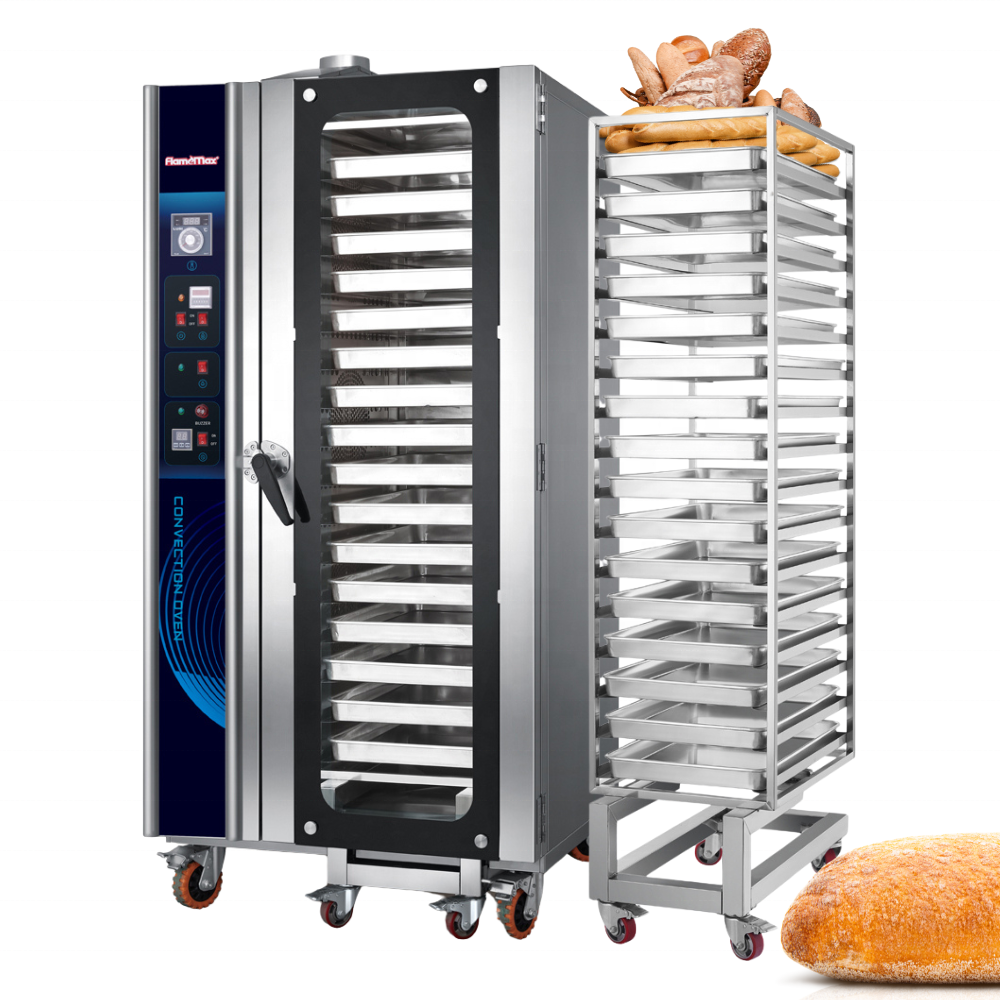
A convection oven is an oven equipped with one or more fans that circulate hot air inside the baking chamber. In commercial applications, this airflow helps transfer heat faster and more evenly across trays. The fan works with electric heating elements or gas burners, depending on the oven design.
The core technical principle is forced convection heat transfer. Instead of waiting for still hot air to move naturally, the fan pushes heated air around the food surface. This improves temperature uniformity, reduces hot spots, and supports faster baking for many products.
Benefits of Using Convection
- Faster baking speed: Many products can bake about 10% to 25% faster compared with conventional heating, depending on recipe and load.
- Better color consistency: Air circulation helps bread, cookies, pastries, and roasted products develop more even surface browning.
- Higher tray efficiency: Multi-layer baking is more stable because heat reaches different rack levels more evenly.
- Improved production control: For bakeries and foodservice chains, repeatable output is important for brand consistency.
- Lower operation pressure: Shorter cycles may improve kitchen workflow during peak hours.
Commercial convection ovens are widely used for bakery equipment, frozen food reheating, pastries, cookies, roasted chicken, pizza snacks, and catering production. For a Manufacturer serving international wholesale buyers, convection design is especially important when customers need stable quality across different markets.
What Is a Conventional Oven?
A conventional oven uses heating elements or burners without active fan circulation. Heat is transferred mainly by radiation from the top or bottom heating source and by natural convection inside the chamber. This heating method is slower and less aggressive than fan-forced convection.
In many commercial kitchens, conventional ovens are still valuable. They provide gentle heat, which is suitable for certain recipes that require controlled rise, moisture retention, or less surface drying.
Ideal Use Cases
- Cakes and sponge products: Gentle heat can reduce the risk of surface cracking or uneven rise.
- Custards and delicate desserts: Lower airflow helps maintain texture and moisture.
- Traditional roasting: Some chefs prefer slower heat penetration for specific meat textures.
- Small-volume kitchens: For light-duty use, conventional ovens may offer simpler operation and lower initial cost.
The main limitation is temperature variation. Without forced airflow, the chamber may have hotter and cooler zones. Operators often need to rotate trays manually. For distributors or wholesalers, this can become an after-sales issue when end users expect fast and uniform baking but choose a basic oven only because of price.
Convection vs. Conventional: Side-by-Side Comparison
The difference between these two oven types can be summarized through heat transfer, baking speed, recipe compatibility, and commercial workflow. The table below gives a practical reference for B2B purchasers and kitchen equipment distributors.
| Comparison Item | Convection Oven | Conventional Oven |
|---|---|---|
| Heating Method | Fan-forced hot air with active circulation | Radiant heat and natural air movement |
| Heat Distribution | More uniform across multiple trays | More likely to have hot and cold zones |
| Baking Speed | Usually faster by about 10% to 25% | Slower, depending on chamber size and load |
| Typical Temperature Setting | Often set about 10°C to 20°C lower than conventional recipes | Uses standard recipe temperature |
| Best For | Bread, cookies, pastries, frozen snacks, roasting, batch baking | Cakes, custards, delicate desserts, traditional baking |
| Operator Skill Requirement | Requires understanding of airflow and temperature adjustment | Simpler for traditional recipes but may require tray rotation |
| Commercial Value | Better for high-volume production and chain kitchens | Suitable for low-volume or specific recipe needs |
Technical Performance Reference
Actual performance depends on chamber design, insulation, heater power, fan speed, tray spacing, and door sealing. For professional procurement, buyers should compare key parameters before confirming bulk orders.
| Technical Parameter | Recommended Commercial Focus | Why It Matters |
|---|---|---|
| Temperature Range | Approx. 50°C to 300°C | Covers bakery, roasting, reheating, and snack production needs |
| Temperature Uniformity | Lower chamber variation is preferred | Improves color consistency and reduces food waste |
| Tray Capacity | Match with 400x600mm or local tray standards | Ensures compatibility with bakery workflow |
| Recovery Time | Fast recovery after door opening | Maintains stable output during peak production |
| Insulation | High-density heat insulation structure | Reduces heat loss and improves operator safety |
| Electrical Components | Use high-temperature resistant wires and reliable controls | Supports durability in commercial kitchen environments |
Use the Right Oven Type for Your Recipe
The best oven is not always the most expensive model. It is the oven that matches the recipe, volume, operator skill, and market positioning. A hotel supplies distributor may need one oven series for bakery clients and another for small restaurants. A chain kitchen may need consistent batch output, while a boutique bakery may need more control over delicate products.
When to Choose a Convection Oven
- The customer needs high-volume baking with multiple trays.
- The menu includes bread, cookies, croissants, pastries, frozen snacks, or roasted food.
- The buyer wants faster turnover during peak business hours.
- The distributor wants a product line with stronger technical selling points.
- The end user cares about consistent browning and lower food waste.
When to Choose a Conventional Oven
- The recipe is sensitive to strong airflow.
- The customer mainly bakes cakes, custards, or delicate desserts.
- The kitchen volume is limited and investment budget is strict.
- The operator prefers traditional baking methods.
Practical Adjustment Rules
When changing from conventional baking to convection baking, the operator should not simply copy the same recipe settings. A common method is to reduce the temperature by about 10°C to 20°C or reduce baking time by about 10% to 25%. Trial baking is still necessary because flour type, dough moisture, tray material, food thickness, and loading quantity all affect results.
For B2B buyers, it is also important to check whether the oven can support Customizable branding, control panels, carton design, voltage requirements, and plug standards. A professional Supplier should provide clear specification sheets, packing options, inspection records, and after-sales technical support. FLAMEMAX supports commercial kitchen equipment buyers with OEM and ODM service for market-specific requirements.
FAQs About Oven Types
Is a convection oven better than a conventional oven?
A convection oven is better for many commercial applications because it offers faster heat transfer, better airflow, and more even baking. However, it is not always better for every recipe. Cakes, custards, and delicate products may perform better in a conventional oven or with reduced fan intensity.
Can convection ovens replace conventional ovens completely?
In some kitchens, yes. In others, no. Large bakeries, fast-food chains, and catering production sites often prefer convection ovens because of speed and consistency. However, pastry shops and dessert kitchens may still keep conventional ovens for specific recipes that need gentler heat.
Why do some products dry out in a convection oven?
Strong airflow increases surface evaporation. This is useful for browning and crisping, but it can dry certain foods. Operators can reduce temperature, shorten baking time, use steam assistance if available, or choose recipes designed for fan-assisted baking.
What should importers check before buying commercial ovens in bulk?
Importers should check heater power, temperature range, tray size, chamber material, fan system, insulation quality, packing method, and inspection process. They should also confirm whether the Manufacturer can provide stable production capacity, spare parts support, and documentation for local market sales.
Are convection ovens suitable for OEM and ODM projects?
Yes. Convection ovens are suitable for OEM and ODM projects because buyers often need different logos, control panel languages, voltage options, appearance designs, and packing solutions. For wholesale distributors, this helps build a private brand and improve market competitiveness.
What makes a commercial oven reliable for long-term use?
Reliability depends on structural design and manufacturing control. Important factors include stainless steel construction, stable heating elements, high-temperature electrical parts, accurate thermostats, strong hinges, durable door seals, safe wiring, and 100% inspection before packing. These details directly affect warranty cost and customer satisfaction.
Conclusion
Convection ovens offer speed, consistency, and batch efficiency, while conventional ovens suit gentler baking needs. For distributors seeking commercial oven solutions, FLAMEMAX provides Manufacturer-level support, Customizable designs, OEM/ODM service, and technical guidance for wholesale projects. Contact [email protected] for product consultation.


 English
  Español
  Français
  Italiano
  日本語
日本語  Deutsch
  Русский
  한국어
한국어  简体中文
简体中文