
Why Do So Many Commercial Kitchens Struggle to Achieve Consistent Baking Results?
Many bakery owners, restaurant operators, and catering equipment distributors invest in new ovens expecting faster production and better food quality, only to face uneven baking, inconsistent textures, and higher energy costs. In many cases, the problem comes from choosing the wrong oven type for specific cooking applications. Understanding the differences between a convection oven and a conventional oven can help commercial buyers improve efficiency, product quality, and kitchen productivity. Selecting the right equipment from a reliable Manufacturer or Supplier also plays a major role in long-term operational success.
A convection oven uses an internal fan to circulate hot air evenly around food, while a conventional oven relies on natural heat movement without forced airflow. Convection ovens usually cook faster and more evenly, making them ideal for commercial baking and roasting. Conventional ovens are often preferred for delicate recipes that require gentler and more stable heat distribution.
For importers, distributors, and foodservice businesses, understanding these oven differences is essential before purchasing commercial kitchen equipment. The following guide explains how each oven works, their advantages, and how to choose the right solution for different cooking environments.
Is a Conventional Oven the Same as a Convection Oven?
Although both appliances are designed for baking, roasting, and cooking, a convection oven is not the same as a conventional oven. The major difference lies in how heat is distributed inside the cooking chamber.
A conventional oven generates heat through top and bottom heating elements. The hot air remains relatively stationary, which can create uneven temperature zones inside the oven cavity. Foods placed closer to the heating source may cook faster than those located farther away.
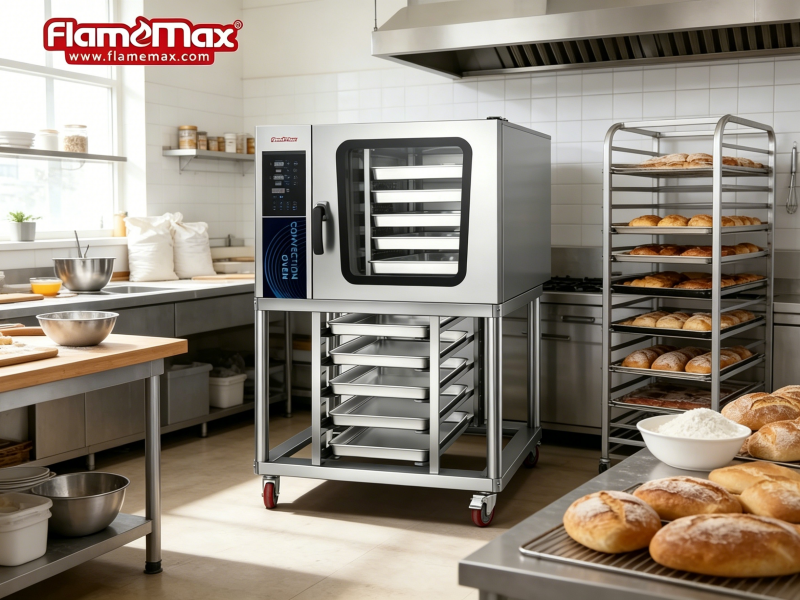
By comparison, what is a convection oven? A convection oven includes one or more internal fans that continuously circulate hot air around the food. This airflow creates a more uniform cooking environment and improves heat transfer efficiency.
For commercial kitchens, this distinction can significantly affect food quality, cooking speed, and production consistency. Bakeries, restaurants, and catering chains often choose convection ovens because they support higher output while maintaining stable baking performance.
Key Differences Between Convection and Conventional Ovens
Heat Distribution
The most important difference between a conventional oven convection system is airflow. Conventional ovens rely on natural heat circulation, while convection ovens actively move heated air with fans.
This forced airflow helps convection ovens eliminate cold spots and maintain more even temperatures across multiple trays. For commercial baking operations, this feature is particularly valuable because it improves product consistency and reduces batch variation.
Cooking Speed
A convection oven for baking generally cooks food 20% to 30% faster than a traditional oven. The moving hot air transfers heat more efficiently to the food surface, shortening cooking times.
Faster cooking can help commercial kitchens improve operational efficiency during peak business hours. Restaurants and bakery chains can increase production capacity while reducing energy consumption per batch.
Food Texture and Browning
Convection ovens are widely known for producing crispier exteriors and more even browning. The circulating air removes moisture from the food surface more quickly, which helps create golden crusts and better roasting results.
This makes convection ovens highly suitable for pastries, cookies, roasted meats, pizza, and baked snacks. However, some delicate products such as soufflés, custards, or sponge cakes may perform better in a conventional oven because gentler airflow reduces the risk of collapse or uneven rising.
Energy Efficiency
Commercial convection ovens are often more energy-efficient because they cook at lower temperatures and shorter times. Many operators lower cooking temperatures by approximately 25°F compared to conventional settings.
For hotels, fast-food chains, and large-scale catering businesses, reduced cooking time can translate into lower electricity usage and higher operational efficiency over time.
Equipment Cost
Convection ovens are usually more expensive than conventional ovens due to their additional fan systems and advanced airflow technology. However, many foodservice businesses consider the investment worthwhile because of improved productivity and better cooking consistency.
Professional OEM/ODM kitchen equipment manufacturers often provide customized convection oven solutions tailored to different market requirements, helping distributors and importers strengthen their local product competitiveness.
When to Use Each Oven Type
Best Applications for Convection Ovens
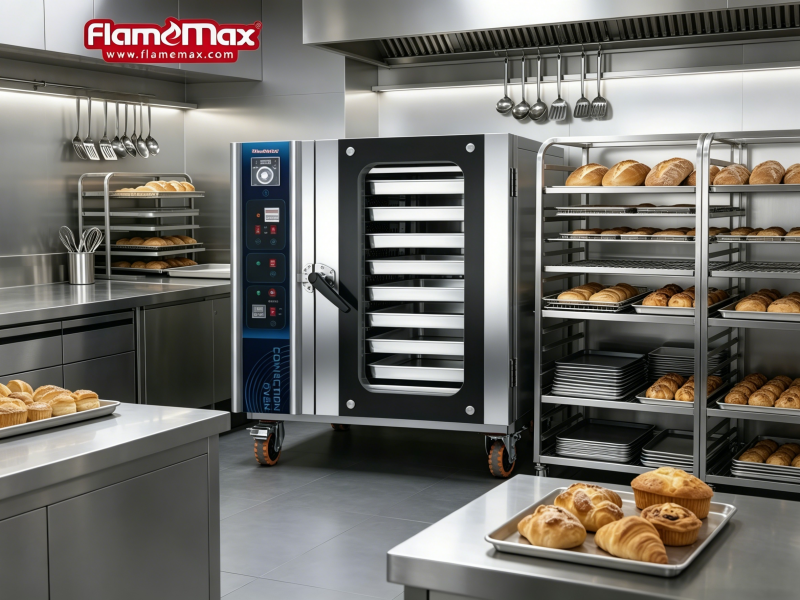
A convection oven for baking is commonly used in commercial bakeries, restaurants, cafés, and fast-food kitchens that require high production efficiency and uniform cooking results.
Convection ovens are ideal for:
- Baking cookies and pastries
- Roasting chicken, meat, and vegetables
- Cooking pizza and bread products
- Preparing frozen foods
- Multi-tray commercial baking
The consistent airflow improves browning and supports large-volume production, making convection ovens highly suitable for professional foodservice environments.
Best Applications for Conventional Ovens
Conventional ovens may still be preferred for recipes that require stable, non-circulated heat. Certain baked goods can be sensitive to moving air, especially products with light batters or delicate structures.
Conventional ovens are commonly used for:
- Cakes and soufflés
- Custards and flans
- Cheesecakes
- Traditional home-style baking
- Recipes requiring slow and gentle cooking
Some chefs also prefer conventional ovens for specific traditional recipes where airflow may alter texture or moisture levels.
Commercial Kitchen Considerations
For commercial buyers, the decision often depends on production scale, menu structure, and customer demand. High-volume foodservice operations usually benefit more from convection technology because it improves speed and consistency.
Importers and distributors frequently cooperate with experienced commercial kitchen equipment Manufacturers that provide customized solutions, including tray capacity options, digital control systems, and voltage configurations for different international markets.
Choosing the Right Setting for Your Needs
Adjusting Temperature and Cooking Time
When switching from a conventional oven to convection mode, operators usually reduce the cooking temperature by approximately 25°F and shorten cooking time by 10% to 20%.
This adjustment helps prevent overcooking while maximizing the efficiency benefits of convection airflow. Many modern commercial ovens include programmable digital controls that simplify this process for kitchen staff.
Understanding Product Requirements
Different foods respond differently to airflow and heat intensity. Crispy foods, roasted meats, and baked snacks generally perform better in convection ovens, while moisture-sensitive desserts may require conventional heat settings.
Commercial kitchens that prepare a wide range of menu items often choose combi or multi-function ovens that allow operators to switch between convection and traditional heating modes.
Selecting the Right Commercial Supplier
Choosing the right oven is not only about cooking performance. Buyers should also evaluate manufacturing quality, after-sales support, spare parts availability, and customization capabilities.
An experienced Supplier with strong OEM/ODM capabilities can help distributors and catering equipment importers develop customized products that match local market requirements. Features such as stainless-steel construction, advanced insulation systems, digital temperature control, and multi-layer safety protection are important considerations for long-term commercial use.
Why Commercial Convection Ovens Continue to Grow in Demand
As bakeries and restaurants focus more on efficiency and product consistency, global demand for commercial convection ovens continues to increase. Faster cooking speed, improved energy efficiency, and uniform baking performance make convection technology attractive for modern foodservice operations.
For distributors and wholesalers, partnering with a reliable commercial kitchen equipment Manufacturer can help ensure stable product quality and long-term business growth in competitive catering equipment markets.
Conclusion
Understanding the differences between a convection oven and a conventional oven helps commercial buyers choose equipment that improves efficiency, consistency, and food quality. The right oven selection can support better kitchen performance, stronger customer satisfaction, and long-term operational success.



 English
  Español
  Français
  Italiano
  日本語
日本語  Deutsch
  Русский
  한국어
한국어  简体中文
简体中文