
High-Load Retail Electrical Environments and Intensive Daily Cleaning Challenges
A busy cinema, amusement venue, supermarket, hotel lobby, or event concession area can turn a seemingly simple popcorn operation into a demanding engineering problem. Peak traffic creates long operating periods, rapid batch turnover, and constant exposure to heat, oil vapor, sugar, salt, dust, and food debris. At the same time, the equipment may share a circuit with refrigerators, lighting, POS terminals, or other concession appliances, creating limited electrical capacity and fluctuating load conditions. If the kettle is undersized, operators face queues, inconsistent freshness, and lost sales. If it is oversized, energy consumption, cleaning labor, and countertop footprint increase unnecessarily. The real problem is not simply choosing a larger commercial popcorn machine; it is matching kettle capacity, production rate, electrical topology, warming configuration, operator ergonomics, and cleaning access to the actual application.
For high-volume cinema and concession use, our professional recommendation is a 12–16 oz kettle commercial popcorn machine with approximately 2.5–4.0 kW heating power, 6–10 minute batch cycles, dedicated circuit protection, and an accessible kettle-and-pan cleaning design. As an experienced Manufacturer and Supplier, we engineer popcorn machine capacity around real operating loads, not nominal specifications alone.
Retailers, importers, wholesalers, and distributors should look beyond catalog dimensions and advertised commercial popcorn machine price. The following application cases explain how experienced buyers can match equipment architecture to traffic, power availability, merchandising requirements, and daily sanitation routines.
Kettle Capacity and Batches per Hour
Matching Popcorn Machine Capacity to Peak Demand
Kettle sizing should begin with peak demand rather than average daily sales. In a cinema lobby, for example, sales may be concentrated into 15–30 minutes before a screening. A machine that appears adequate during quiet periods can become a bottleneck when hundreds of customers arrive simultaneously. For engineering purposes, the buyer should estimate the number of finished popcorn portions required during the busiest 30-minute window and then convert that requirement into kettle batches.
A practical commercial calculation is to consider a 12 oz kettle capable of producing approximately 3–4 finished batches per hour under normal operating conditions. A larger 16 oz kettle may support higher throughput, but only if the heating system can recover quickly between batches. The important relationship is not simply kettle volume; it is kettle load × cycle time × operator recovery time.
- 12 oz kettle: suitable for moderate concession traffic and compact retail points.
- 16 oz kettle: preferred for higher-volume cinema, stadium, and entertainment applications.
- Cycle target: approximately 6–10 minutes depending on recipe, heating power, and operator procedure.
- Peak planning: size for the busiest service period, not the average hourly demand.
- Production margin: allow approximately 15–25% additional capacity for demand surges.
Electrical Load Must Follow Production Requirements
Increasing popcorn machine capacity without checking the electrical environment is a common purchasing mistake. A larger kettle normally requires greater heating power and may affect circuit selection, plug configuration, cable specification, and local certification. For an overseas project, the Manufacturer or Supplier should confirm whether the destination market requires 220–240 V single-phase power, 110–120 V single-phase power, or another configuration.
For a concession island with multiple appliances, the system should be evaluated as a complete electrical topology, rather than treating the popcorn machine as an isolated device. For example, a recommended arrangement may be main distribution panel → dedicated branch circuit → overcurrent protection → commercial popcorn machine. Where several appliances share a distribution board, the buyer should verify simultaneous load and avoid placing the popcorn machine on an already heavily loaded circuit.
- Confirm rated voltage and frequency before quotation.
- Verify rated current and recommended circuit protection.
- Check plug and socket standards for the destination country.
- Consider voltage drop where equipment is installed far from the distribution panel.
- Request factory electrical drawings for large multi-machine installations.
| Application | Typical Kettle | Target Batch Cycle | Recommended Production Approach | Electrical Consideration |
|---|---|---|---|---|
| Small retail shop | 6–8 oz | 8–10 min | Low to moderate volume | Standard dedicated branch circuit |
| Cinema lobby | 12–16 oz | 6–9 min | High peak volume | Dedicated circuit and load planning |
| Stadium concession | 16 oz+ | 5–8 min | Very high peak demand | High-load distribution planning |
| Mobile event cart | 8–12 oz | 7–10 min | Variable demand | Portable power or dedicated supply |
Countertop vs Cart
Countertop Systems for Permanent Retail Locations
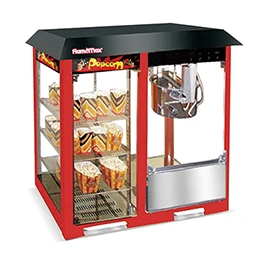
A countertop commercial popcorn machine is generally the better engineering choice when the equipment will remain in one location. Supermarkets, cinemas, convenience stores, hotel breakfast areas, and indoor entertainment venues often have a fixed counter with access to permanent electrical supply. In this configuration, the machine can be positioned at a comfortable operating height while the counter provides additional storage for kernels, oil, packaging, scoops, and cleaning materials.
Human ergonomics should influence the specification. Operators may open the kettle dozens of times during a busy shift, so excessive reaching, bending, or twisting creates unnecessary fatigue. The working surface should allow the operator to see the kettle, remove finished popcorn, and access controls without reaching across hot surfaces.
- Keep primary controls within comfortable standing reach.
- Provide sufficient rear and side clearance for ventilation and servicing.
- Keep packaging materials away from hot kettle surfaces.
- Position the machine where customers can see production without obstructing the operator.
- Ensure the counter can support the machine’s operating weight safely.
Cart Systems for Flexible Concession Operations
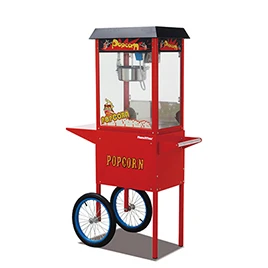
A popcorn cart is advantageous when visual merchandising and mobility are important. Event organizers, amusement parks, shopping centers, outdoor festivals, and temporary concession operators may change the selling location throughout the day. However, mobility introduces additional engineering challenges. The buyer must consider portable electrical supply, extension-cable limitations, uneven flooring, outdoor environmental exposure, and cable routing.
The cart should not be selected only because it looks attractive. Wheel diameter, locking casters, center of gravity, working height, and access to service components all affect operational safety. For outdoor applications, the operator should also consider humidity, dust, wind-blown debris, rain exposure, and temperature variation. Unless the machine is specifically designed and certified for outdoor use, it should remain under suitable weather protection.
- Use locking casters to prevent movement during operation.
- Keep power cables away from customer walking paths.
- Use destination-market-approved electrical accessories.
- Provide weather protection for temporary outdoor installations.
- Check cart dimensions against elevators, doorways, and transport vehicles.
Warming Deck and Display
Freshness, Visibility, and Sales Conversion
The warming deck is more than an accessory; it connects production with merchandising. In a cinema or amusement venue, customers often purchase popcorn because they can see and smell freshly prepared product. A well-designed display chamber allows the operator to produce in controlled batches while maintaining the finished product at an appropriate serving condition.
The design objective is to avoid both underproduction and excessive holding. If the operator prepares too much popcorn during a slow period, product may lose its desirable texture and perceived freshness. If the warming area is too small, the operator may need to stop selling while waiting for another batch. Therefore, the warming volume should be coordinated with kettle capacity, peak customer flow, and expected holding time.
- Match warming volume with the output of the selected kettle.
- Use clear viewing panels for direct product visibility.
- Keep finished popcorn separated from raw ingredients.
- Use accessible serving doors to reduce unnecessary operator movement.
- Design the display around the actual retail portion size.
Display Architecture and Environmental Conditions
In a shopping mall, the machine may operate in an air-conditioned environment with relatively stable temperature and humidity. In contrast, a stadium or outdoor event may experience high ambient temperature, elevated humidity, dust, and rapid environmental changes. These factors influence how quickly the machine reaches operating temperature and how the product behaves during holding.
The equipment layout should also separate the customer-facing display zone from the service zone. A practical system topology is customer viewing area → illuminated display chamber → operator access door → kettle and heating assembly → rear service area. This arrangement allows merchandising to remain attractive while maintenance personnel can reach critical components without dismantling the entire cabinet.
For importers and distributors, display configuration can also influence commercial popcorn machine price. Lighting, stainless-steel construction, decorative panels, warming functions, cart architecture, and custom branding all contribute to total cost. The right approach is to define which features increase actual sales value before comparing supplier quotations.
Cleaning Access
Daily Cleaning Should Be Designed Into the Machine
Commercial popcorn equipment is exposed to oil, kernels, seasoning, and food residue every operating day. Cleaning therefore cannot be treated as an after-sales inconvenience. A professional commercial popcorn machine should be designed so that operators can reach high-residue areas quickly and safely. If cleaning requires complicated disassembly, staff may postpone it, eventually creating odor, carbonized oil deposits, poor appearance, and avoidable service calls.
The kettle is the highest-priority cleaning area because oil and seasoning residue accumulate around the cooking chamber. Handles, hinges, drain points, doors, trays, and the bottom of the cabinet also deserve routine attention. A good design uses removable or accessible components while minimizing the number of small parts that can be misplaced.
- Provide direct access to the kettle and surrounding surfaces.
- Use smooth stainless-steel surfaces where practical.
- Minimize inaccessible corners where oil and crumbs can accumulate.
- Make removable trays easy to lift without excessive force.
- Separate electrical components from routine wet-cleaning zones.
- Allow adequate cooling time before deep cleaning hot components.
Electrical Protection During Cleaning
Cleaning becomes particularly important when the equipment is installed in a high-moisture food-service environment. Operators must understand that a washable food cabinet does not mean the entire electrical system can be sprayed directly. The design should maintain a clear separation between the food-contact/cleaning zone and electrical control zone.
For a permanent installation, the recommended arrangement is dedicated branch circuit → approved isolation/protection device → machine power input → protected internal control system → heating and lighting loads. Before cleaning, the operator should follow the manufacturer’s shutdown procedure and ensure that energized electrical components are protected from water and cleaning chemicals.
For international buyers, the Manufacturer and Supplier should provide cleaning instructions together with electrical documentation. This is particularly important for distributors who must train multiple end users across different countries. Clear instructions reduce misuse, warranty disputes, and avoidable equipment downtime.
Application-Specific Selection and Commercial Popcorn Machine Price
Why the Lowest Quotation Is Not Always the Lowest Cost
When buyers compare commercial popcorn machine price, they often focus on kettle size and cabinet appearance while overlooking total operating cost. A low-priced machine may have insufficient heating recovery, limited cleaning access, weaker structural components, or an electrical configuration that does not fit the destination market. These issues can increase labor, downtime, and replacement costs after installation.
A professional purchasing evaluation should therefore compare equipment using a total-cost framework. For example, a cinema distributor should consider expected batches per hour, operating hours per day, cleaning time, energy demand, spare-parts availability, and warranty support. A supermarket may place greater emphasis on compact dimensions and easy sanitation, while an event operator may prioritize cart mobility and rapid setup.
- Compare actual output rather than kettle volume alone.
- Confirm rated electrical parameters before finalizing the order.
- Evaluate cleaning time as a labor cost.
- Check spare-parts and technical-support availability.
- Consider expected service life rather than initial purchase price only.
- Request application-specific recommendations from an experienced Supplier.
What a Professional Manufacturer Should Confirm Before Production
A reliable Manufacturer should collect application data before recommending a model. This process reduces the risk of selecting equipment that looks correct in a catalog but performs poorly in the customer’s actual environment. For international projects, our engineering review normally considers the sales location, expected daily and peak volume, installation position, electrical infrastructure, customer flow, cleaning method, and display requirements.
- Country and destination electrical standard.
- Available voltage, frequency, and circuit capacity.
- Required popcorn machine capacity and expected peak output.
- Countertop or cart installation.
- Indoor, semi-outdoor, or protected outdoor environment.
- Required display and warming configuration.
- Cleaning frequency and operator skill level.
- Packaging, branding, certification, and import requirements.
This engineering-first process is especially valuable for wholesalers and distributors because one standardized model may be deployed across several markets. Where electrical standards or customer requirements differ, the Supplier can determine which specifications should remain common and which should be customized. That approach provides better consistency without forcing every customer into the same machine configuration.
Practical Procurement Checklist for Retailers and Distributors
From Specification to Installation
Before placing a purchase order, the buyer should translate the application into measurable technical requirements. A useful specification sheet should include the desired kettle size, estimated batches per hour, electrical rating, cabinet dimensions, warming area, cleaning access, and installation conditions. This creates an objective basis for comparing different offers and prevents important requirements from being lost during commercial negotiations.
For example, a high-volume cinema project might specify a 16 oz kettle, rapid recovery, a large visible warming chamber, stainless-steel construction, and a dedicated 220–240 V electrical circuit. A small convenience store may instead require an 8 oz kettle, compact countertop dimensions, lower connected load, and exceptionally simple daily cleaning.
- Define peak demand before selecting kettle capacity.
- Calculate available electrical capacity at the installation point.
- Confirm physical clearance and operator working height.
- Specify display requirements according to customer traffic.
- Review cleaning procedures before approving the final design.
- Request drawings, electrical specifications, and installation instructions.
- Confirm packaging and shipping dimensions for international logistics.
Recommended Engineering Principle
The most reliable selection principle is simple: do not buy capacity that the site cannot power, and do not buy electrical power that the operation cannot convert into useful peak-hour output. Kettle size, heating power, batch time, warming volume, cleaning access, and electrical topology must function as one system. This is where an experienced commercial popcorn machine Manufacturer and Supplier creates measurable value beyond a basic equipment quotation.
Conclusion and Inquiry
The right commercial popcorn machine balances popcorn machine capacity, electrical environment, throughput, display performance, ergonomics, and cleaning access. For a project-specific recommendation, send us your target output, kettle size, voltage, installation environment, and application details, and our engineering team can recommend the appropriate configuration and commercial popcorn machine price.


 English
  Español
  Français
  Italiano
  日本語
日本語  Deutsch
  Русский
  한국어
한국어  简体中文
简体中文