
Electrical Reliability and Maintenance Challenges in Commercial Popcorn Kettles
Commercial popcorn kettles operate under demanding conditions where repeated heating cycles, accumulated oil residues, high ambient temperatures, and continuous production place significant stress on electrical and mechanical components. In cinemas, shopping malls, amusement parks, food courts, and mobile snack concessions, unstable power supplies or poorly configured heating systems can cause inconsistent popping temperatures, excessive energy consumption, and unexpected equipment downtime. These problems become more serious during peak business hours, when operators require continuous production and fast recovery between batches. Without properly selected commercial popcorn kettle parts, suitable popcorn machine heating control, and accessible maintenance arrangements, even a well-designed machine can experience premature component failure. The engineering challenge is therefore to balance heating performance, electrical protection, mechanical reliability, and long-term serviceability across different operating environments.
For commercial popcorn kettles, a practical engineering configuration includes a 220–240V AC power supply, appropriately rated heating elements, temperature control matched to the kettle design, high-temperature-resistant wiring, independent over-temperature protection, and a correctly aligned agitator system. FLAMEMAX specializes in commercial popcorn kettle components and popcorn machine heating control solutions, helping distributors select reliable configurations for cinemas, retail concessions, food courts, and high-volume snack operations.
For equipment importers, wholesale distributors, catering suppliers, and retail equipment operators, selecting the correct component configuration is essential for reducing after-sales costs and maintaining consistent product performance. The following engineering analysis examines practical operating cases, component selection, electrical arrangements, and maintenance strategies for different commercial environments.
1. Identify Wear and Heat-Critical Parts in Different Operating Environments
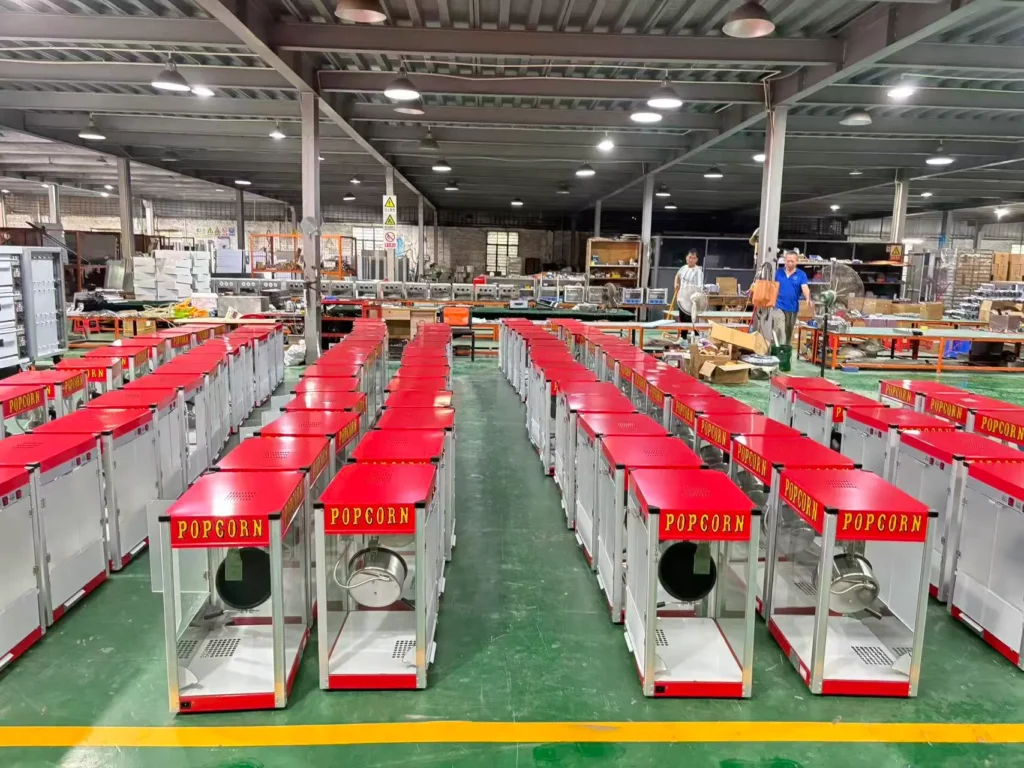
Commercial popcorn kettles combine electrical heating, mechanical agitation, and temperature regulation within a relatively compact assembly. Each operating cycle exposes selected components to thermal expansion, vibration, electrical loading, and contamination. Identifying the parts most likely to deteriorate is therefore the first step in developing a reliable equipment configuration.
Heating Elements and Temperature-Sensitive Components
The heating element is one of the most important commercial popcorn kettle parts because it directly determines how quickly the kettle reaches its operating temperature and how consistently heat is transferred to the kernels. Repeated heating and cooling can gradually affect electrical connections, insulation materials, and the mechanical condition of the heating assembly.
For commercial applications, engineering evaluation should consider the following factors:
- Heating element power: Select the rated wattage according to kettle capacity, supply voltage, and expected production frequency. The actual power rating must match the manufacturer’s electrical specification.
- Electrical insulation: Use insulation materials and terminal assemblies suitable for the maximum operating temperature and electrical load.
- Terminal protection: Protect electrical connections against oil contamination, moisture, accidental contact, and mechanical disturbance.
- Temperature sensing: Position the temperature sensor to obtain representative readings without exposing it to unnecessary mechanical damage.
- Over-temperature protection: Incorporate an independent protective device where required by the equipment’s electrical design.
Wiring, Switches, and Protective Components
Electrical accessories require particular attention because popcorn machines frequently operate in environments where heat, grease, and operator handling occur simultaneously. The high-temperature electrical environment around the kettle can accelerate insulation deterioration if ordinary wiring is installed too close to heating surfaces.
FLAMEMAX engineering recommendations include evaluating the following components during product selection and maintenance:
- High-temperature-resistant power cables and internal connecting wires.
- Temperature-rated terminal blocks and insulated electrical connectors.
- Power switches and control switches with appropriate electrical ratings.
- Thermostats or electronic temperature controllers compatible with the heating circuit.
- Fuses, circuit protection, and grounding arrangements selected according to the machine’s electrical design.
- Motor capacitors and electrical connections, where applicable to the agitator motor configuration.
These components should be assessed as a complete electrical system rather than as isolated replacement parts. A switch with an inadequate current rating, for example, can become a failure point even when the heating element itself is correctly specified.
Mechanical Wear Around the Kettle Assembly
Mechanical components are equally important. Continuous agitation exposes the motor, drive shaft, coupling, mounting brackets, and internal stirring mechanism to repeated movement. Accumulated popcorn fragments and hardened cooking residues may also increase mechanical resistance.
In high-volume cinema operations, these conditions can become more pronounced because the equipment may operate for several hours each day. The engineering inspection should therefore cover motor noise, shaft movement, coupling wear, fastening security, and agitator clearance. Identifying early mechanical deterioration helps distributors prepare suitable replacement commercial popcorn kettle parts before a failure interrupts production.
2. Compare Thermostat and Control Arrangements for Different Production Requirements
Popcorn machine heating control determines how the kettle receives electrical power, how temperature is monitored, and how the heating cycle responds to operating conditions. Different commercial environments require different control priorities. A small retail concession may prioritize simple operation and low maintenance costs, while a cinema concession may require repeatable batch performance and efficient recovery during continuous production.
Mechanical Thermostat Control
A mechanical thermostat generally provides a relatively straightforward temperature-control arrangement. When the sensed temperature reaches the thermostat’s switching point, the heating circuit changes state according to its designed operating characteristics.
This arrangement can be suitable for standard commercial popcorn machines where straightforward operation, accessible replacement, and economical component sourcing are important.
- Simple operating principle and relatively uncomplicated maintenance.
- Suitable for equipment designed around conventional temperature-switching control.
- Replacement thermostats must match the original temperature range, electrical rating, sensor type, and mounting arrangement.
- Temperature differential and switching characteristics should be considered when evaluating heating consistency.
- Periodic inspection is required to identify loose terminals, damaged sensing components, or abnormal switching behavior.
Electronic Temperature Control
Electronic controllers can provide more flexible temperature monitoring and adjustment when the machine design supports this arrangement. Depending on the controller specification, the system may offer digital temperature indication, adjustable setpoints, sensor monitoring, and additional operating functions.
However, electronic control should not automatically be considered superior in every environment. Its suitability depends on the controller’s protection rating, sensor compatibility, electrical noise conditions, temperature resistance, and availability of replacement components.
- Use a compatible temperature sensor, such as the specified thermocouple or resistance sensor.
- Verify the controller’s input voltage and output switching capacity.
- Provide appropriate isolation or switching devices when the heating element exceeds the controller’s direct switching rating.
- Separate low-voltage sensor wiring from high-current heating circuits where practical.
- Provide a clearly identified replacement procedure for the controller and sensor assembly.
Independent Over-Temperature Protection
Temperature regulation and safety protection serve different purposes. The operating thermostat or electronic controller maintains the intended heating condition, while an independent thermal cut-out can interrupt the heating circuit if abnormal temperatures occur.
For this reason, commercial equipment should not depend exclusively on a single temperature-control component for both normal operation and protective shutdown. The final protective arrangement must follow the machine’s electrical design and applicable market requirements.
3. Check Agitator Alignment and Motor Access Before Finalizing the Design
The agitator system helps distribute kernels and cooking oil throughout the kettle during the popping process. Its mechanical performance influences batch consistency, kernel movement, and the likelihood of localized overheating. Even when the heating system operates correctly, poor agitator alignment can create unnecessary mechanical resistance and reduce equipment reliability.
Agitator Shaft Alignment and Mechanical Clearance
The shaft should maintain the alignment specified by the kettle assembly. Excessive radial movement, uneven clearance, or incorrect coupling installation can increase vibration and place additional loads on the motor bearings and mounting structure.
During assembly inspection, the following points should be checked:
- Confirm that the agitator shaft is installed in the correct position and orientation.
- Check the clearance between the stirring mechanism and the kettle’s internal surface.
- Verify that mounting brackets and fasteners are properly secured.
- Rotate the mechanism manually when the equipment is isolated from electrical power, checking for abnormal resistance.
- Inspect the coupling for looseness, deformation, or excessive wear.
- Confirm that the agitator does not interfere with kettle tilting or unloading operations.
Motor Selection and Operating Conditions
The motor should be selected according to the mechanical load, required rotation speed, operating frequency, and available electrical supply. An underspecified motor may experience excessive temperature rise or reduced starting performance, while an unnecessarily oversized motor may increase equipment cost without providing a meaningful operational benefit.
Motor selection should therefore be based on the actual agitator mechanism rather than a general assumption about kettle capacity. Engineers should also consider the motor’s insulation class, enclosure protection, mounting dimensions, rated voltage, and service conditions.
Motor Access and Maintenance Ergonomics
Popcorn machine serviceability depends heavily on whether technicians can inspect and replace components without dismantling unrelated assemblies. In busy retail environments, difficult motor access can increase maintenance time and make routine inspections less likely to be completed.
A service-oriented layout should provide:
- Accessible motor mounting bolts and electrical terminals.
- A clearly identified wiring connection arrangement.
- Sufficient clearance for motor removal and replacement.
- Protection against accidental contact with moving mechanical parts.
- Practical access to the agitator coupling and shaft assembly.
- Clearly separated electrical and mechanical inspection points.
For distributors supplying their own branded equipment, these design considerations are particularly important because easier servicing reduces the complexity of technical training and improves the efficiency of local after-sales teams.
4. Build a Commercial Popcorn Kettle Parts List for Distributor Support
For importers and wholesale distributors, a complete spare-parts strategy is more valuable than purchasing individual components only after equipment failure. A structured parts list helps identify common replacement items, organize warehouse inventory, simplify quotation procedures, and reduce the time required to respond to customer maintenance requests.
Recommended Spare-Parts Classification
Commercial popcorn kettle parts can be divided into several functional groups. This classification allows distributors to organize their inventories according to replacement frequency, technical importance, and compatibility requirements.
| Component Category | Typical Parts | Priority | Main Inspection Focus |
|---|---|---|---|
| Heating system | Heating element, thermostat, thermal cut-out | High | Heating performance and temperature protection |
| Electrical system | Switches, wiring, terminals, connectors | High | Electrical ratings and insulation condition |
| Control system | Temperature controller, sensor, indicator | Medium–High | Sensor accuracy and control compatibility |
| Agitator system | Motor, coupling, shaft, stirring mechanism | High | Alignment, movement, and mechanical wear |
| Structural assembly | Mounting brackets, fasteners, kettle supports | Medium | Mechanical stability and deformation |
| Operating accessories | Handles, switches, lamps, control accessories | Medium | Operator convenience and functional condition |
Inventory Planning for Different Distribution Models
Different distributors require different inventory strategies. A regional importer supplying hundreds of machines annually may need a broader replacement-parts inventory than a retailer purchasing equipment for a single store. Similarly, distributors operating their own service departments should maintain essential components that can be replaced without waiting for international shipments.
The following comparison illustrates how operating conditions influence spare-parts planning:
| Application Environment | Operating Pattern | Inventory Priority | Service Strategy |
|---|---|---|---|
| Cinema concession | Long daily operating hours and peak-period production | Heating elements, thermostats, switches, motors | Preventive inspection and rapid replacement |
| Shopping mall kiosk | Regular daily production with limited service space | Heating controls, wiring, switches | Compact spare-parts storage and accessible maintenance |
| Amusement park | Variable production with seasonal demand peaks | Heating assemblies, motors, electrical accessories | Pre-season inspection and standby components |
| Mobile snack concession | Variable operating hours and potentially changing supply conditions | Electrical protection, connectors, switches, control parts | Compact service kits and supply verification |
These are qualitative inventory priorities rather than universal failure-rate predictions. Actual stock quantities should be calculated using installed machine numbers, operating hours, historical replacement records, local delivery lead times, and the distributor’s service capacity.
Component Identification and Replacement Compatibility
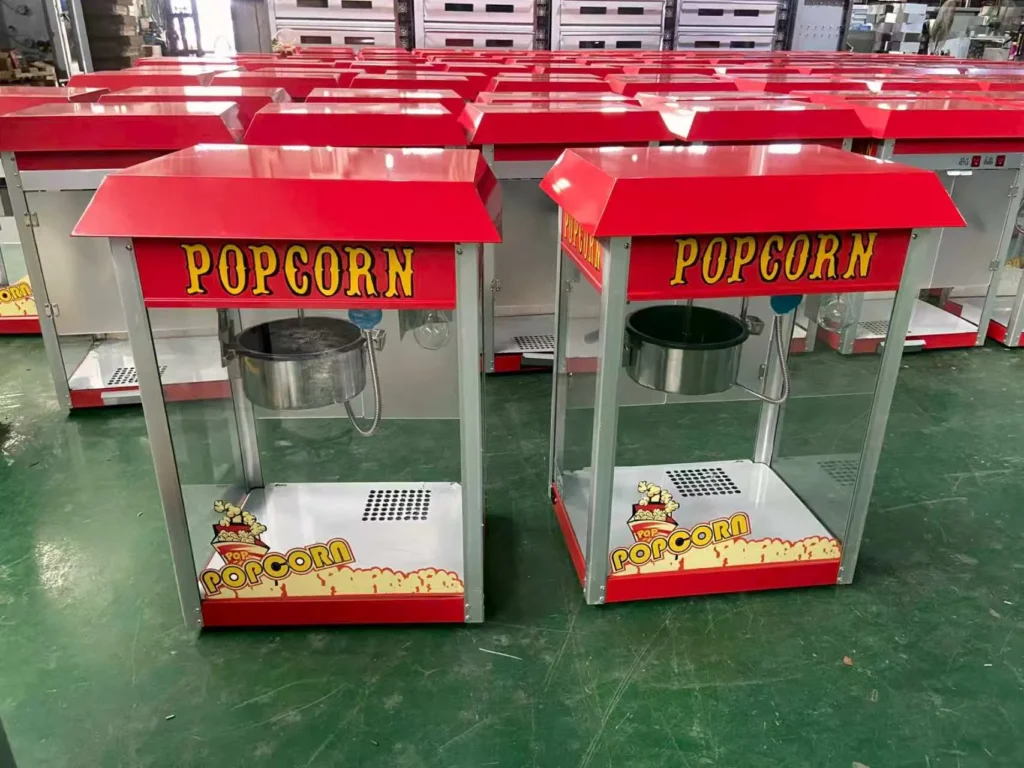
One of the most common difficulties in international spare-parts distribution is component identification. Two popcorn machines may have similar external appearances but use different heating elements, thermostat ranges, motor specifications, or electrical connectors.
To reduce incorrect orders, FLAMEMAX recommends maintaining the following technical information for every equipment model:
- Complete machine model and serial number.
- Kettle capacity and heating element specifications.
- Rated voltage, frequency, current, and power.
- Thermostat type, temperature range, and connection details.
- Motor voltage, power, rotation speed, and mounting dimensions.
- Electrical wiring diagrams and terminal identification.
- Component photographs, dimensions, and replacement references.
Distributors should also establish clear procedures for identifying obsolete components and confirming the compatibility of replacement parts with previous production batches. This is particularly useful for OEM customers selling machines under their own brands.
5. Adapt Electrical System Topology to Different Commercial Locations
Although popcorn machines use relatively straightforward electrical systems, their installation environments can differ significantly. Electrical supply conditions, grounding arrangements, ambient temperature, ventilation, and branch-circuit protection all influence the reliability of the equipment.
Standard Fixed-Retail Installation
Shopping malls, cinemas, and permanent snack counters generally operate with a fixed electrical installation. In this environment, the recommended system topology is based on a protected supply circuit feeding the machine’s main power switch and control assembly, with separate functional branches for heating, agitation, and auxiliary loads where required by the design.
A simplified functional arrangement is:
Building electrical distribution → Branch-circuit protection → Equipment power input → Main switch → Functional control circuits → Heating and agitator loads.
The protective earth connection should be continuous and connected to the equipment’s designated grounding point. Heating and motor circuits should be rated according to their respective electrical loads, and protective devices must be coordinated with the manufacturer’s specifications.
Mobile and Temporary Concession Applications
Mobile snack stands, temporary event counters, and outdoor concessions may encounter longer supply cables, extension connections, fluctuating source conditions, and limited access to professional electrical maintenance. These factors make electrical verification particularly important.
Before commissioning, the installation team should verify:
- Whether the available supply voltage and frequency match the machine rating.
- Whether the electrical source can support the machine’s total operating load.
- Whether cable dimensions and connection methods are appropriate for the current and cable length.
- Whether grounding and circuit protection are correctly provided.
- Whether electrical connections are protected from moisture, accidental pulling, and physical damage.
- Whether the machine has sufficient ventilation and is positioned away from excessive external heat sources.
Where generators or portable power systems are used, their capacity and output stability must be evaluated against the machine’s actual electrical requirements. A generator should not be selected solely according to its advertised maximum output.
Electrical Separation and Control Reliability
Within the equipment, a well-organized electrical control topology can improve fault identification and reduce unnecessary maintenance. Where the design includes electronic temperature control, low-voltage sensor wiring should be routed appropriately in relation to high-current heating cables.
Practical engineering measures include:
- Using clearly identified terminal connections.
- Keeping power wiring and temperature-sensor wiring appropriately separated.
- Providing secure cable routing and strain relief.
- Protecting electrical terminals against accidental contact.
- Ensuring that grounding connections remain accessible for inspection.
- Providing electrical diagrams that correspond to the actual production configuration.
These arrangements are particularly useful for international distributors whose technicians may need to troubleshoot equipment without direct access to the original factory engineering team.
6. Manage Heat, Grease, and Ventilation Challenges in High-Volume Operations
Commercial popcorn machines are frequently installed close to other food preparation equipment, illuminated display counters, and customer service areas. Their surrounding environment may contain elevated temperatures, airborne oil particles, dust, and limited ventilation. These conditions should be considered when evaluating component life and machine placement.
Thermal Management Around the Electrical Assembly
Heat management involves more than selecting a suitable heating element. The motor, wiring, control components, and external housing must also operate within their respective temperature limits.
For this reason, the installation layout should provide appropriate clearance around ventilation openings and avoid placing heat-sensitive electrical accessories directly against the kettle’s hottest surfaces. The final arrangement should be checked against the manufacturer’s installation requirements.
Grease and Contamination Control
Cooking oil residues can accumulate around the kettle, control panel, and nearby structural surfaces. If cleaning procedures are poorly controlled, contamination may eventually affect switches, connectors, and mechanical assemblies.
Recommended operating practices include:
- Allowing the machine to cool and isolating its electrical supply before cleaning or maintenance.
- Removing cooking residues using cleaning methods approved for the equipment’s materials.
- Avoiding direct water spraying onto electrical components.
- Checking cable entries and electrical enclosures for contamination.
- Inspecting moving components for hardened residues that may increase mechanical resistance.
- Maintaining unobstructed ventilation openings.
Environmental Differences Between Indoor and Outdoor Operations
Indoor cinema installations usually offer more stable environmental conditions than temporary outdoor concessions. However, indoor locations may still experience elevated ambient temperatures due to nearby ovens, fryers, and dense equipment arrangements. Outdoor environments can introduce additional concerns involving humidity, condensation, dust, and changing electrical supply conditions.
Therefore, component selection should consider the actual installation environment instead of assuming that all commercial popcorn machines operate under identical conditions. Enclosure protection, electrical insulation, ventilation, and cleaning access should be evaluated together.
7. Improve Popcorn Machine Serviceability Through Modular Maintenance Design
For importers and distributors, long-term equipment performance is closely connected to maintenance efficiency. A machine that is technically reliable but difficult to repair can still create significant after-sales expenses. Popcorn machine serviceability should therefore be considered during product selection, OEM customization, and production engineering.
Design for Practical Component Replacement
A modular arrangement allows frequently serviced components to be inspected and replaced without unnecessarily dismantling the entire machine. Heating controls, switches, motors, and electrical terminals should be positioned according to the equipment’s structural design and maintenance requirements.
Useful design considerations include:
- Accessible control-panel fastening points.
- Clearly identified electrical connectors.
- Practical access to the heating assembly.
- Standardized mounting arrangements where technically appropriate.
- Removable covers that permit inspection without damaging the housing.
- Consistent component identification across the same equipment series.
Maintenance Procedures for Local Service Teams
Distributors with their own after-sales departments benefit from standardized inspection procedures. Instead of relying entirely on individual technician experience, a structured maintenance checklist helps ensure that important components are examined consistently.
A practical inspection schedule can include:
| Inspection Stage | Recommended Checks | Maintenance Objective |
|---|---|---|
| Before operation | Power cable, grounding, external condition, ventilation | Confirm installation readiness |
| Routine cleaning | Kettle residues, control-panel cleanliness, mechanical obstruction | Reduce contamination and operating resistance |
| Periodic inspection | Terminals, heating response, thermostat operation, motor noise | Identify deterioration before failure |
| Component replacement | Part number, electrical rating, mounting dimensions, connection arrangement | Maintain equipment compatibility |
| After maintenance | Electrical safety, functional operation, protective-device verification | Confirm correct restoration of the machine |
Inspection intervals should be determined by operating hours, environmental conditions, manufacturer instructions, and local safety requirements. Electrical testing and repairs should only be performed by qualified personnel using appropriate isolation procedures.
8. Establish Factory Quality Control for Consistent Replacement Parts
For international wholesalers, product consistency is essential because a replacement component must perform correctly across the distributor’s installed equipment base. Inconsistent dimensions, electrical specifications, or material quality can create additional maintenance problems even when the replacement part appears visually similar to the original.
Material Selection and Manufacturing Accuracy
FLAMEMAX manufactures commercial catering equipment using mid-to-high-end materials and advanced production processes, including laser cutting, bending, welding, and polishing. These manufacturing capabilities support dimensional consistency, structural quality, and a professional equipment appearance.
For popcorn machine components, quality evaluation should focus on:
- Dimensional consistency and correct mounting interfaces.
- Electrical component ratings and material specifications.
- Insulation condition and terminal connection quality.
- Mechanical alignment and assembly accuracy.
- Surface finishing and resistance to normal operating contamination.
- Functional compatibility with the corresponding equipment model.
Inspection Before Packaging and Shipment
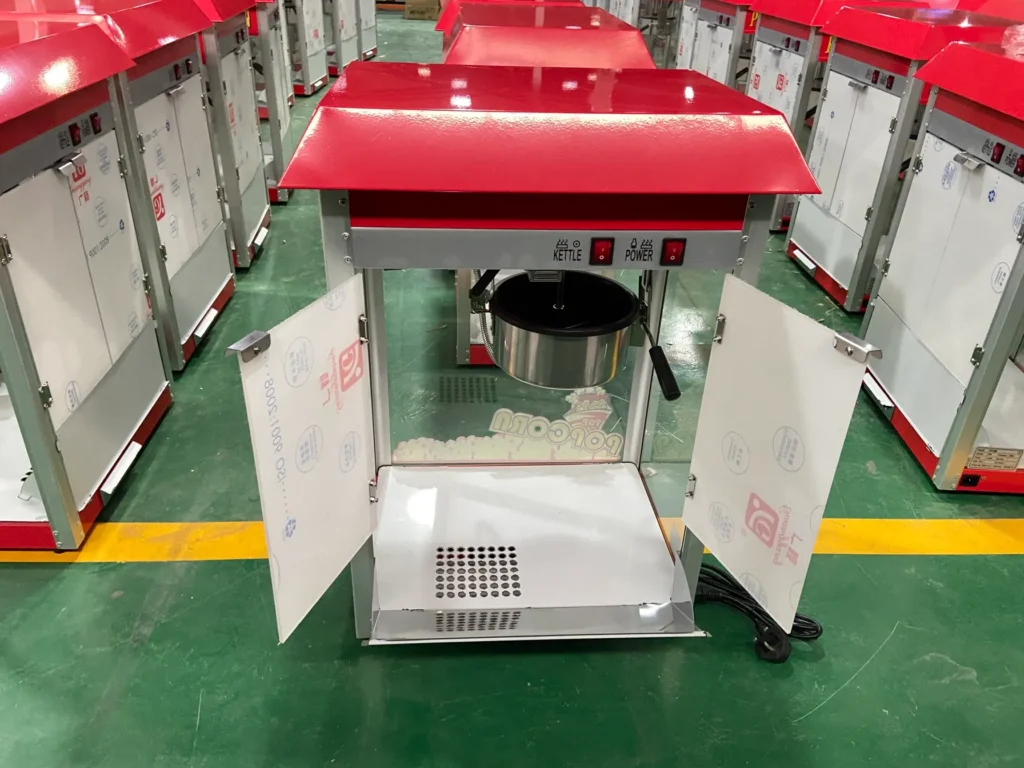
Electrical and mechanical components should undergo inspection according to their functions and applicable testing requirements. Heating assemblies require verification of electrical characteristics and functional performance, while mechanical assemblies require dimensional and movement checks.
FLAMEMAX applies a 100% product inspection before packing as part of its manufacturing quality-control approach. Its production infrastructure includes a 15,000 m² workshop, more than 50 sets of advanced production facilities, over 10 semi-automatic assembly production lines, and more than 10 professional testing facilities.
For international orders, packaging also requires attention. Different components may require protective cartons, reinforced packaging, or wooden and plywood cases according to their weight, structure, and transportation requirements. Appropriate packaging reduces the risk of physical damage during container loading and international transportation.
9. Support OEM Customization and Long-Term Distributor Development
OEM customers often require more than a standard commercial popcorn machine. Their projects may involve customized branding, different market voltage requirements, specific control-panel layouts, or adjustments to equipment appearance. These requirements should be evaluated together with electrical compatibility and long-term spare-parts availability.
Customization of Electrical and External Configurations
FLAMEMAX provides flexible customization options for international wholesale customers, including logo placement, carton design, control-panel design, and color customization. Where electrical modifications are requested, the engineering team should first evaluate the destination market’s supply characteristics and applicable safety requirements.
Typical OEM evaluation points include:
- Destination-market voltage and frequency.
- Heating element specifications and control compatibility.
- Motor electrical requirements and mechanical dimensions.
- Switch arrangement and control-panel labeling.
- Power-cable specifications and plug compatibility.
- Replacement-part standardization across customized production batches.
Technical Documentation and After-Sales Coordination
Long-term distributor cooperation requires consistent communication between the factory, importer, warehouse team, and local service department. Technical documentation should identify machine models, electrical specifications, replacement references, and maintenance requirements.
FLAMEMAX supports international B2B customers through a professional international service team, 24-hour online technical support, and after-sales coordination. Free warehouse storage and loading coordination are also available to support customers organizing international shipments.
For distributors managing several product categories, consolidating popcorn machines and other commercial catering equipment into coordinated orders can simplify procurement and shipment planning. A consistent parts identification system also helps maintain compatibility when equipment is reordered over multiple purchasing cycles.
10. Engineering Recommendations for Different Commercial Popcorn Applications
The final configuration should be determined by the actual operating environment rather than by a single universal component arrangement. The following recommendations summarize the main engineering priorities for different customer applications.
Cinema and Entertainment Venues
These environments generally prioritize continuous production, repeatable heating performance, and rapid maintenance response. The recommended configuration emphasizes correctly rated heating components, reliable temperature regulation, independent protective devices where specified, and accessible motor assemblies. Distributors should prioritize replacement heating elements, thermostats, switches, and agitator components.
Shopping Mall and Retail Concessions
Retail concessions often have limited equipment space and require straightforward daily operation. Compact equipment layouts, accessible control panels, manageable cleaning procedures, and clearly identified replacement parts are important. Electrical connections should be protected from cleaning-related contamination, and sufficient ventilation should be maintained around the machine.
Mobile Snack Businesses and Temporary Events
Mobile concessions require additional attention to electrical supply verification, grounding, cable protection, and environmental exposure. Before operation, technicians should confirm that the available power source meets the equipment’s rated requirements. A compact spare-parts kit containing compatible switches, connectors, and other frequently serviced components can also improve maintenance readiness.
Wholesale Distribution and Multi-Location Projects
Importers and distributors supplying several locations should prioritize equipment standardization, component compatibility, and organized technical documentation. Maintaining consistent machine configurations across different customer projects makes spare-parts management easier and reduces the training burden on local service teams.
For OEM distributors, these arrangements also create a more consistent after-sales experience under their own brands. The combination of reliable manufacturing, documented specifications, and accessible replacement components supports long-term product distribution.
Conclusion: Reliable Popcorn Kettle Components for Commercial Applications
Reliable commercial popcorn equipment requires coordinated heating, electrical protection, mechanical alignment, and practical maintenance design. FLAMEMAX provides commercial popcorn kettle parts, flexible OEM customization, and technical support for international wholesalers and distributors. Contact [email protected] to discuss equipment specifications, spare-parts requirements, and wholesale cooperation.



 English
 Español
 Français
 Italiano
 日本語
 Deutsch
 Русский
 한국어
 简体中文