
Utility Availability: Electrical Capacity and Gas Infrastructure Constraints
A restaurant project can lose performance, margin, and commissioning time when the electrical environment or gas infrastructure is not matched to the selected oven. The problem becomes serious in dense urban kitchens, shopping centers, food courts, and converted buildings where limited electrical capacity, three-phase distribution, gas pressure instability, and restricted ventilation routes are common. If operators choose a commercial pizza oven gas or electric configuration based only on purchase price, the result may be slow recovery, nuisance breaker trips, excessive installation cost, or insufficient production capacity during peak periods. The solution is to evaluate the complete utility system before selecting the oven, rather than treating the oven as an isolated appliance.
For restaurant projects, our professional recommendation is to select a 12–20 kW electric pizza oven when stable three-phase power is available, or a gas commercial pizza oven where electrical capacity is restricted and approved gas infrastructure can continuously deliver the required heat input. We specialize in matching oven performance with real kitchen utility conditions.
Retailers, importers, wholesalers, and distributors should look beyond nominal oven specifications. The following engineering cases explain how utility conditions, thermal recovery, installation requirements, and operating costs determine whether gas or electric is the better commercial pizza oven solution.
Utility Availability and Project-Specific Power Architecture
Electricity: When a High-Capacity Supply Creates an Advantage
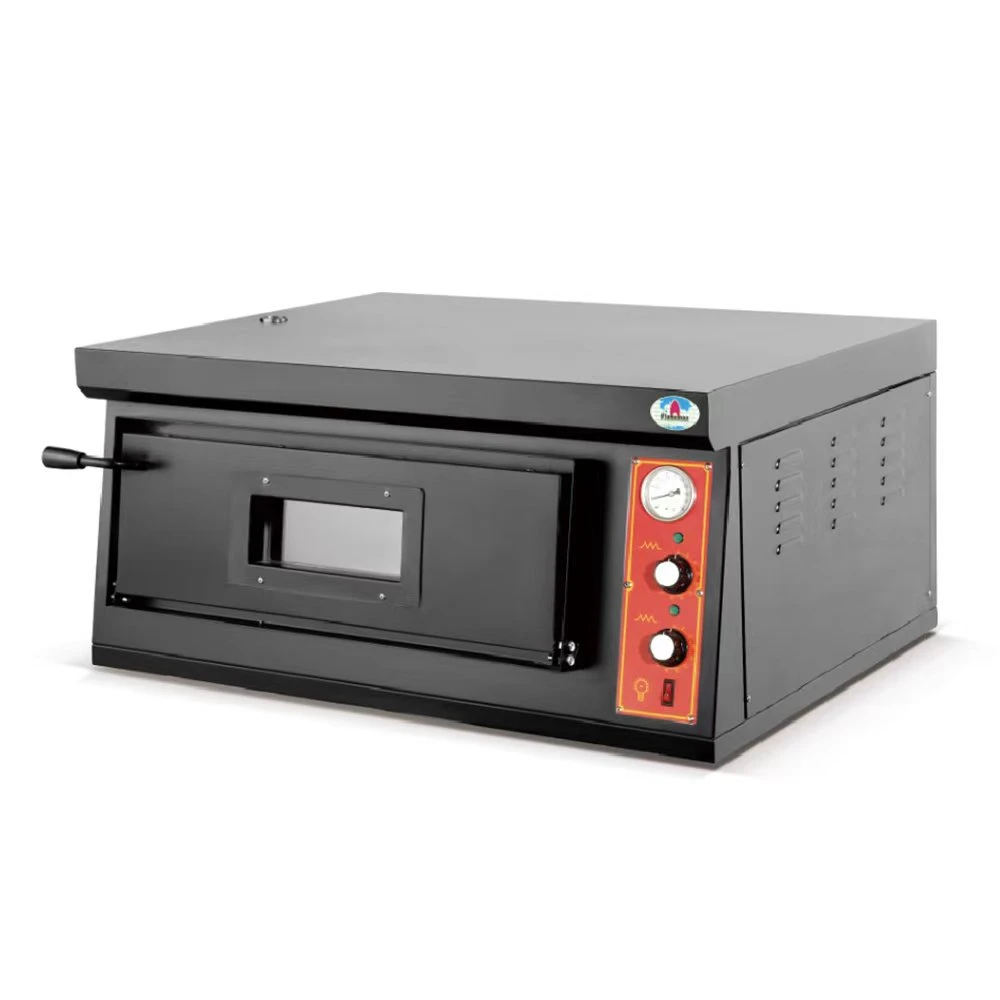
For a modern restaurant, an electric pizza oven can provide highly predictable installation and operation when the building has sufficient electrical capacity. Typical commercial units may operate at approximately 9–20 kW, while high-throughput double-deck configurations can require 18–40 kW or more. Before specifying an electric pizza oven, the project engineer should verify the incoming supply, phase configuration, breaker rating, cable cross-section, voltage tolerance, and available spare capacity.
For example, a 15 kW three-phase oven at 400 V draws approximately 21.7 A per phase under an ideal balanced-load assumption. In practical design, engineers should consider power factor, diversity, ambient temperature, cable installation method, and continuous-load requirements. A recommended three-phase 400 V commercial kitchen distribution system should include an appropriately rated MCCB/MCB, local isolation, protective earthing, and adequate conductor sizing according to local electrical regulations.
Gas: When Utility Limitations Favor a Gas Configuration
Gas becomes attractive when the restaurant has limited electrical capacity but reliable natural gas or LPG infrastructure. A gas commercial pizza oven can deliver substantial thermal input without placing the same electrical heating load on the building distribution system. This can be particularly valuable in older restaurants where the available electrical service is already heavily loaded by refrigeration, HVAC, induction cooking, dishwashers, and ventilation equipment.
However, gas availability should never be interpreted simply as “a gas pipe exists.” The project must verify gas type, dynamic pressure, pipe diameter, regulator capacity, total connected load, shut-off arrangements, combustion-air requirements, and local authority approval. For LPG projects, cylinder or tank capacity and vaporization capability must also be evaluated. A system that maintains static pressure but suffers pressure drop during simultaneous operation can cause burner instability and inconsistent baking performance.
Electrical Environment and System Topology
The most reliable approach is to evaluate the oven as part of the complete kitchen power architecture. A typical electric configuration can be represented as main incoming supply → main distribution board → dedicated commercial-kitchen feeder → local isolator → oven protection device → electric pizza oven control system. This topology reduces the risk of shared-load interference and makes maintenance easier.
For multi-oven installations, the distributor should also assess demand management. Two 15 kW ovens do not automatically mean the building can simply add 30 kW of continuous demand. HVAC compressors, refrigeration systems, water heaters, and other cooking equipment may operate simultaneously. A professional project design should therefore reserve adequate capacity rather than designing around the theoretical minimum.
Recovery and Temperature Control Under Peak Restaurant Demand
Why Recovery Time Matters More Than Maximum Temperature
Restaurant operators often compare gas and electric ovens by maximum temperature, but maximum temperature alone does not determine production capability. In commercial operation, recovery time after opening the door is often more important. A pizza oven may operate at 350–500°C, depending on the cooking method and product specification, but the critical question is how rapidly the oven restores the required deck and chamber temperature after several pizzas are loaded.
Consider a restaurant producing 25–40 pizzas per hour during the lunch peak. If the oven loses 30–50°C after repeated door openings and requires several minutes to recover, the operator may experience longer bake times and inconsistent crust color. An electric pizza oven with independently controlled heating zones can provide strong temperature stability because the heating elements can respond rapidly to changes in chamber temperature.
Electric Heating: Precise Zonal Control
Electric systems are particularly suitable for restaurants that require repeatable baking conditions. Independent top and bottom heating controls can allow the operator to establish, for example, a 60:40 or 50:50 heat distribution depending on dough thickness, topping moisture, deck material, and desired crust characteristics.
A practical operating specification may target a chamber setpoint of 400°C with a control tolerance of approximately ±5–10°C, depending on sensor position and controller design. For a thin-crust pizza, the operator may prioritize rapid top heat for cheese and topping browning while maintaining sufficient bottom heat for crust development. For thicker products, the balance may shift toward longer and more evenly distributed thermal input.
Gas Heating: High Thermal Input and Strong Recovery
Gas ovens can offer excellent recovery performance because burners provide high instantaneous thermal input. This is useful for restaurants with frequent door openings and high-volume production. However, combustion-based systems require careful burner modulation and airflow management. Poorly tuned combustion can create temperature gradients, excessive exhaust demand, or unstable flame behavior.
The choice of commercial pizza oven gas or electric should therefore consider the complete thermal control philosophy. Gas can be advantageous when high heat input and rapid recovery are the priority, while electric can be superior when fine temperature adjustment, repeatability, and simple thermal zoning are more important.
Application Comparison by Restaurant Type
| Application Scenario | Typical Production | Preferred Configuration | Key Utility Condition | Main Engineering Priority |
|---|---|---|---|---|
| Small independent pizzeria | 15–30 pizzas/hour | Electric or compact gas | 230 V single-phase or 400 V three-phase / approved gas | Low installation complexity |
| Urban restaurant | 25–50 pizzas/hour | Electric pizza oven | Dedicated 12–20 kW three-phase supply | Temperature stability and compact installation |
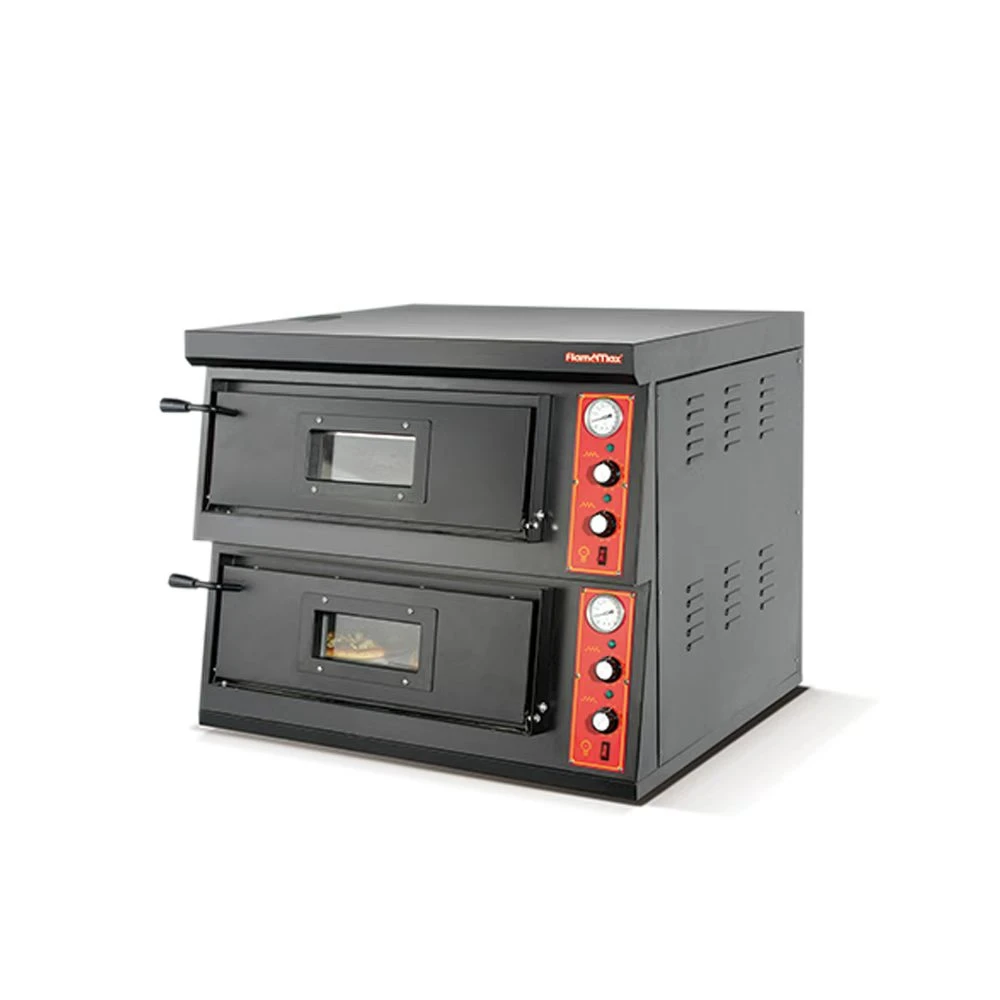
| High-volume pizzeria | 50–100+ pizzas/hour | Gas or multi-deck electric | High-capacity gas or 25–40+ kW electrical system | Recovery speed and throughput |
| Shopping mall food court | 20–50 pizzas/hour | Electric pizza oven | Restricted electrical load must be confirmed | Ventilation and building approval |
| Remote or utility-limited site | Variable | Gas where permitted | Limited electrical capacity | Independent thermal capacity |
Installation and Exhaust: Matching the Oven to the Kitchen Environment
Ventilation Is a System Design Issue
Installation is often underestimated when comparing a commercial pizza oven gas or electric. The oven may fit physically into the kitchen, but that does not guarantee that the surrounding ventilation environment, exhaust system, and make-up air system can support it.
Gas equipment produces combustion products and therefore normally requires an appropriately designed exhaust arrangement. The final configuration depends on local regulations, oven construction, flue design, hood classification, and whether the appliance uses direct or indirect ventilation. Exhaust requirements should be confirmed with the equipment manufacturer and the local mechanical engineer before installation.
Electric ovens generally simplify combustion management because there is no burner exhaust. This can make the electric pizza oven particularly attractive for shopping malls, compact urban kitchens, hotels, and restaurants located inside buildings with strict mechanical-services limitations. Nevertheless, electric cooking equipment can still generate heat, steam, smoke, grease aerosols, and cooking odors, so a suitable commercial-kitchen exhaust system may still be required.
Clearance, Heat Load, and Operator Ergonomics
A technically correct installation must also consider human factors. The oven loading height should allow operators to insert and remove pizzas without excessive wrist extension or repetitive shoulder elevation. The front working zone should remain clear during peak periods, and door movement should not interfere with adjacent equipment.
For planning purposes, the distributor should evaluate at least 100–150 mm of service clearance where permitted by the manufacturer, while maintaining all mandatory side, rear, and top clearances specified in the installation manual. The exact clearance should never be reduced simply to fit the oven into a crowded kitchen.
Ambient temperature is another important variable. In a busy kitchen, the surrounding air may exceed 35°C, especially near a cooking line. Control electronics, relays, contactors, and temperature sensors must therefore operate within their specified environmental limits. A well-designed hot-kitchen electrical environment separates heat-sensitive electrical components from direct radiant heat wherever possible.
Recommended Installation Topology
For an electric pizza oven, a practical topology is utility supply → main distribution board → dedicated circuit → local lockable isolator → protective device → oven terminal block → temperature controller and heating-element system. The oven should not normally share a circuit with unrelated high-load appliances unless the electrical engineer has specifically designed the system for simultaneous operation.
For a gas unit, the basic topology can be considered as gas source → isolation valve → regulator/filter where required → correctly sized gas line → appliance shut-off → burner control system → combustion chamber → exhaust system. Each component must be selected according to the appliance rating and applicable local code.
Operating Cost Framework: Total Cost of Ownership Rather Than Purchase Price
Energy Consumption and Production Economics
For importers and distributors, selling a commercial pizza oven based only on its purchase price can create problems later. Restaurant customers are increasingly interested in total cost of ownership, including energy consumption, maintenance, installation, downtime, and expected service life.
An electric pizza oven rated at 15 kW does not necessarily consume 15 kWh for every hour of operation because heating elements cycle according to thermostat demand. If average duty cycle during a representative operating period is 55%, the approximate electrical consumption would be 8.25 kWh per operating hour, although actual consumption depends on insulation, setpoint, door openings, ambient temperature, product load, and control strategy.
Gas ovens require a similar engineering calculation based on burner input and duty cycle. A burner rated at 30 kW thermal input may not continuously consume gas at its maximum firing rate. Therefore, a meaningful operating-cost model should use measured or validated average consumption rather than the maximum nameplate rating alone.
Maintenance and Downtime
Electric ovens generally have a relatively straightforward heating architecture consisting of heating elements, contactors or solid-state switching devices, sensors, controllers, insulation, and related wiring. Preventive maintenance should include inspection of terminals, element condition, temperature-sensor accuracy, door seals, insulation, and electrical protection.
Gas equipment adds combustion-related components such as burners, ignition systems, flame detection, regulators, valves, and exhaust interfaces. These components require appropriate inspection and servicing. The cost impact is not necessarily a disadvantage, but it should be included in the project model.
Gas vs Electric Decision Matrix
| Decision Factor | Gas Commercial Pizza Oven | Electric Pizza Oven |
|---|---|---|
| Electrical demand | Lower heating load | Higher; typically 9–40+ kW depending on configuration |
| Temperature control | Strong, with good burner modulation | Highly predictable and easily zoned |
| Recovery | Excellent with sufficient gas input | Excellent with correctly sized heating capacity |
| Installation complexity | Higher due to gas and combustion requirements | Generally simpler |
| Ventilation considerations | Combustion exhaust environment is critical | Still requires appropriate cooking exhaust |
| Best-fit location | High-volume sites with reliable gas infrastructure | Urban, mall, hotel, and compact commercial kitchens |
| Control philosophy | High thermal input and rapid recovery | Precise zonal temperature management |
| Key project risk | Gas pressure and exhaust constraints | Electrical capacity and peak-load constraints |
How We Recommend Making the Final Selection
The most professional selection method is to score the oven against five project variables: utility availability, required throughput, recovery performance, installation constraints, and lifecycle cost. If a restaurant has a strong three-phase electrical supply, restricted mechanical services, and a priority on repeatable temperature control, an electric pizza oven is often the logical choice. If the site has limited electrical capacity but robust approved gas infrastructure and high peak production requirements, a gas configuration may offer a stronger commercial solution.
For distributors, this framework also improves product positioning. Instead of asking customers whether they simply want gas or electric, ask for the building voltage, available amperage, phase configuration, gas type and pressure, target operating temperature, pizzas per hour, kitchen dimensions, exhaust arrangement, and expected operating hours. These parameters allow the supplier to recommend the correct commercial pizza oven rather than merely the lowest-cost model.
Project Conclusion and Inquiry
There is no universal winner in the commercial pizza oven gas or electric decision. The right solution depends on utility capacity, thermal demand, installation conditions, and operating economics. For project-specific specifications, load calculations, system topology, and model selection, send us your kitchen parameters and production targets for a professional recommendation.


 English
  Español
  Français
  Italiano
  日本語
日本語  Deutsch
  Русский
  한국어
한국어  简体中文
简体中文