
Why Does Your Panini Grill Lose Heat When Orders Pile Up?
Choosing a commercial panini grill by price alone often creates problems later. A grill may look powerful on paper but still produce uneven browning, slow recovery, or excessive grease buildup during peak service. Undersized plates force operators to run repeated batches, while weak heating systems cause temperature drop under load. The result is longer ticket times, inconsistent sandwiches, and higher labor costs. For restaurants, cafés, hotels, and foodservice distributors, the real question is not simply “How many watts?” It is whether the grill can maintain the required cooking temperature, contact pressure, heat recovery, and cleaning efficiency throughout the service period. The correct specification depends on menu volume, product thickness, plate geometry, and electrical capacity.
For a commercial panini grill, the key selection standards are plate surface, contact configuration, cooking area, heating power, and recovery performance. Our company evaluates these factors as a Manufacturer and Supplier to provide Customizable OEM and ODM solutions for different commercial kitchens.
Before comparing models, it helps to separate appearance from measurable performance. The following sections examine plate design, contact configuration, peak-hour recovery, and grease management so buyers can select equipment based on operating conditions rather than marketing claims.
How Should You Choose the Plate Type?
Smooth vs Ribbed Plates
Plate geometry directly affects contact area, heat transfer, browning, and cleaning time. Smooth plates provide broad, consistent contact across the bread surface. They are suitable when the priority is uniform browning, fast cleaning, and flexibility across sandwiches, wraps, flatbreads, and other products. They also make it easier to press products with irregular shapes.
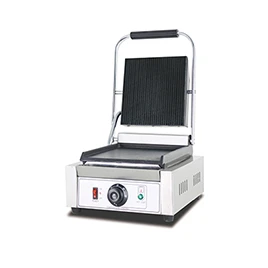
Ribbed plates create characteristic grill marks and allow some grease to move away from the main contact surface. They are useful for operators who want a more pronounced grilled appearance. However, the ribs reduce the effective contact area. Product thickness and bread structure therefore become more important. Excessive rib depth can also make cleaning more labor-intensive.
| Plate Type | Typical Advantage | Best Application | Key Consideration |
|---|---|---|---|
| Smooth | High contact uniformity | Cafés, sandwiches, wraps | Less visual grill marking |
| Ribbed | Distinct grill marks | Grilled sandwiches and panini | More complex cleaning |
Plate Material and Surface Finish
Plate material matters as much as surface pattern. Cast iron offers high thermal mass and can stabilize temperature during repeated loading. However, it is heavy and requires appropriate surface treatment and maintenance. Cast aluminum can provide faster thermal response and lower equipment weight. Depending on the design, a non-stick coating may reduce product adhesion and simplify cleaning, but coating durability depends on operating temperature, utensils, and maintenance practices.
For OEM projects, buyers should also specify plate dimensions, thickness, surface treatment, temperature range, and coating requirements rather than simply requesting a “panini press.”
Single or Double Contact Grill: Which Configuration Fits Your Kitchen?
Single vs Double Contact Grill
A single contact grill normally heats the lower cooking surface while the upper plate presses the product. It is compact, relatively simple to operate, and suitable for moderate-volume sandwich production. Its main limitation is that heat transfer is not symmetrical when the upper surface is not independently heated.
A double contact grill uses independently heated upper and lower plates. This configuration can reduce cooking time because heat is transferred from both directions. It is particularly useful for thicker sandwiches or busy operations where consistent cycle times matter.
However, double contact does not automatically mean better performance. The upper plate must have appropriate temperature control, spring balance, hinge movement, and contact pressure. Excessive pressure can crush soft bread or force fillings out. Insufficient pressure creates air gaps and causes uneven browning.
| Configuration | Typical Power Range* | Cooking Area | Operational Focus |
|---|---|---|---|
| Compact single | 1.5–2.2 kW | Approx. 300 × 230 mm | Low to medium volume |
| Standard double | 2.8–3.6 kW | Approx. 500 × 250 mm | Medium to high volume |
| Large double | 3.6–5.0 kW+ | Approx. 700 × 300 mm+ | High-volume production |
*Actual ratings vary by voltage, plate size, heating architecture, and regional electrical requirements.
Size Should Match Throughput
Do not select plate size simply because the larger model appears more professional. A larger grill consumes more counter space and may require higher electrical capacity. Instead, estimate orders per hour, sandwiches per batch, average cooking time, and peak-hour demand. For example, a café serving 20 panini per hour has very different requirements from a hotel breakfast operation producing 80 or more units during a short service window.
Can the Grill Recover Heat During Rush Periods?
Recovery During Rush Periods
Heat recovery is one of the most important specifications that buyers often overlook. The thermostat setting tells you the target temperature, but it does not tell you how quickly the plates return to that temperature after cold food is loaded.
During continuous service, opening the grill transfers heat away from the plates and into the food. If the heating elements cannot replace that energy quickly, the surface temperature falls. The next sandwich may cook more slowly or brown less evenly. Operators may compensate by extending cooking time, which increases ticket delays.
A well-designed commercial sandwich griller balances heating-element capacity, plate thermal mass, thermostat accuracy, and insulation. High wattage alone is not enough. The heating system must distribute heat effectively across the cooking surface.
What Buyers Should Request from a Supplier
- Rated power in watts or kilowatts
- Operating voltage and frequency
- Temperature control range
- Heating-element configuration
- Plate material and thermal mass
- Measured heat recovery behavior under repeated loading
For an OEM or ODM project, testing should reproduce actual operating conditions rather than relying only on no-load temperature tests. A useful factory evaluation is to preheat the unit, load representative product, record surface temperature changes, and measure the time required to return to the specified operating range.
How Important Are Cleaning and Grease Handling?
Cleaning and Grease Handling
Grease management affects both hygiene and operating cost. A grill with poor drainage can allow oil, cheese, crumbs, and filling residues to accumulate around the plates and hinge area. This increases cleaning time and may eventually affect thermostat performance, electrical components, or mechanical movement.
Look for a removable grease tray with sufficient capacity and easy access. The drainage path should guide grease away from the heating components. Corners should be accessible for routine cleaning. Where appropriate, stainless steel construction improves durability and simplifies sanitation.
Practical Cleaning Checklist
- Confirm whether the grease tray is removable without moving the entire machine.
- Check whether plate edges and hinge areas are easy to reach.
- Verify the recommended cleaning temperature and procedure.
- Determine whether the plate surface requires special utensils or chemicals.
- Inspect exposed electrical and mechanical areas for grease protection.
Buyers should also distinguish between “easy to clean” as a marketing statement and measurable design features. For high-volume kitchens, saving several minutes during every cleaning cycle can create meaningful labor savings over the equipment’s service life.
Specification Matters More Than Appearance
When comparing a panini press commercial model from different suppliers, request the same technical information from each factory. Compare plate dimensions, rated power, temperature range, control method, construction materials, grease handling, certification requirements, and warranty terms. This creates a practical technical baseline.
A reliable Manufacturer should also be able to discuss voltage options, plug standards, packaging, spare parts, logo application, control-panel design, and production testing. For distributors seeking differentiation, Customizable plate configurations, branding, electrical specifications, and packaging can make an OEM program more commercially useful than a standard catalogue unit.
How to Select the Right Commercial Panini Grill for Your Business
The best equipment is the model that matches actual throughput, menu requirements, available counter space, electrical infrastructure, and cleaning procedures. A high-wattage grill is not automatically the right choice. Plate geometry and heat recovery can be equally important.
- Define peak-hour production requirements.
- Select smooth or ribbed plates according to the menu.
- Choose single or double contact heating based on cycle time.
- Verify power, voltage, temperature control, and heat recovery.
- Evaluate grease drainage and cleaning access.
- Request factory testing and certification documentation.
- For private-label projects, confirm OEM/ODM and Customizable capabilities before ordering.
Choosing a commercial panini grill should be an engineering decision, not a wattage comparison. Our team can assess your menu, throughput, plate requirements, and electrical market specifications, then recommend a suitable OEM or ODM configuration. Contact our Manufacturer team for technical specifications, customization options, and a project quotation.


 English
  Español
  Français
  Italiano
  日本語
日本語  Deutsch
  Русский
  한국어
한국어  简体中文
简体中文