
Gas vs electric: Power Supply, Ventilation and High-Demand Kitchen Environments
Commercial noodle and pasta kitchens often face a difficult combination of high production volume, limited kitchen space, unstable utility conditions, and strict hygiene requirements. A cooker that performs well in a test kitchen may lose recovery speed when dozens of baskets enter the tank simultaneously. In high-humidity commercial kitchens, electrical loading, ventilation, drainage, water pressure, and heat dissipation can also become system-level problems rather than simple equipment specifications. If a restaurant, central kitchen, hotel buffet, or food-service distributor selects equipment only by tank size or heating power, the result can be slow recovery, inconsistent cooking quality, excessive energy consumption, and difficult cleaning. Therefore, choosing a commercial noodle cooker requires an engineering assessment of the complete operating environment, not merely a comparison of catalogue prices.
For high-volume commercial noodle cooking, we recommend a 12–24 kW electric system or appropriately sized gas heating, a 20–40 L cooking tank, independent baskets, automatic or assisted water refill, efficient overflow control, and a full drainage system. As an experienced Manufacturer and Supplier, we engineer customizable noodle cooking machines for demanding commercial kitchens, including OEM and ODM projects.
For retailers, importers, wholesalers, and distributors, the following practical cases explain how cooker configuration should match the real application. We combine cooking capacity, utilities, ergonomics, hygiene, and system topology to achieve reliable equipment-to-environment compatibility.
Basket and tank configuration
The first engineering question is not simply how large the tank should be, but how many portions must be cooked during the busiest five to fifteen minutes. A restaurant serving individual noodle bowls has a very different demand profile from a hotel breakfast buffet or a central kitchen producing hundreds of portions per hour.
- Small restaurants: typically 15–25 L tank capacity with 2–4 baskets.
- Busy food courts: approximately 25–40 L with 4–8 baskets.
- Central kitchens: 40–80 L or modular multiple-tank configurations.
- Recommended basket diameter: approximately 120–180 mm for individual portions.
- Basket handles should provide at least 80–120 mm of clearance from the hottest tank surfaces.
- Basket loading should allow operators to lift and drain portions without excessive wrist rotation.
For a commercial pasta cooker, independent baskets are particularly valuable because different pasta shapes may require different cooking times. A multi-basket system also prevents the operator from stopping the entire cooking cycle when only one portion is ready. Our customizable basket layout can therefore be designed around serving volume, portion size, and counter dimensions rather than forcing every customer into a standard configuration.
Water refill and recovery
Water management directly affects cooking consistency. Every basket introduces a thermal load and carries some water out of the tank. In a high-volume noodle restaurant, this can gradually reduce the water level and increase starch concentration. Without proper refill and overflow management, the operator may experience unstable cooking temperatures, foaming, and inconsistent texture.
For kitchens operating continuously, we recommend treating the cooker as a small water-management system rather than an isolated appliance. The preferred topology is filtered water supply → pressure regulation → controlled refill valve → cooking tank → overflow protection → drainage. Where local water quality is poor, an additional filtration or softening stage can be specified.
- Typical recommended inlet pressure: approximately 0.15–0.40 MPa.
- Provide a dedicated water shut-off valve close to the machine.
- Use a refill line sized for the required recovery rate rather than selecting the smallest available connection.
- Maintain sufficient freeboard above the cooking water to prevent overflow during basket loading.
- Consider automatic water-level control for operations exceeding 4–6 hours per day.
- For heavily starchy products, include an easy-to-clean overflow path.
A professional noodle cooking machine should recover water level without forcing employees to repeatedly interrupt production. This reduces labor and makes portion-to-portion cooking more predictable.
Drainage and cleaning
Drainage is one of the most underestimated design factors when purchasing a commercial noodle cooker. Pasta and noodles release starch, oil, seasoning residue, and food particles into the cooking water. If the drain is undersized or positioned poorly, cleaning becomes slow and operators may postpone full drainage until the end of the shift.
For a professional installation, the drainage topology should be planned together with the floor layout: cooking tank → large-bore drain valve → heat-resistant drain pipe → accessible floor drain or grease-management system. The exact connection must comply with local plumbing and food-service regulations.
- Use a full-flow drain valve whenever possible.
- Position the drain handle outside the hottest working zone.
- Avoid unnecessary 90-degree bends in the drain pipe.
- Provide removable strainers where food particles are likely to accumulate.
- Design tank corners with minimal dead zones.
- Allow operators to access the tank without removing major electrical or heating components.
In high-temperature, wet cleaning environments, electrical components should be separated from areas exposed to direct water spray. For electric models, the control box, terminal connections, heating elements, and cable routing should be selected according to the installation environment and applicable electrical standards. This is particularly important for OEM and ODM projects exported to different markets.
Why you need to consider these things before buying the commercial noodle cooker?
Purchasing decisions based only on heating power or advertised capacity can create expensive operational problems. A 24 kW cooker is not automatically better than a 12 kW model. The correct specification depends on the number of portions per hour, incoming water temperature, basket loading, available electrical capacity, ventilation, and operating schedule.
Before purchasing, retailers and importers should ask suppliers for a complete application calculation rather than a simple quotation.
- How many portions are required per hour?
- How many baskets operate simultaneously?
- What is the expected recovery time after a full basket load?
- Is the site supplied with single-phase or three-phase power?
- What are the available voltage and frequency?
- Is gas infrastructure available, and are local ventilation requirements compatible?
- What are the incoming water pressure and temperature?
- Where is the floor drain located?
- How much counter or floor space is available?
- Will the equipment operate continuously during peak service?
These answers allow an experienced Manufacturer to calculate a suitable heating system, tank volume, basket count, water-management method, and control architecture. A reliable Supplier should be able to explain why the proposed configuration fits the application instead of simply offering the lowest initial price.
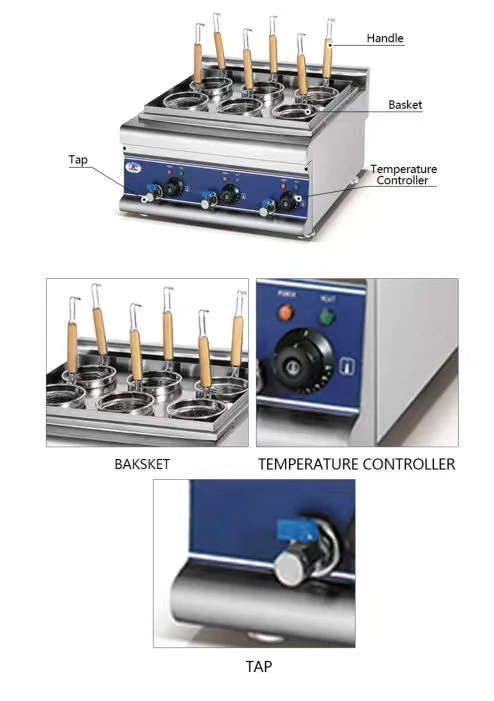
Electric heating in modern commercial kitchens
Electric heating is often preferred where kitchens have reliable electrical infrastructure and strict indoor air-quality requirements. An electric commercial noodle cooker can provide precise temperature control, compact installation, and relatively simple integration into a modern food-service line. However, high-power models require careful electrical planning.
For example, a 24 kW three-phase heater represents a substantial continuous electrical load. The actual current depends on the supply voltage and phase configuration, so the final circuit must be designed by a qualified electrician according to local regulations. The equipment should not simply be connected to an existing socket because the machine physically fits the countertop.
For installations with 380–415 V three-phase power, a dedicated circuit is commonly appropriate for higher-capacity models. In other markets, 208–240 V electrical systems may require different current calculations and circuit arrangements. Our OEM/ODM engineering process can adapt voltage, frequency, controls, wiring, and safety components to the target market, subject to applicable certification requirements.
Gas heating and ventilation considerations
Gas heating can provide strong thermal output and may be advantageous in facilities where gas infrastructure is already available. It can also reduce dependence on electrical capacity. However, gas equipment introduces additional engineering requirements, including combustion air, exhaust, flame protection, gas pressure, and local installation regulations.
In a kitchen with natural gas supply, mechanical exhaust ventilation, and limited electrical capacity, a gas commercial pasta cooker may be a practical solution. By contrast, an electrically heated system may be more suitable for an indoor kitchen where ventilation capacity is constrained.
- Confirm local gas type before finalizing burner specifications.
- Verify inlet gas pressure with the installation requirements.
- Provide compliant combustion and exhaust ventilation.
- Install required flame-failure and safety protection.
- Keep combustible materials outside the manufacturer’s specified clearance zones.
- Coordinate gas, electrical, water, and drainage connections before installation.
The decision should therefore be based on total installation conditions rather than a simple gas-versus-electric price comparison.
Application comparison: restaurant, hotel and central kitchen
The same commercial noodle cooker cannot efficiently serve every business model. The following comparison illustrates how operating conditions influence configuration decisions.
| Application | Typical Peak Demand | Suggested Tank | Basket Configuration | Preferred Heating | Key Engineering Priority |
|---|---|---|---|---|---|
| Small noodle restaurant | 30–60 portions/hour | 15–25 L | 2–4 baskets | Electric | Compact footprint and easy cleaning |
| Food court / fast-casual | 60–150 portions/hour | 25–40 L | 4–8 baskets | Electric or gas | Fast recovery and workflow efficiency |
| Hotel buffet | 40–100 portions/hour | 20–40 L | 4–6 baskets | Electric | Noise, appearance and operator ergonomics |
| Central kitchen | 150–400+ portions/hour | 40–80+ L | 8+ baskets or modular | Gas or high-power electric | Continuous production and water management |
These figures are engineering starting points rather than universal specifications. Actual capacity depends on noodle type, portion weight, cooking time, water temperature, basket loading, and recovery requirements. A professional Supplier should validate the configuration against the customer’s production data before confirming the final model.
Human ergonomics and operator workflow
Commercial cooking equipment is operated hundreds of times during a shift, so ergonomics directly influences productivity and safety. An operator should be able to load noodles, lower the basket, monitor cooking, lift the basket, shake off excess water, and transfer the portion to the serving container without unnecessary movement.
The ideal workstation keeps the most frequently used components within a comfortable operating envelope. Basket handles should not collide with adjacent equipment, and the drainage position should not force the operator to reach across hot water.
- Place basket handles toward the operator’s natural working position.
- Keep frequently used controls visible without requiring operators to bend repeatedly.
- Use clearly identifiable controls for heating, water refill, and drainage.
- Provide sufficient clearance around hot surfaces and moving baskets.
- Position the cooker close enough to preparation and serving stations to minimize unnecessary carrying.
- Consider right-handed and left-handed workflow requirements for customized projects.
For OEM customers, these ergonomic details can be incorporated into the final design, including control-panel location, basket dimensions, tank depth, legs, casters, splash protection, and connection positions.
Temperature control and cooking consistency
Cooking consistency depends on recovery performance as much as maximum heating power. When several baskets of cold noodles are introduced simultaneously, tank temperature can drop sharply. If the heating system cannot restore the required temperature quickly, cooking time becomes unpredictable.
A high-quality commercial noodle cooker should therefore be evaluated under realistic load conditions. Important parameters include heating power, tank water volume, initial water temperature, product temperature, basket loading, and expected recovery time.
- Record the initial water temperature before testing.
- Test with the actual noodle or pasta portion weight.
- Measure recovery after one basket and after maximum simultaneous basket loading.
- Compare cooking time at low, medium, and peak production loads.
- Check temperature stability rather than relying only on the maximum thermostat setting.
- For automated systems, define acceptable temperature-control tolerance before production.
This approach is particularly important for distributors because equipment performance claims should be linked to defined testing conditions. It gives buyers a more meaningful basis for comparing manufacturers.
Customizable design for OEM and ODM projects
For importers and distributors, standard equipment may be sufficient for general applications, but larger projects often require a customizable system topology. Our OEM and ODM engineering approach can consider the complete interface between the cooker and the customer’s kitchen.
Customization may include tank dimensions, basket quantity, heating power, voltage, frequency, control logic, water inlet location, drainage outlet, working height, countertop integration, stainless-steel finish, branding, packaging, and user-interface language. The objective is not customization for its own sake; every modification should solve a defined installation or operational requirement.
For example, a distributor supplying equipment to high-density urban kitchens with limited electrical capacity may need a lower-power modular configuration. A central kitchen operating with three-phase industrial power, high-pressure filtered water, dedicated exhaust, and continuous drainage may instead benefit from a larger multi-basket system with automated water management.
A capable Manufacturer should document these requirements before production. This reduces installation surprises and gives distributors a repeatable specification for future orders.
System topology and installation coordination
The cooker should be considered one node in a larger commercial-kitchen system. The basic topology includes electrical or gas energy → heating system → cooking tank → basket operation → water management → drainage → cleaning workflow. Each interface can affect machine performance.
For an electric installation, the project should coordinate main distribution board capacity, dedicated circuit protection, grounding, isolation, cable routing, water supply, and drainage. For gas installations, the topology additionally includes gas supply, pressure regulation, combustion air, exhaust ventilation, and flame-safety controls.
- Confirm utility connection points before equipment shipment.
- Prepare dedicated isolation points where required.
- Verify floor drainage capacity before installation.
- Leave service access around electrical and heating components.
- Check that adjacent equipment does not obstruct ventilation or operator access.
- Complete commissioning using actual operating conditions whenever possible.
This systems-engineering approach is one of the key differences between buying generic kitchen equipment and working with an experienced commercial cooking equipment Manufacturer.
Why distributors should evaluate total cost of ownership
The lowest purchase price does not necessarily represent the lowest operating cost. Energy consumption, water usage, cleaning labor, downtime, replacement components, installation complexity, and service accessibility all contribute to total cost of ownership.
For a high-volume restaurant, even a small reduction in recovery time can increase throughput during peak periods. Similarly, an easy-access drain can save significant labor over thousands of cleaning cycles. Better water-level control can reduce manual intervention, while properly specified electrical components can minimize nuisance shutdowns caused by overloaded circuits.
- Compare rated heating power and expected duty cycle.
- Estimate daily operating hours and annual operating days.
- Consider water and cleaning requirements.
- Evaluate availability of replacement heating and control components.
- Check service access before approving the final layout.
- Ask for installation and maintenance recommendations.
For wholesalers and distributors, these factors also influence warranty risk and customer satisfaction. A robust specification can reduce after-sales issues and create a more reliable product portfolio.
Final recommendation for selecting a commercial noodle cooking machine
Choosing the right commercial noodle cooker is ultimately an application-engineering decision. Gas or electric heating, tank size, basket count, water recovery, drainage, ergonomics, electrical environment, ventilation, and system topology must work together. As an experienced Manufacturer and Supplier, we support customizable commercial noodle cooker, commercial pasta cooker, and noodle cooking machine projects for restaurants, hotels, central kitchens, retailers, importers, wholesalers, and distributors. For OEM or ODM requirements, send us your production capacity, utilities, dimensions, and target market so we can recommend a practical configuration and quotation.


 English
  Español
  Français
  Italiano
  日本語
日本語  Deutsch
  Русский
  한국어
한국어  简体中文
简体中文