
High-Volume Kitchens Face Heat, Power, Space, and Throughput Constraints
In quick-service restaurants, central kitchens, hotels, and food courts, fryer performance is rarely limited by nominal heating power alone. Operators must balance high ambient kitchen temperatures, humid and grease-laden environments, three-phase electrical supply, and limited back-of-house floor space. If the oil tank is undersized, food temperature recovery slows and product quality becomes inconsistent during peak periods. If the unit is oversized, valuable cooking-line space and electrical capacity are wasted. Poorly selected fryer dimensions can also obstruct ventilation, service access, or adjacent equipment. These problems become especially serious when imported equipment is installed into a 400 V 3-phase commercial kitchen distribution system without matching load calculations. The result is avoidable downtime, uneven frying, higher operating costs, and frustrated kitchen staff.
For high-volume foodservice, we recommend sizing commercial deep fryers around actual oil-to-food ratios, batch recovery time, and peak-hour demand. As an experienced specialist in commercial frying applications, we typically evaluate 15–30 L oil capacity per tank, 4–8 kg practical basket loading, 18–36 kW heating power for larger electric systems, and a dedicated three-phase supply before finalizing the configuration.
For retailers, importers, wholesalers, and distributors, the following application cases explain how to match fryer capacity with real operating conditions. The examples show how equipment selection, electrical design, basket configuration, and peak-hour sizing work together to achieve reliable performance.
Oil Capacity vs Food Load: Establishing the Correct Thermal Balance
The first engineering decision is not simply choosing a large tank. Commercial fryer capacity must be evaluated against the actual food load introduced during each batch. Oil volume acts as the thermal reservoir, while the heating system determines how quickly that reservoir can recover after frozen or refrigerated food is added. A fryer with a large nominal tank but insufficient heating power may perform worse than a smaller, properly matched system.
For example, consider a quick-service restaurant frying frozen French fries at approximately 175–180°C. A 20 L tank may be suitable for moderate production when each basket contains 4–5 kg of product. However, continuously loading 7–8 kg into the same tank can create a large temperature drop, particularly when the electrical system cannot deliver sufficient recovery power. The practical commercial deep fryer capacity should therefore be specified using both oil volume and food throughput.
- Typical oil volume: 15–20 L per tank for moderate-volume operations.
- High-output tank range: 20–30 L per tank for QSR, hotel, and food-court applications.
- Recommended working basket load: approximately 20–30% of oil volume by weight, depending on product type.
- Typical frying temperature: 165–185°C for fries, chicken, seafood, and similar products.
- Design the tank and heating system together rather than selecting oil volume independently.
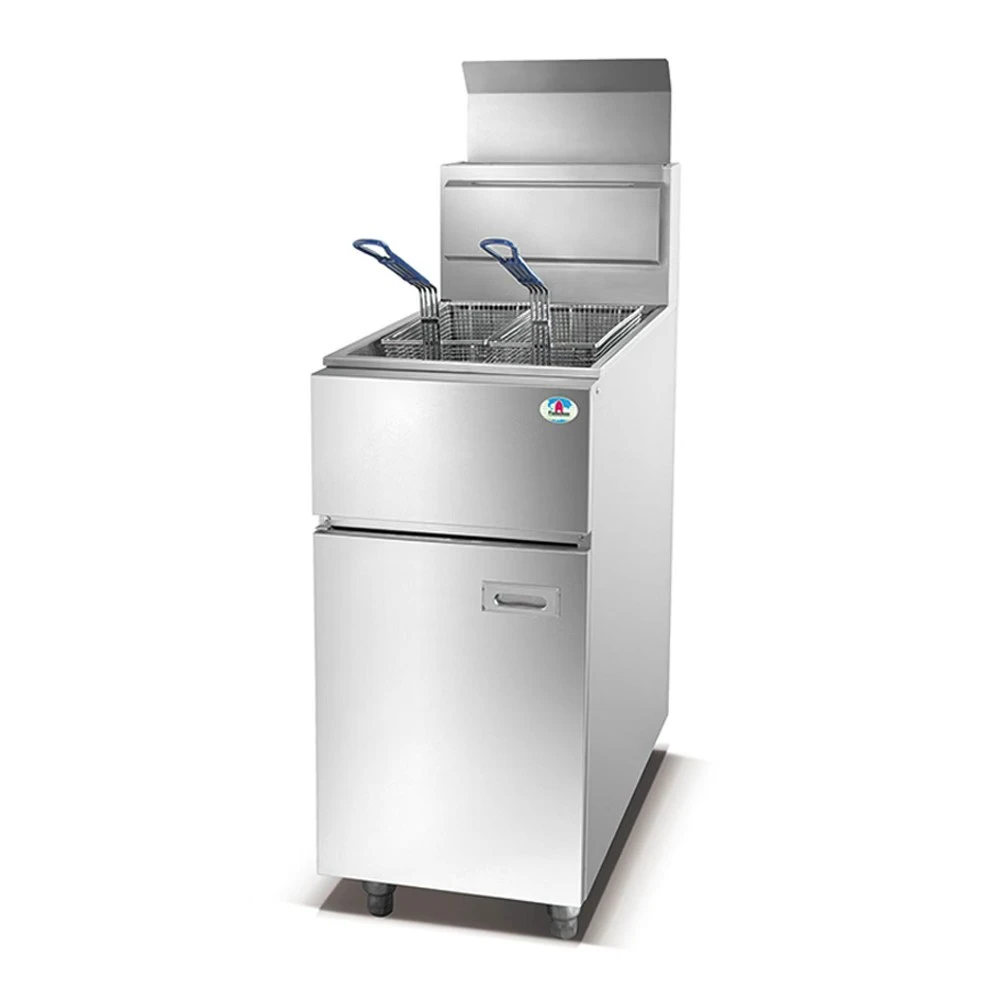
Why Oil-to-Food Ratio Matters
When too much cold food enters a relatively small oil volume, the temperature falls sharply. This can increase frying time, increase oil absorption, and produce pale or greasy products. Conversely, an excessively large oil tank may increase oil consumption and filtration requirements without improving actual output.
A practical engineering approach is to calculate the expected batch load first, then determine the oil volume and heating power required to maintain stable frying conditions. For distributors, this method is particularly important because a unit marketed simply as a “30 L fryer” may be interpreted differently by different customers. A technically useful specification should identify tank volume, recommended food load, heating power, recovery performance, and expected hourly output.
Application Example: QSR French Fry Line
- Oil capacity: 24 L × 2 tanks
- Target oil temperature: 175°C
- Basket load: 5–6 kg per basket
- Heating power: approximately 18–24 kW total, depending on configuration
- Target production: approximately 80–120 kg/h, subject to product and cycle time
- Recommended installation: dedicated 3-phase electrical circuit with local isolation
Recovery Between Batches: The Key Performance Indicator for Commercial Fryers
In professional kitchens, recovery time often matters more than maximum rated temperature. A fryer may reach 180°C easily when empty, yet struggle when frozen chicken, fries, onion rings, or breaded seafood are introduced repeatedly. The critical question is how quickly the oil returns to the target temperature after a realistic production load.
For this reason, commercial fryer selection should consider the complete electrical heating topology, including heating elements, contactors or solid-state controls, temperature sensors, control logic, and the upstream electrical supply. A typical high-output installation may use a 400 V 3-phase electrical supply feeding a dedicated fryer circuit with individual overcurrent protection and local isolation. This arrangement helps distribute electrical load and simplifies maintenance.
Recovery performance depends on several variables:
- Heating power relative to oil volume.
- Initial food temperature, such as frozen versus refrigerated product.
- Batch weight and basket loading density.
- Oil level and tank geometry.
- Heating element placement and effective heat-transfer area.
- Ambient conditions, particularly high kitchen temperature and continuous radiant heat.
- Electrical supply stability and available connected load.
Designing for Stable Recovery
Suppose a restaurant operates a 25 L electric fryer and introduces 6 kg of frozen fries every few minutes. If the heating system is undersized, the temperature may fall from 175°C to 145°C or lower before gradually recovering. The operator may compensate by extending cooking time, reducing batch size, or increasing set temperature. None of these solutions addresses the underlying capacity problem.
A better approach is to size the heating system according to the intended production cycle. For high-frequency batch frying, a higher power-to-oil-volume ratio can provide stronger recovery. However, increasing power also increases the demand on the commercial kitchen electrical infrastructure, so the equipment specification must be coordinated with the building supply.
Recommended Electrical Engineering Checklist
- Confirm available supply voltage, typically 380–415 V, 3-phase, 50 Hz in many international markets.
- Calculate connected load from the actual fryer rating rather than relying on nominal tank size.
- Provide dedicated electrical protection for each fryer or fryer bank where required by local codes.
- Verify cable sizing, breaker rating, earthing, and isolation requirements with the installation electrician.
- Maintain adequate ventilation because high ambient temperature and grease vapor can affect equipment reliability.
- Allow service clearance around electrical components and heating controls.
Basket Configuration: Converting Fryer Volume into Usable Throughput
Basket configuration is frequently overlooked when buyers compare commercial deep fryer capacity. Two fryers may have identical 24 L tanks but produce different results because of basket dimensions, basket count, product loading, and operator workflow. For a busy kitchen, the correct basket configuration can improve labor efficiency without increasing the total fryer footprint.
A single large basket is suitable when the operator usually cooks one product in high volume. However, two smaller baskets can provide better flexibility when fries, chicken, seafood, and specialty products require different cooking cycles. Multiple baskets also allow the operator to stagger production rather than waiting for an entire tank to complete one cycle.
| Application | Typical Oil Capacity | Basket Configuration | Typical Batch Load | Priority |
|---|---|---|---|---|
| Small café | 10–15 L | 1 × medium basket | 2–3 kg | Compact footprint |
| Hotel restaurant | 15–20 L | 1–2 baskets | 3–5 kg | Menu flexibility |
| QSR | 20–30 L | 2 baskets | 5–7 kg total | Fast recovery |
| Central kitchen | 25–35 L | 2–3 baskets | 6–10 kg total | Maximum throughput |
Ergonomics and Fryer Dimensions
Basket design should also be evaluated from an ergonomic perspective. Operators may lift and lower baskets dozens or hundreds of times during a busy shift. Excessive basket weight, long handles, awkward lifting height, or restricted access can increase fatigue and reduce consistency.
The correct fryer dimensions should therefore be assessed together with working height, basket reach, oil drain location, filtration access, and the position of adjacent preparation equipment. A fryer that technically fits a kitchen but forces operators to reach across another appliance is not an efficient installation.
- Keep frequently used basket handles within a comfortable operating reach.
- Avoid placing controls where operators must reach over hot oil.
- Allow sufficient clearance for basket removal and oil filtration.
- Consider the total line width when specifying multiple fryer tanks.
- Check rear clearance for electrical connections and ventilation requirements.
- Confirm doorways, elevators, and service entrances before selecting oversized fryer dimensions.
Dual-Basket Configuration for Mixed Menus
For restaurants serving both fries and breaded protein, a dual-basket arrangement is often more practical than a single oversized basket. One basket can operate on a shorter cycle while another completes a longer product cycle. This creates a smoother workflow and reduces unnecessary idle time.
In export projects, we also recommend confirming whether the customer requires metric or imperial basket specifications, removable handles, lifting brackets, filtration compatibility, and replacement-basket availability. These details can materially influence long-term operating costs even though they may not appear in the headline commercial fryer capacity specification.
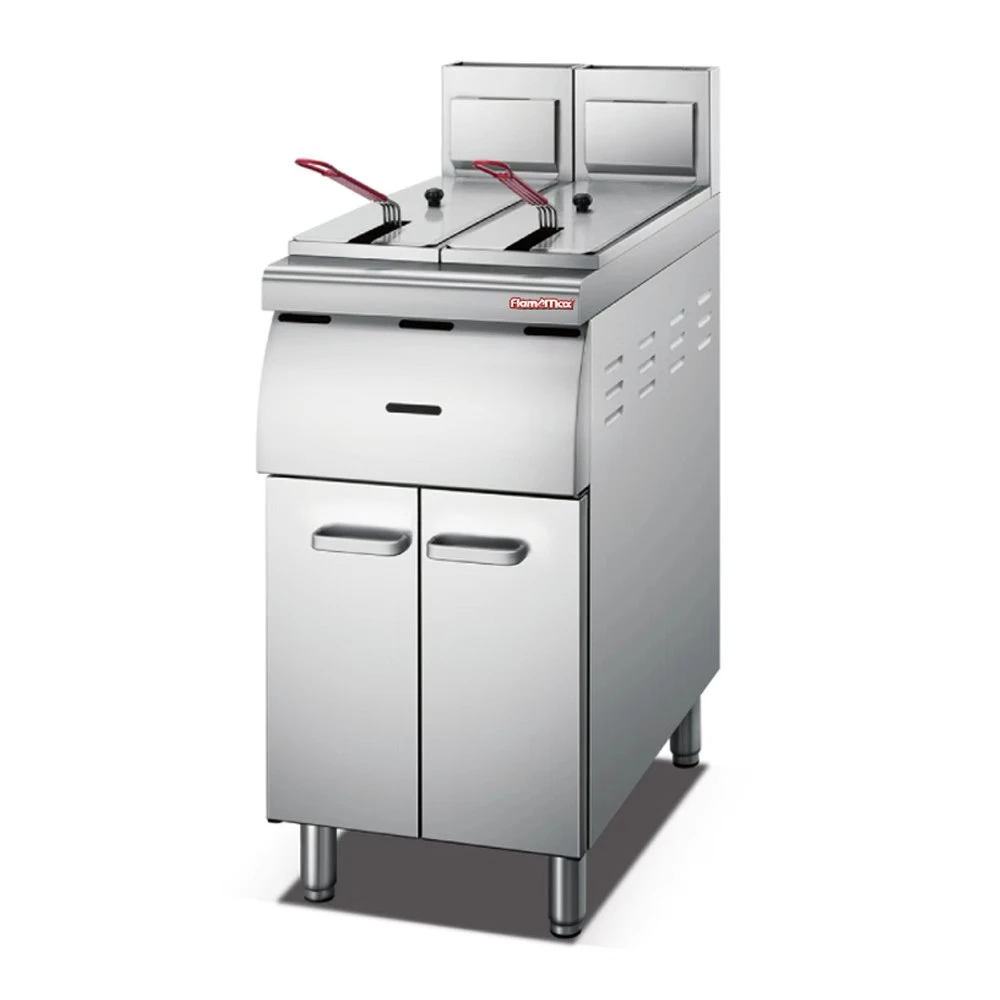
Peak-Hour Sizing: Designing for the Busiest 60 Minutes
Peak-hour sizing is where many fryer installations fail. Average daily sales are not sufficient for equipment selection because fryer demand is highly concentrated. A restaurant may operate for twelve hours but experience 35–45% of its daily fried-food demand during a two-hour lunch or dinner peak. If the fryer is sized around the daily average, queues and temperature instability appear precisely when customer demand is highest.
The correct approach is to calculate the required output during the busiest operating window. For example, if a QSR expects 180 kg of fried products during a two-hour peak, the average required production is 90 kg/h. A safety margin of approximately 15–25% can then be considered to accommodate demand spikes, product changes, and operational interruptions.
- Determine peak-hour fried-food demand in kg/h, not only portions per day.
- Convert menu portions into actual raw product weight.
- Include frozen-product temperature and expected batch size.
- Allow approximately 15–25% design margin for demand fluctuations where appropriate.
- Evaluate recovery time under realistic consecutive batches.
- Check whether the building can support the resulting electrical connected load.
Peak-Hour Capacity Example
Consider a food-court operator selling approximately 1,000 fried-food portions per day. If each portion averages 150 g and 40% of sales occur during the busiest two-hour period, peak demand is approximately 60 kg/h. A system producing only 40–45 kg/h would become a bottleneck even though its daily theoretical output may appear adequate.
For this application, a two-tank configuration could provide operational redundancy. One tank might be dedicated to fries while the second handles chicken or other products. The system topology could consist of two independent electric fryer tanks connected to a common commercial kitchen electrical distribution board, with separate protection and control for each heating circuit. This arrangement also allows partial operation if one tank requires maintenance.
Balancing Capacity with Installation Constraints
Increasing fryer capacity is not always the best answer. Larger tanks require more oil, more heating power, greater floor space, and potentially larger ventilation capacity. The final design should therefore balance output against the physical and electrical environment.
Before confirming an export order, we recommend collecting the following site information:
- Available voltage and phase: 220–240 V single-phase or 380–415 V three-phase.
- Available frequency: typically 50 Hz or 60 Hz.
- Total available electrical capacity in kW or A.
- Kitchen operating temperature and ventilation conditions.
- Required production in kg/h during peak periods.
- Available installation width, depth, and service clearance.
- Required fryer dimensions for the existing cooking line.
- Drainage, filtration, cleaning, and oil disposal arrangements.
Integrated Application Design for Commercial Fryer Projects
The strongest fryer solution is not determined by one specification. Commercial fryer capacity, electrical power, basket configuration, recovery performance, physical dimensions, and peak-hour output must be treated as one integrated engineering system.
For importers and distributors, this approach also reduces after-sales risk. Instead of offering customers a generic 20 L, 25 L, or 30 L fryer, the product can be positioned according to application: compact café, hotel kitchen, QSR, food court, catering operation, or central production kitchen. Each application can then have a defined oil volume, basket load, heating power, electrical topology, and installation envelope.
For example, a compact café may prioritize a 12–15 L tank and small footprint, while a high-volume QSR may require two 24–30 L tanks, dual baskets, stronger recovery, and a dedicated 3-phase power supply. A central kitchen may prioritize maximum throughput, filtration integration, redundant fryer capacity, and easier service access over compact fryer dimensions.
Engineering Recommendation for Export Specifications
- Specify oil capacity together with recommended food load.
- State heating power and supply requirements clearly.
- Provide realistic recovery expectations under defined batch conditions.
- List basket quantity, dimensions, and recommended loading weight.
- Publish external fryer dimensions and required installation clearances.
- Identify environmental conditions such as high ambient temperature, humidity, grease vapor, and continuous commercial-duty operation.
- Confirm the required electrical system topology before shipment.
- Size equipment for peak-hour demand rather than daily average production.
Conclusion: Specify Capacity Around the Real Application
The right commercial fryer is one that matches oil volume, food load, recovery, basket workflow, peak demand, fryer dimensions, and the site’s electrical environment. If you are sourcing for a restaurant, QSR, hotel, food court, or distribution project, send us your target output, menu, power supply, and installation space for a professional configuration recommendation and quotation.


 English
  Español
  Français
  Italiano
  日本語
日本語  Deutsch
  Русский
  한국어
한국어  简体中文
简体中文