
Why Does Your Commercial Food Warmer Display Lose Heat, Dry Out Food, or Waste Counter Space?
Choosing a commercial food warmer display looks simple until the first installation exposes the problems: food temperature drops between production and service, hot air dries out pastries or prepared meals, condensation clouds the glass, and an oversized unit consumes valuable counter space. Poor temperature uniformity can also create food-safety risks, while weak shelf layouts reduce usable capacity. For distributors, restaurant-equipment dealers, and foodservice operators, these issues mean returns, complaints, and higher operating costs. The real challenge is not simply buying a heated display. It is selecting the right combination of heating method, temperature control, humidity management, glass construction, shelf geometry, electrical specification, and cleaning design. This guide explains the engineering points our experienced factory team recommends checking before placing an order.
What Is the Best Standard for Selecting a Commercial Food Warmer Display?
The best commercial food warmer display balances usable capacity, stable temperature, suitable humidity, visibility, cleaning access, and energy consumption. Our company recommends evaluating countertop dimensions, heating technology, control accuracy, glass design, shelf loading, and local electrical requirements before comparing prices. The right specification protects food quality while maximizing service efficiency and display value.
With the basic selection principle established, the next step is to examine the technical details that determine real-world performance. The following sections focus on the design factors that experienced buyers should verify before choosing a food warmer display case or countertop food warmer.
Countertop Size and Shelf Layout
Start With the Actual Countertop Footprint
A warmer should fit the operating environment, not merely the product catalog. Measure the available countertop width, depth, and height first. Leave sufficient rear and side clearance for ventilation, electrical connections, and routine cleaning. A unit that fits exactly into a counter opening may become difficult to service.
For many restaurants and convenience-food applications, usable internal volume is more important than external dimensions. A deep cabinet may appear attractive on paper but provide poor product visibility or inefficient shelf access. A shallow cabinet with well-designed shelves can sometimes hold more saleable portions.
Shelf Spacing Affects Both Capacity and Heat Distribution
Fixed shelves are economical, but adjustable shelves provide greater flexibility when products change by season or menu. Buyers should check:
- Clear shelf height for the tallest products.
- Maximum shelf load and structural support.
- Air circulation gaps around each product level.
- Front-to-back product visibility.
- Ease of removing shelves during cleaning.
Overloading a shelf can obstruct warm-air circulation and create temperature differences between levels. A professional Manufacturer should therefore evaluate shelf geometry together with the heating system rather than treating the shelves as a separate cosmetic component.
| Typical Design | Best Application | Key Advantage | Main Limitation |
|---|---|---|---|
| 2-Shelf Countertop Display | Small cafés, bakeries | Compact footprint | Lower display capacity |
| 3-Shelf Countertop Display | Convenience stores, QSR | Better vertical utilization | Requires stronger internal airflow design |
| 4-Shelf High-Capacity Display | High-volume foodservice | Maximum product presentation | Higher power and cleaning requirements |
Humidity vs Dry Heat
Why Heating Method Changes Food Quality
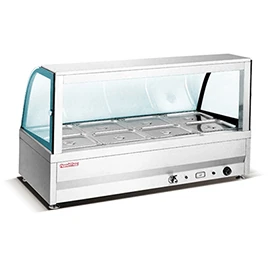
Not every food should be heated in the same way. Dry heat is suitable for products where surface crispness is desirable, but prolonged exposure can cause moisture loss. Fried foods, baked goods, sandwiches, and prepared meals may gradually become dry when the internal environment has excessive airflow or insufficient humidity control.
A humidified warming system introduces controlled moisture into the heated chamber. This can reduce excessive moisture loss and help maintain the texture of certain prepared foods. However, too much humidity can create condensation on the glass, soften crispy products, and increase cleaning requirements.
Match the System to the Food
Before selecting a food warmer display case, identify the product’s holding characteristics. Key questions include:
- Does the product need to remain crisp?
- Does it contain significant moisture?
- What is the expected holding time?
- Will the cabinet be opened frequently?
- Is visible condensation acceptable?
For distributors, this distinction is commercially important. A good Supplier should not simply recommend the highest heating power. The heating method should correspond to the food category, loading pattern, ambient conditions, and expected holding period.
Temperature Control
Stable Temperature Is More Important Than Maximum Temperature
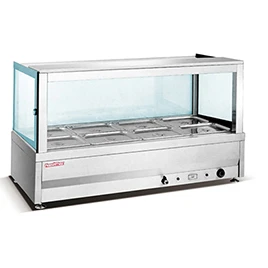
A common purchasing mistake is focusing on the highest temperature listed in a specification sheet. In actual foodservice operation, temperature stability and uniformity are usually more important. A cabinet that reaches a high temperature but fluctuates significantly can provide worse results than a lower-temperature system with accurate control.
The control system should be evaluated for setpoint accuracy, sensor position, temperature recovery, heating response, and over-temperature protection. The sensor should measure a meaningful cabinet location rather than an isolated hot zone next to the heating element.
Digital Controls and Temperature Uniformity
A digital controller can provide clearer operating information and easier adjustment. However, the display alone does not guarantee performance. Buyers should request actual test data showing temperature distribution at multiple shelf positions.
| Parameter | Basic Commercial Design | Higher-Specification Design |
|---|---|---|
| Temperature setting | Mechanical or simple digital control | Digital programmable control |
| Control accuracy | Typically broader tolerance | Typically tighter tolerance |
| Temperature monitoring | Single-point sensing | Optimized sensor placement and testing |
| Recovery after door opening | Slower | Optimized heater and airflow response |
Exact performance depends on cabinet size, insulation, heater wattage, ambient temperature, product load, and airflow design. For OEM projects, these parameters should be confirmed during prototype testing rather than copied from a standard catalog model.
Electrical Specification Must Match the Target Market
International buyers should also verify voltage, frequency, rated power, plug configuration, circuit protection, and applicable electrical requirements. A unit designed for one market should not automatically be assumed suitable for another. An experienced Manufacturer can adapt the electrical configuration during an OEM or ODM project.
Glass, Lighting and Cleaning
Glass Design Is Part of Thermal Performance
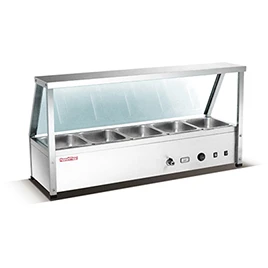
Glass is not only a visual component. It affects heat retention, condensation, product visibility, cleaning time, and energy consumption. Single-glazed construction may be economical, while double-glazed or specially designed glass can improve thermal performance depending on the application.
Buyers should examine the number of glass panels, door configuration, sealing method, frame construction, and accessibility for cleaning. Poorly designed joints can trap grease, food particles, and moisture. Over time, these areas become difficult to maintain and can damage the perceived quality of the equipment.
Lighting Should Improve Sales Without Creating Excess Heat
LED lighting is widely preferred because it provides efficient illumination with relatively low heat output. Light positioning also matters. A well-designed lighting system should illuminate each shelf without producing strong glare or creating unnecessary hot spots near sensitive food.
For bakery and prepared-food applications, color appearance can influence customer perception. The lighting specification should therefore be evaluated together with the cabinet glass and product type rather than selected only by wattage.
Cleaning Access Is a Long-Term Cost Factor
Commercial equipment is cleaned repeatedly. A display that takes ten minutes longer to clean every day can create substantial labor costs over its service life.
Look for removable shelves, accessible drip areas, smooth internal surfaces, rounded corners, removable water trays, and easy-to-reach glass surfaces. Avoid unnecessary gaps around brackets and fasteners where grease can accumulate.
For a Customizable project, cleaning requirements should be included during engineering review. A good ODM partner can modify shelf supports, doors, lighting positions, or internal layouts before mass production, reducing the need for expensive modifications later.
How to Compare Suppliers Before Ordering
Do Not Compare Price Alone
Two visually similar warmers can have very different internal designs. When evaluating a Supplier, request information about:
- Heating element type and rated power.
- Temperature control method and accuracy.
- Temperature uniformity test conditions.
- Insulation construction.
- Glass configuration.
- Shelf material and loading capacity.
- Electrical certification and target-market requirements.
- Spare parts and after-sales support.
For private-label customers, confirm whether the factory supports OEM branding, packaging customization, logo application, control-panel design, and product documentation. For customers developing a new product, an experienced ODM team can provide a more complete engineering solution, from cabinet dimensions to heating and control architecture.
Prototype Testing Should Come Before Mass Production
For a new commercial food warmer display, prototype validation is highly recommended. Test the unit under realistic loading conditions, not only when empty. Check the temperature at different shelf positions, recovery after opening, condensation, lighting, noise, cleaning access, and power consumption.
This approach allows buyers to identify design problems before committing to a large production quantity. It also gives the factory objective data for further optimization.
Final Buying Recommendation
A reliable commercial food warmer display should be selected as a complete thermal and merchandising system, not simply by appearance or price. Evaluate size, shelf layout, humidity, temperature stability, glass, lighting, cleaning, and electrical requirements. Contact our company with your target market, food type, dimensions, and capacity requirements to discuss an OEM, ODM, or Customizable solution and request a technical quotation.



 English
  Español
  Français
  Italiano
  日本語
日本語  Deutsch
  Русский
  한국어
한국어  简体中文
简体中文