
Why Does My Bread Proofer Fail to Maintain Stable Temperature and Humidity?
Your bakery may have the right recipe, skilled operators, and high-quality ingredients, yet inconsistent proofing results can still reduce production efficiency. The main problem is often unstable proofer temperature and humidity. When a commercial proofer cannot maintain the correct environment, dough may suffer from slow fermentation, uneven expansion, dry skin formation, or collapsed structure. These problems create waste, increase labor costs, and damage product consistency. The solution is not simply increasing heat or moisture. It requires accurate control of temperature accuracy, humidity distribution, airflow design, and equipment capacity. Choosing the right bread proofer configuration is essential for modern commercial baking operations.
The ideal bread proofer setup requires precise proofer temperature and humidity control, suitable capacity, efficient airflow, and hygienic design. Our company provides professional Manufacturer and Supplier solutions with Customizable, OEM, and ODM options for different bakery production needs.
Understanding proofing technology helps bakery owners and production managers avoid common failures. The following guide explains the key technical factors behind reliable fermentation performance, from dough requirements to equipment design standards.
Commercial Bread Proofer Temperature and Humidity Technical Guidelines
Typical proofing ranges by dough
Different dough formulas require different environmental conditions. A professional commercial proofer must provide adjustable settings because yeast activity, dough hydration, fat content, and sugar concentration directly influence fermentation speed.
The most common industry practice is maintaining a controlled environment between 30°C and 40°C proofing temperature with 75% to 90% relative humidity. However, these values are not universal. High-sugar doughs, enriched doughs, and frozen dough products usually require more careful adjustment.
- Lean dough: Generally performs well at approximately 32°C to 38°C with 75% to 85% RH. Excessive heat can accelerate yeast activity and weaken gluten structure.
- Enriched dough: Products containing butter, milk, or sugar often need stable conditions around 30°C to 35°C because higher temperatures can affect texture and fermentation balance.
- Frozen dough: Requires gradual temperature recovery and precise humidity management to prevent condensation damage.
| Dough Type | Recommended Temperature | Recommended Humidity | Main Control Concern |
|---|---|---|---|
| Lean bread dough | 32°C-38°C | 75%-85% RH | Prevent drying and uneven expansion |
| Sweet/enriched dough | 30°C-35°C | 80%-90% RH | Protect fermentation balance |
| Frozen dough | 28°C-35°C | 75%-85% RH | Control thawing and condensation |
A reliable bread proofer should not only reach the target temperature but also maintain uniform conditions throughout the cabinet. Poorly designed units may create hot zones near heaters and cold zones near doors, causing inconsistent final products. Therefore, professional buyers should evaluate temperature uniformity, humidity recovery speed, and air circulation performance before purchasing equipment.
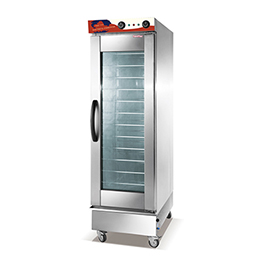
Humidity control and skinning
One of the most common complaints from bakeries is dough surface skinning. This occurs when moisture evaporates from the dough surface faster than the proofer can replace it. The result is a dry outer layer that restricts expansion and creates cracks during baking.
Effective humidity control depends on several technical components:
- Steam or water mist generation system: Provides moisture according to real-time humidity requirements.
- Humidity sensor accuracy: High-quality sensors help maintain stable relative humidity (RH) levels.
- Airflow management: Gentle air movement prevents moisture loss without creating excessive turbulence.
- Insulated cabinet structure: Reduces heat loss and improves energy efficiency.
Many commercial users focus only on heating power, but humidity control is equally important. A high-power heating system cannot compensate for poor moisture management. For this reason, advanced commercial proofer designs integrate independent controls for temperature and humidity.
Our company designs equipment with independent temperature and humidity regulation to support different production environments. As an experienced Manufacturer, we understand that bakeries require stable performance during long production cycles, especially when operating multiple shifts.
Proofer capacity matching
Selecting the correct capacity is another critical factor. An oversized proofer may increase energy consumption, while an undersized unit creates production bottlenecks. The correct choice depends on daily output, tray quantity, dough fermentation time, and factory workflow.
A professional capacity calculation should consider:
- Daily production volume: Estimate the number of dough pieces requiring proofing per shift.
- Proofing cycle time: Longer fermentation cycles require more available space.
- Tray dimensions: Rack size and tray spacing directly influence cabinet design.
- Future expansion: A Customizable design allows businesses to increase capacity later.
| Equipment Type | Typical Capacity | Suitable Application |
|---|---|---|
| Small cabinet proofer | 8-16 trays | Small bakeries and test kitchens |
| Medium commercial proofer | 16-32 trays | Retail bakeries and restaurants |
| Industrial rack proofer | 32+ trays | Large-scale production lines |
Capacity should also match upstream and downstream equipment. If the oven capacity is much higher than the proofer capacity, the oven may wait for finished dough. If the proofer is too large compared with production demand, unnecessary operating costs increase.
Experienced equipment buyers often request OEM or ODM solutions because standard models may not fit every factory layout. A professional Supplier should provide engineering support, including rack configuration, door direction, control system selection, and production flow optimization.
Cleaning and condensation
Hygiene is a major concern in commercial fermentation environments. Warm and humid conditions naturally create risks related to condensation, mold growth, and bacterial contamination. A well-designed bread proofer must support easy cleaning and long-term sanitation.
Key hygiene design features include:
- Stainless steel interior construction: Provides corrosion resistance and easier daily cleaning.
- Rounded internal corners: Reduce dirt accumulation areas.
- Drainage system: Removes excess water caused by condensation.
- Removable components: Allow operators to clean sensors, trays, and humidification areas.
Condensation problems usually happen when the temperature difference between inside and outside the cabinet becomes too large. Poor insulation, frequent door opening, or incorrect humidity settings can increase water accumulation. Operators should monitor door opening frequency, maintain proper air sealing performance, and follow regular cleaning schedules.
A reliable commercial proofer combines fermentation performance with practical maintenance. Our company provides solutions designed for professional bakeries, including OEM customization, private-label manufacturing support, and application-based recommendations. This approach helps customers select equipment according to actual production requirements rather than choosing only by price.
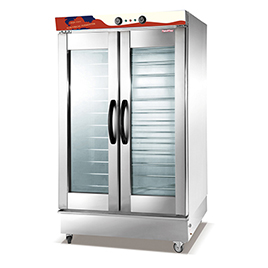
Control system and operational accuracy
Modern proofers depend on intelligent control technology to maintain stable fermentation conditions. Manual adjustment often creates inconsistent results because operators cannot react quickly enough to environmental changes.
Important control features include:
- Digital temperature controller: Maintains precise heating performance.
- Humidity monitoring system: Allows operators to observe real-time moisture conditions.
- Programmable recipes: Supports different bread types with saved parameters.
- Alarm protection: Alerts users when temperature or humidity exceeds limits.
For export customers, equipment reliability is especially important. A professional Manufacturer should provide stable electrical design, durable components, and technical documentation for different markets. Our company focuses on delivering dependable bakery equipment solutions for global customers through flexible production and engineering support.
Conclusion
Stable proofer temperature and humidity control determines bread quality and production efficiency. Choose a professional Supplier with proven engineering capability and contact our team for Customizable bread proofer solutions tailored to your bakery needs.

 English
  Español
  Français
  Italiano
  日本語
日本語  Deutsch
  Русский
  한국어
한국어  简体中文
简体中文