
Why Does a 600×400 Tray Not Fit the Oven You Just Bought?
A tray may look close enough to the oven cavity, yet still fail in daily production. The problem is rarely just the tray’s nominal size. External dimensions, rack geometry, shelf pitch, loading orientation, and usable cavity dimensions all affect actual compatibility. A common sourcing mistake is comparing a 600×400 tray vs GN 1/1 by surface area alone. That can lead to racks that cannot accept the selected trays, doors that interfere with loading, or claimed capacity that cannot be achieved in practice. For importers and hotel-supply distributors, these errors create replacement costs, installation delays, customer complaints, and after-sales pressure. The correct approach is to verify the complete tray-and-rack system before comparing oven capacity or placing a bulk order.
Commercial oven tray compatibility depends on tray dimensions, rack geometry, shelf pitch, loading direction, and usable cavity space. The 600×400 tray is a common bakery format, while GN 1/1 follows a different catering standard. FLAMEMAX evaluates these interfaces during equipment design and production inspection to help buyers select the correct oven configuration.
For importers, the key is to move beyond catalogue dimensions. The following checks explain where compatibility problems actually occur and how to verify an oven before purchasing in volume.
Compare External Dimensions and Rack Geometry
The first check is not simply whether a tray can enter the oven. Buyers should compare the tray’s external dimensions with the oven’s rack width, rack depth, support structure, and usable cavity opening. A 600×400 mm bakery tray has a fundamentally different geometry from a GN 1/1 pan, which is based on the Gastronorm system.
For a bakery equipment project, a nominal 600×400 mm tray generally requires a rack system designed around its rectangular footprint. A GN 1/1 pan is approximately 530×325 mm externally. Although both formats can be used in commercial food production, they should not be treated as interchangeable.
| Parameter | 600×400 Bakery Tray | GN 1/1 Pan |
|---|---|---|
| Nominal external size | 600 × 400 mm | 530 × 325 mm |
| Typical application | Bakery, pastry, bread production | Hotel, catering, restaurant production |
| Reference system | Bakery tray format | EN 631 / Gastronorm system |
| Compatibility requirement | 600×400 rack geometry | GN-compatible rack geometry |
The difference becomes more important when the oven is supplied with multiple shelves. A rack designed for one standard may physically accept another tray only after modification, but this does not mean the configuration is commercially practical. Side clearances, tray stops, support rails, and thermal airflow gaps must remain correct.
For OEM projects, buyers should therefore request the actual usable cavity dimensions and rack drawing rather than relying only on the oven’s advertised external dimensions. This is particularly important when importing equipment for a private-label product range.
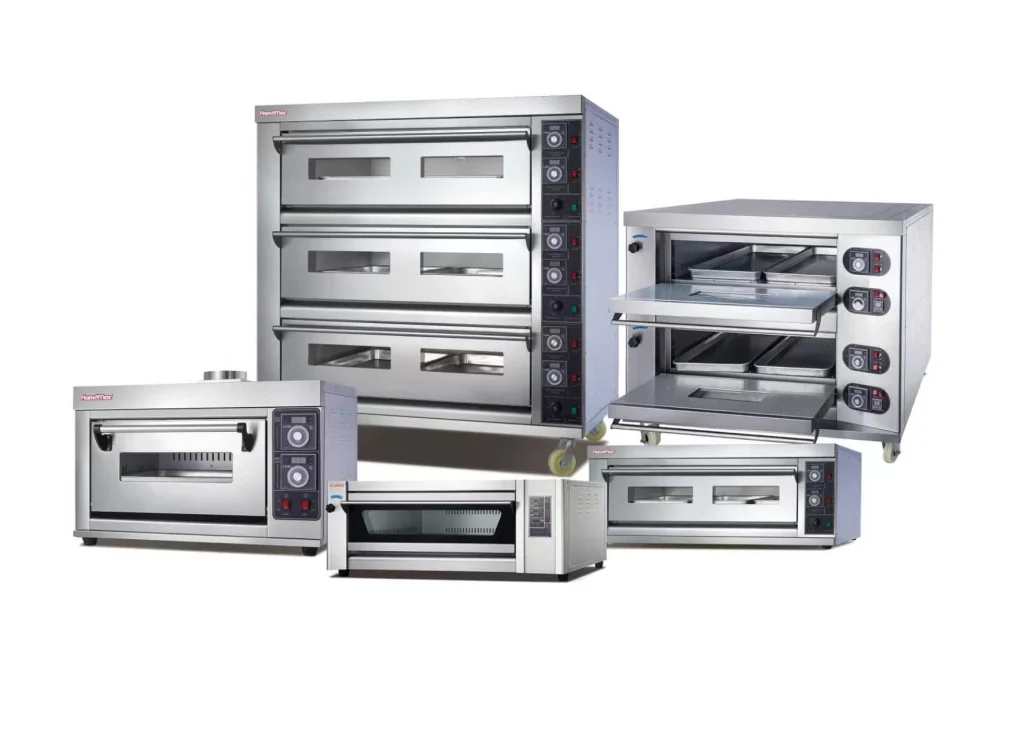
Check Shelf Pitch and Loading Orientation
Even when the tray footprint is correct, the second major issue is shelf pitch. Shelf pitch is the vertical distance between two adjacent tray positions. It determines whether the oven can accommodate the required product height while maintaining sufficient space for hot-air circulation and even heat transfer.
A catalogue may state that an oven holds 10 trays, but that figure has limited value without knowing the tray format and shelf arrangement. For example, a 10-tray oven designed for shallow bakery products may not provide the same practical production capacity for taller food products.
Why Loading Direction Matters
The tray should also be checked in its actual loading orientation. Some racks are designed for front-to-back loading, while others use a configuration where the tray position and support rails dictate orientation. The difference affects door clearance, operator access, and how easily the tray can be removed when fully loaded.
Before approving a commercial oven, buyers should verify:
- Tray width and depth against the rack opening.
- Shelf pitch against the intended product height.
- Loading orientation and operator access.
- Rail spacing and tray-stop position.
- Door opening clearance during loading and unloading.
- Required clearance for air circulation around the products.
These details are especially important for high-volume users. A tray that technically fits but requires excessive force to insert or remove is not a successful production configuration. Good commercial oven tray compatibility should support repeatable operation, not merely physical entry into the cavity.
Plan Tray Availability in the Destination Market
Tray compatibility should also be evaluated from a procurement perspective. An oven can be technically excellent but commercially inconvenient if its required trays are difficult or expensive to source in the destination market.
For distributors, this is a critical issue. Standardized tray formats reduce the customer’s dependence on a single equipment supplier. If replacement trays are readily available from local bakery-equipment distributors, customers can maintain production more easily. If the tray is an unusual custom size, every replacement becomes a potential after-sales problem.
Check the Local Supply Chain Before Ordering
Before placing a container order, importers should confirm:
- Which bakery tray size standard is most common among their target customers.
- Whether 600×400 mm trays are locally stocked.
- Whether the required tray material and thickness are available.
- Whether replacement trays can be sourced from multiple suppliers.
- Whether the same format is compatible with customers’ existing equipment.
Material should not be overlooked. Aluminum, stainless steel, and coated trays can have different weights, thermal characteristics, and cleaning requirements. The tray’s actual rim profile can also influence rack compatibility even when the stated length and width are identical.
For a distributor building a product portfolio, standardization can reduce SKU complexity. If several oven models, proofers, racks, and bakery accessories use the same tray format, inventory management becomes simpler. This can also improve customer confidence because replacement accessories are easier to obtain.
FLAMEMAX supports commercial kitchen equipment buyers with multiple equipment series and flexible customization. For OEM projects, tray format, rack configuration, control-panel design, logo, and packaging requirements can be coordinated according to the target market and application.
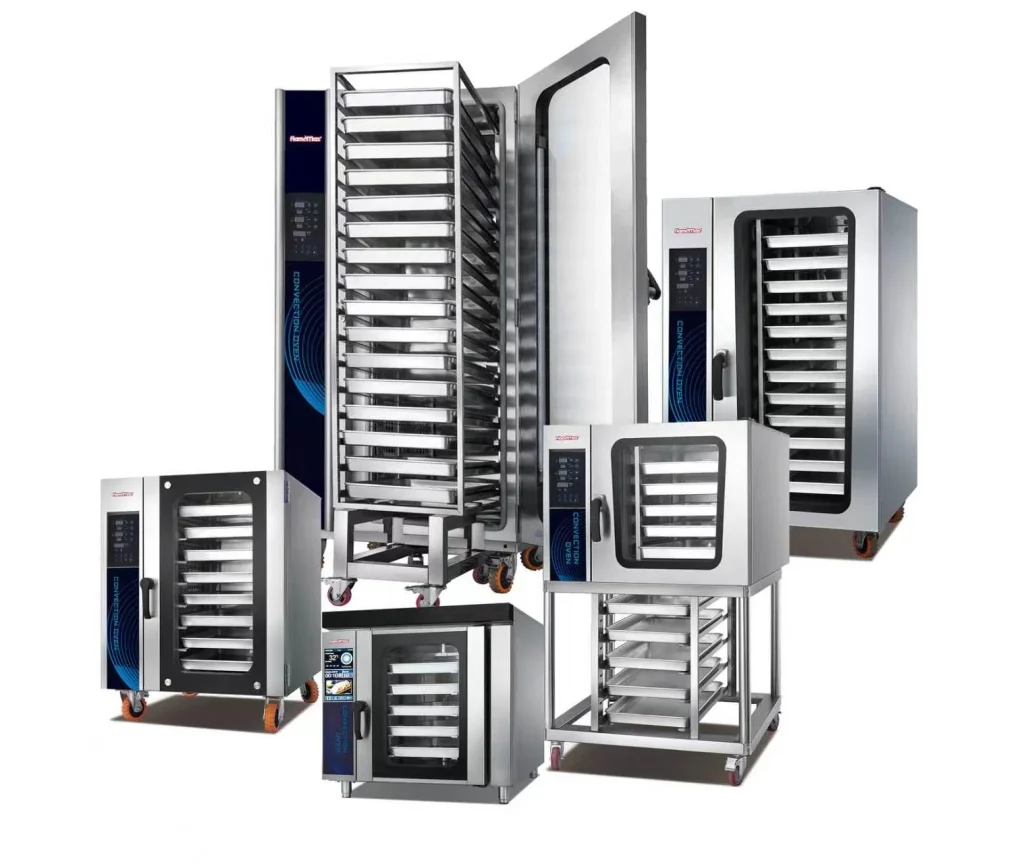
Prevent False Capacity Comparisons
Capacity is one of the most frequently misunderstood specifications in commercial oven purchasing. The stated number of trays does not automatically indicate higher production output. A meaningful comparison must use the same tray format, same shelf pitch, same product loading conditions, and comparable heating configuration.
Consider two ovens advertised as 10-tray models. One may be configured for 600×400 mm bakery trays, while another may be configured for GN 1/1 pans. The number “10” is identical, but the usable tray area is different.
| Comparison Item | 600×400 Configuration | GN 1/1 Configuration |
|---|---|---|
| Nominal tray area | 240,000 mm² | 172,250 mm² |
| Approx. area difference | 600×400 provides about 39% more nominal tray area | |
| Best comparison method | Compare usable tray area + shelf count + product load | |
The calculation illustrates why capacity claims should be treated carefully. Nominal tray area does not equal actual food-production output. Product spacing, dough expansion, pan depth, cooking temperature, humidity, airflow, and loading practice all influence the final result.
Use a Standardized Procurement Checklist
For technical evaluation, buyers should ask suppliers to provide the following information:
- Usable internal cavity width, depth, and height.
- Compatible tray or pan dimensions.
- Rack drawing and shelf pitch.
- Maximum tray quantity under the specified configuration.
- Recommended loading orientation.
- Heating method and airflow arrangement.
- Electrical specifications and available voltage options.
- Actual product inspection and testing procedures.
This approach makes supplier comparisons much more reliable. It also helps importers avoid purchasing an oven based solely on external dimensions, tray count, or marketing capacity.
For professional B2B procurement, 100% inspection before packing is another important control point. FLAMEMAX operates a 15,000 m² production workshop with dedicated testing facilities, advanced fabrication equipment, assembly lines, and international technical support. Such controls help ensure that the specified rack and tray configuration is checked before shipment.
Conclusion: Verify the Interface Before You Compare Capacity
The right oven starts with the right tray interface. Compare dimensions, rack geometry, shelf pitch, loading direction, local tray availability, and real usable capacity before ordering. For OEM or bulk projects, contact FLAMEMAX at [email protected] with the required tray format and oven application for technical configuration support.


 English
  Español
  Français
  Italiano
  日本語
日本語  Deutsch
  Русский
  한국어
한국어  简体中文
简体中文